Transcript
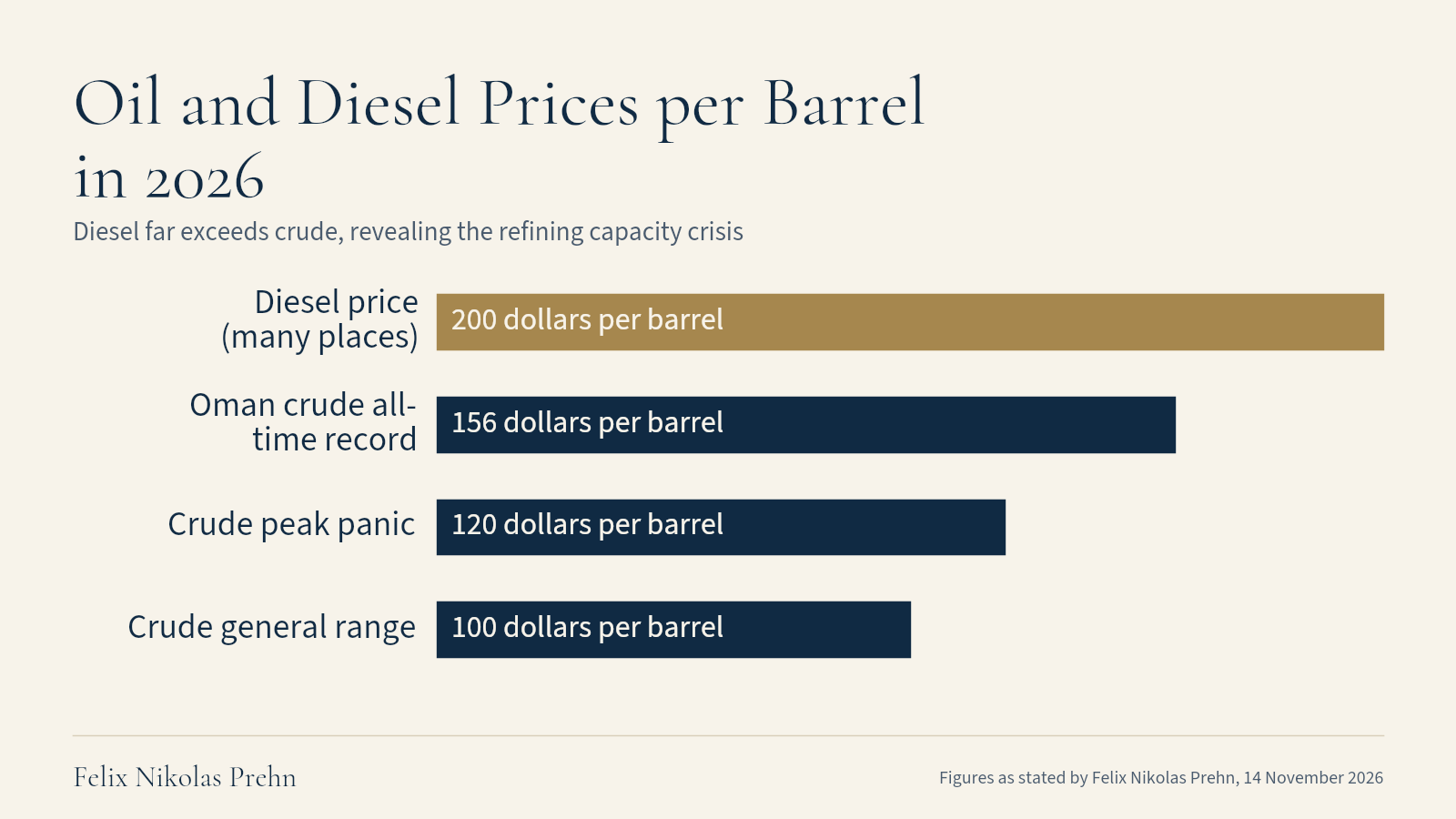
The price of oil is nearly doubled this year. And that alone should worry most people because it feeds into basically everything you buy. The oil price is not even the number that's hurting you most. Diesel price is over $200 a barrel in many places. Oman crude, which is where you get into which oil price actually printed the all-time record for any uh widely quoted market price in history.
I think it was $156 a barrel. And my guest today called negative oil prices a month before it happened. He's fabulous stock. By the way, the price of oil has nearly doubled this year. And that alone should worry most people because it feeds into basically everything you buy, everything you do.
But it actually gets worse because the oil price is not even the number that's hurting you most. And my guest today called negative oil prices a month before it happened. He spent 36 years inside the oil market. who's three times the number one analyst oil analyst that is on Wall Street at Deutsche and later lead oil analyst at Mitsuo and now runs his own research firm and he says the real squeeze and I think the real pain if I'm reading this right is actually in diesel uh because we're looking at diesel right now is over like $6 a gallon I can't remember what it was this morning about two pounds a litre in the in the UK and Paul seems to think it's going to stay high for a while and I really want to know why what we can actually do about this. This is Paul Sankey. Thank you very much for joining us.
Hi Felix. Thanks for having me. Your pleasure. Now, what's the what's the oil price really telling me right now?
What what do you read into that? Well, yeah. I mean, the question actually becomes which oil price, and you know, this is one of the the references you've made really, which is to say that the diesel price is over $200 a barrel in many places and certainly has been this year. Jet fuel is a derivative of distillate. So, that's also been enormously highly priced.
And then actually, as you know, we've seen relatively muted to those levels, crude prices, say closer to $100 a barrel. Um I think we just about got to 120 at the peak of the panic. Although actually interestingly Oman crude which is where you get into which oil price actually printed the all-time record for any uh widely quoted market price in history. I think it was $156 a barrel at the peak panic. So clearly what you've got there is an issue with the various different types of crude oil.
So, for example, Canadian crude right now is as much as $35 cheaper than Brent crude oil, which is what everyone looks at. But the bottom line is that the products of oil are far more highly priced than they normally are relative to crude. And what that's telling you is that there's a shortage of refining capacity. And the there's a two very important reasons for that. the the the longer running one is the Russia Ukraine war, but there was a major shift during the course of that war towards much more advanced drones on the parts of the Ukrainians. Uh and the attack, you know, sometimes as much as 1,200 km away there, the Ukrainians ability to hit Russian energy infrastructure and particularly Russian refining became a very big story this year.
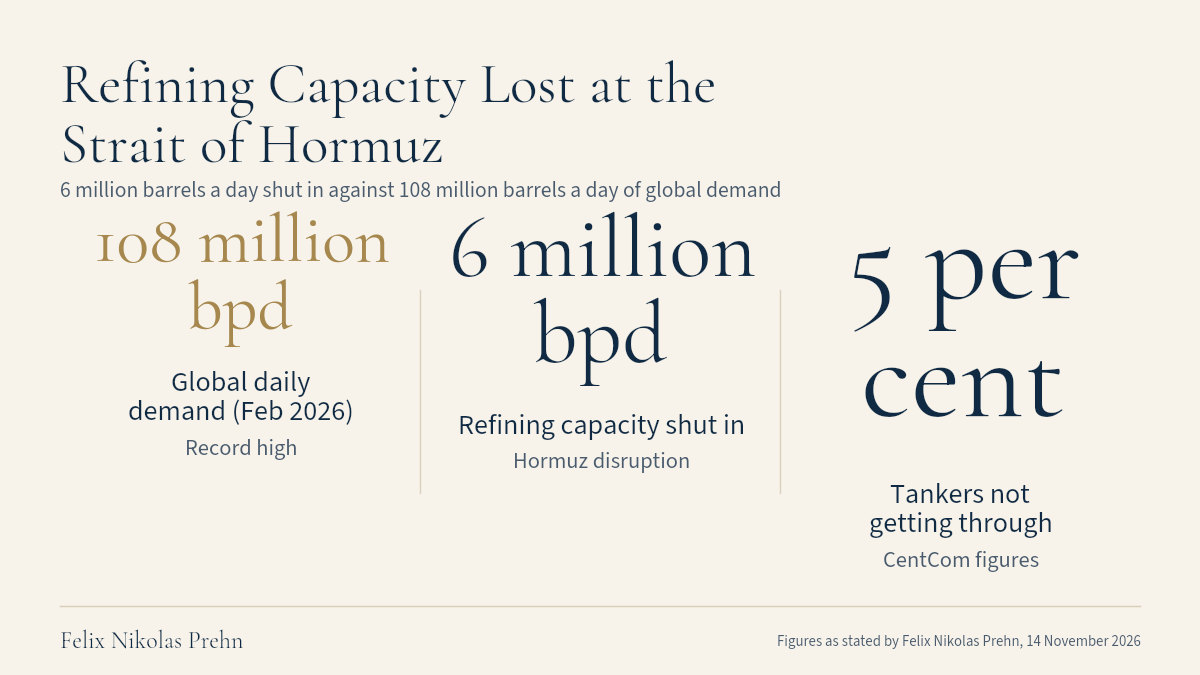
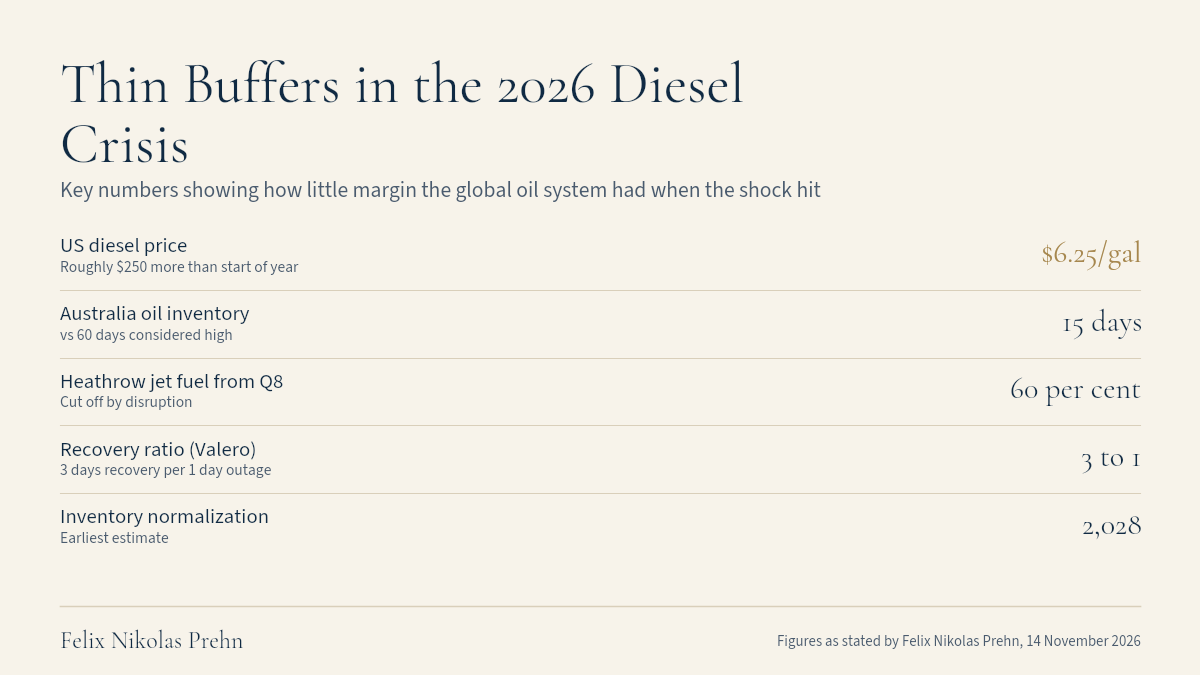
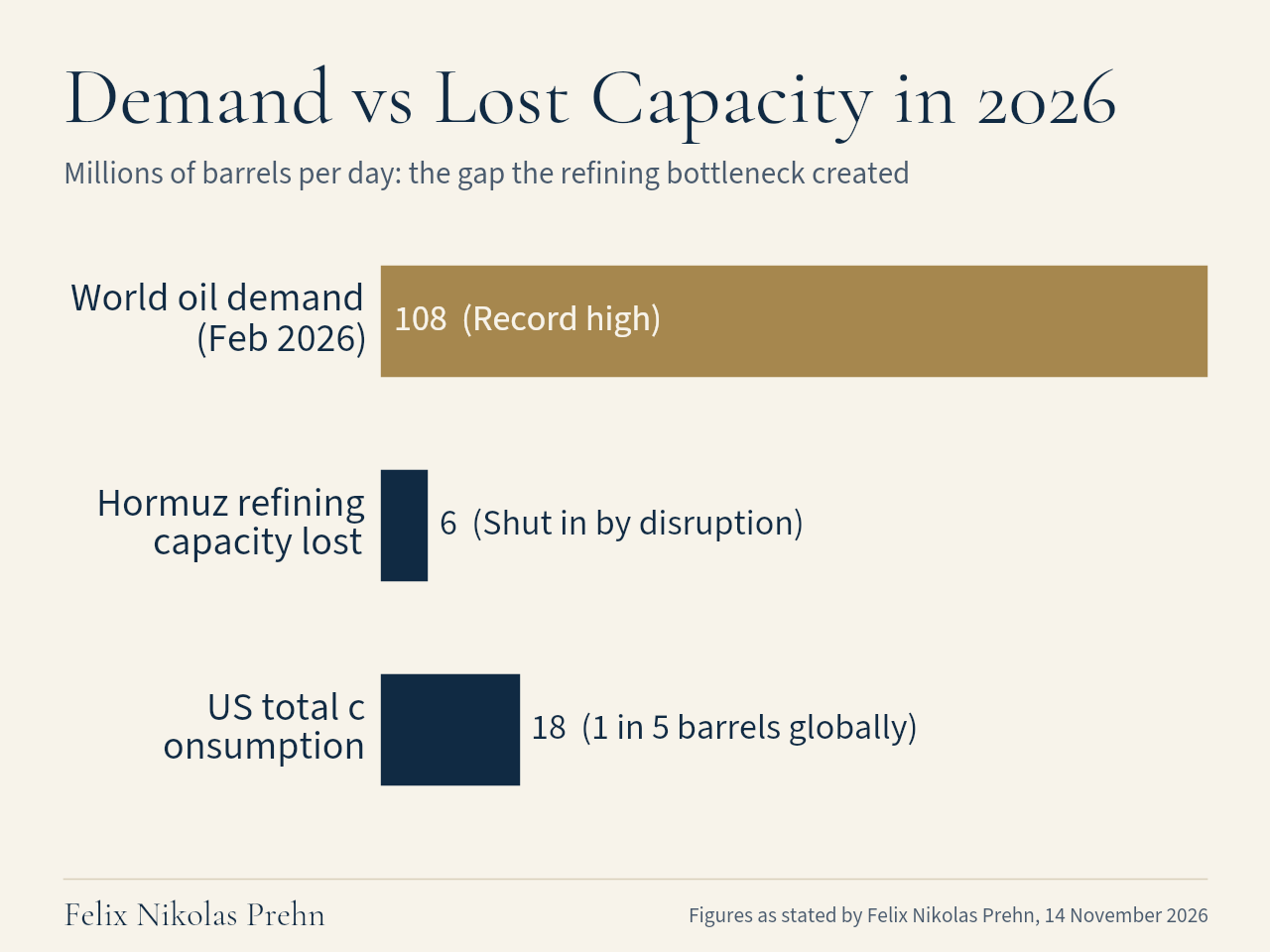
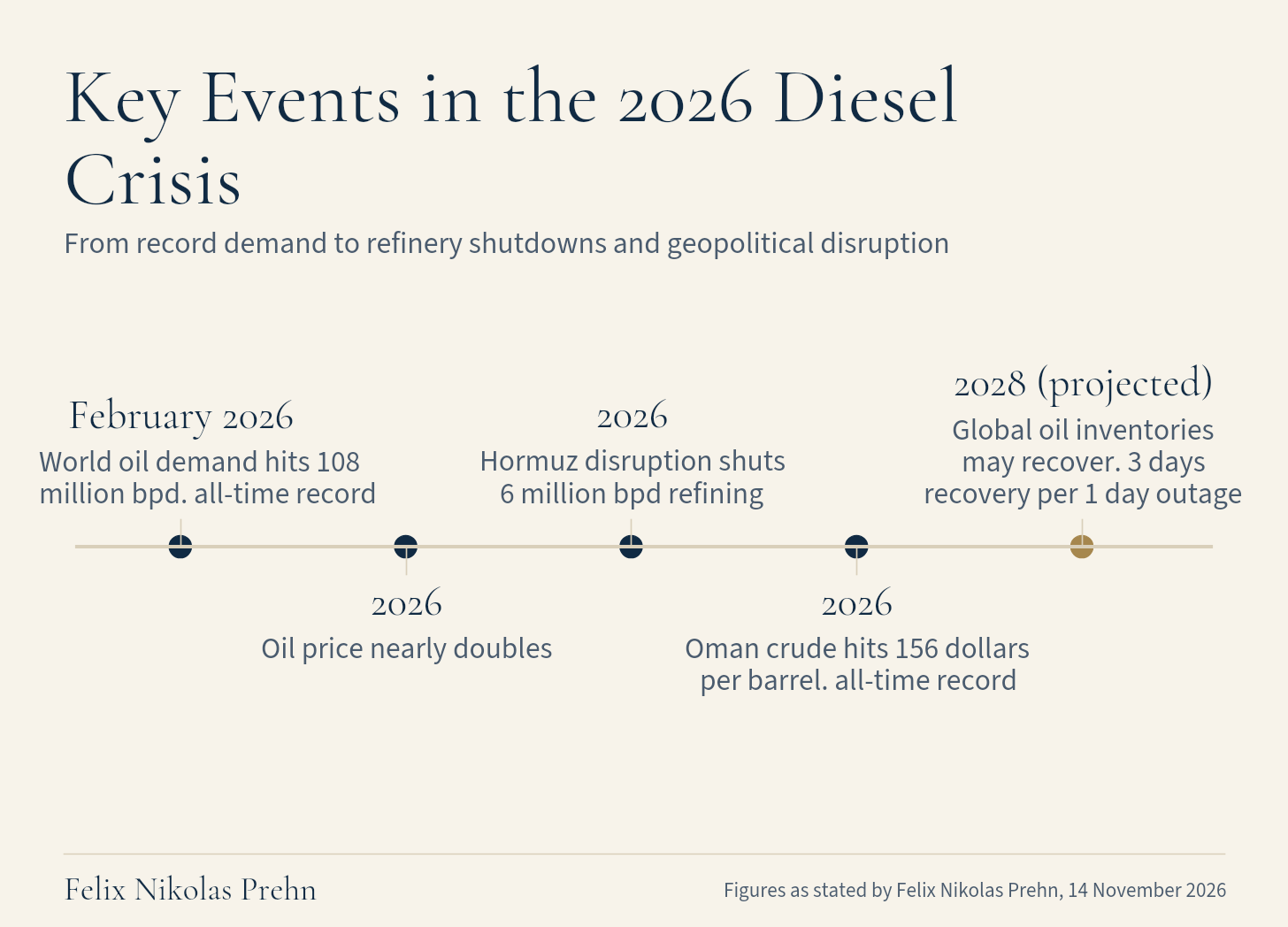
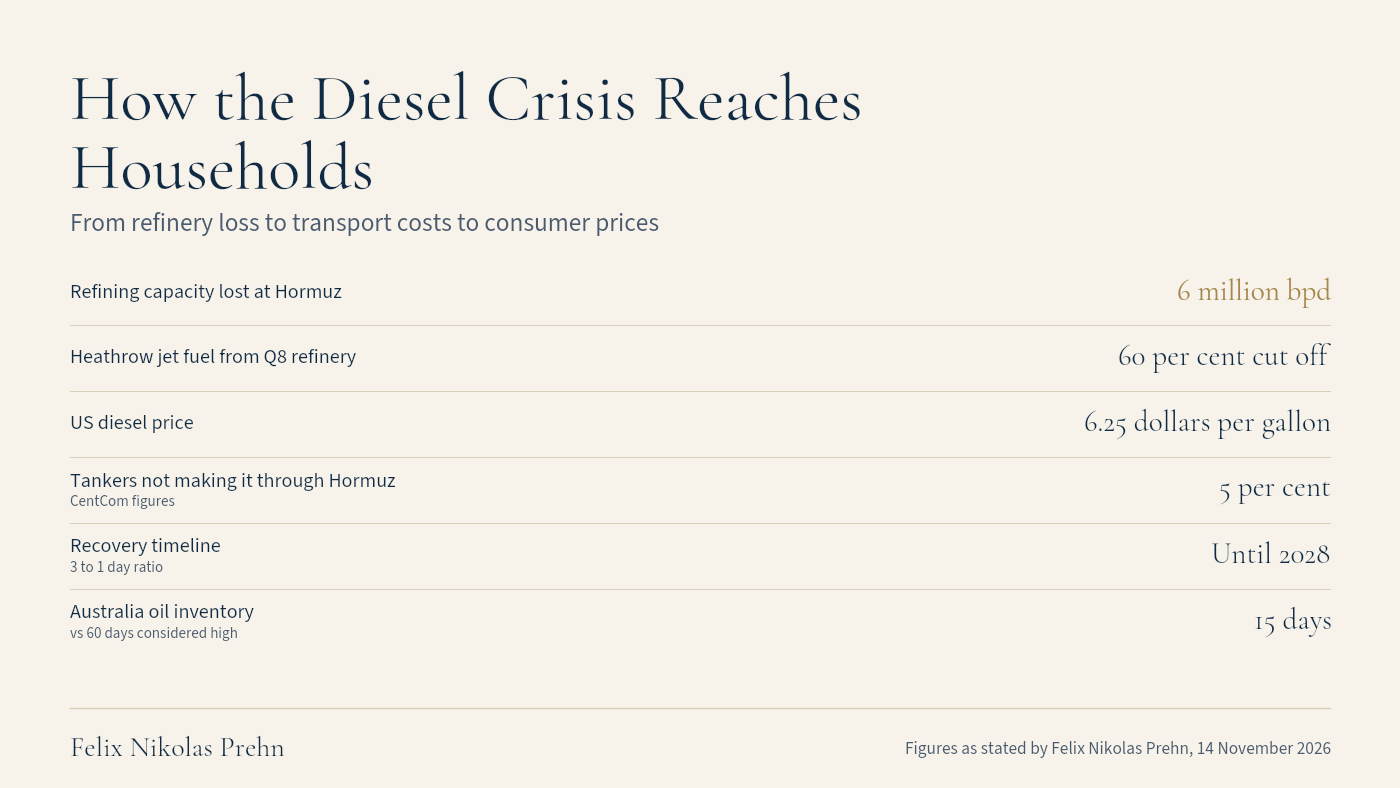
They've also proven themselves capable of hitting tankers which is another whole story. And then of course you had the Hormuz disaster which uh effectively shut in about 6 million barrels a day of refining capacity behind Hormuz and then of course starved the global refining system of particularly Asian refining system of crude oil. Now what we've addressed at times getting more than previous to the crisis levels of crude oil out of the hormuz we've not been able to do that with either liquid natural gas or diesel jet fuel. And just to finish, an example would be that the Q8 refinery was supplying 60 per cent of uh of Heath Rose jet fuel to give you an idea of the dependence there and you know that has been simply cut off and as a result we've seen this extraordinary value to refining and the ability to refine because we've lost so much refining capacity globally. Now, Winston here has watched this entire podcast and thought, well, wouldn't it be wonderful if you and I could also track the same kind of data that the oil traders are tracking?
So, he's built it into his Winston app. And you can see it right here, the energy dashboard. And one of the key numbers though that I would watch out for is the diesel over crude number because that really tells you this massive differential that we've got here. And once that starts coming down again, inflation might come down. The market might potentially rally some more.
So, if you want to get access to that, there's a link down below in the description um to a free free trial to that. Oh dear, the screen's gone dark. Uh there it is again. And um just play with it. It's a free trial.
Zero risk. If you don't like it, just cancel it. If you go forget to cancel it, just tell us and we'll do it for you. And of course, we'll refund you. And let's continue.
So why does why does diesel matter more than than than say crude oil prices? Well, we don't use crude. So, you know, there's actually almost no use of crude. Certainly not in your life. There's a couple of, you know, strange exceptions.
The Saudis burned crude during the summer uh for peak electricity demand reasons. The Japanese historically had burned crude, but pretty much no longer do. But the reality is that the everyday use of the vast majority 99.99 per cent of people is going to be either gasoline for their car. Uh diesel distillate would be for a truck for their Amazon package which would also come on a ship that used diesel and then of course I mentioned jet fuel as a derivative. served the if you've rush delivered your package I'm sure you do Felix then it would have come by aeroplane and that's also diesel and as we all know essentially there's no economic ability to replace diesel particularly in jet planes but certainly also in ships anything where you want the energy density of oil over a very long distance because at some point electricity has to be reconnected and therefore the distances that you can take electricity at a much lower density and much heavier eight it it simply doesn't work for a lot of our transport uses and as a result we remain very dependent on oil so we can't replace diesel so how does the just what we threw from the beginning how does this knock on effect work you so you shut down the straight of Hamus because there's a war going on so oil doesn't come out of Saudi and Kuwait and Iraq and Iran and all these places but at the same time you are now talking about a refining issue which means that the factories essentially that would normally receive the crude and process it into something usable. Those are shut down as a result of the Russian war.
Is is that what you're saying? Or that just takes some of the world's capacity out. Yeah, exactly. So, basically, we wouldn't we would think of it as a processing unit. Basically, what a refinery does is you boil oil literally at pressure.
So, it's extremely dangerous and highly explosive and you do it at a massive scale. So, you know, the biggest refineries in the world now are 600,000 barrels a day. uh you get up to a million barrels a day at Jamnaggar in India. Um you know so you have these enormous facilities and um basically what they do is exactly as I said they literally boil the oil. So they they they they turn it into a gas and as it boils different fractions come off at different temperatures. So you have gas at the top and you have asphalt that goes on roads at the bottom.
And then you have what we call middle distillates and they're called middle distillates precisely because they come out of the middle of the refining tower and then get further processed into more complex products such as jet fuel. But the the bottom line is that if you would, you know, put WTI in a kettle, you would uh and boil it, you would get gasoline and then a massive explosion. So don't do that. We're not we're not suggesting people do this, by the way. Don't try this at home, children.
The diesel prices are high. Let me boil my under any circumstances. Do not do that at home. Now, if you took Canadian heavy oil, which has the consistency of peanut butter, you would get a very black kettle. It would not you would really achieve very little.
And so there's also an issue of the complexity of refining. the ability to take a Venezuelan or a Canadian very heavy oil as opposed to a North Sea light or a medium which comes out of the Gulf of Hormuz or straight of Hormuz is all another whole comp complexity.
But basically what you've done over time is you've shut down refineries because they were uneconomic or too expensive to run in the case of California. You also shut them down because of bankruptcy and COVID. And actually oil demand held up and actually hit all-time record highs. Believe it or not, in February of 2026, world oil demand hit 108 million barrels a day. That's 1,300 barrels a second of consumption of oil.
And at the same time, you know, with the cold winter that was. But at the same time, you had these enormous refining um issues that we've talked about in Russia, Ukraine, and in uh you know, Q8, Bahrain are the two big ones, but Saudi and UAE as well. Okay. So, we've got high oil prices. We've got a lack of capacity to process oil from somewhere else in the world.
Um presumably it takes far too long to build a new refinery, open one up, and no one's done it because they haven't made money for a while. So, what happens next? say, you know, there is some sort of semi-piece and the straight opens up a bit more like it sort of has, right? The last few weeks we saw a bit more oil flow. Why are we not seeing prices come down then? Because I mean I looked at diesel prices this morning.
What was it 625 or whatever it is uh you know in the US which is pretty extraordinary. It's about $250 more than it was at the beginning of the year. So why why is that not coming down? Well, we didn't talk about tankers, but the simple answer is actually that the Russia Ukraine situation hasn't been resolved and and although there was a lull in attacks Russia Ukraine, Ukraine had started bombing refineries again in the past week or so. Number one.
Number two is that the shipping in in the uh straight of Hormuz is still highly dangerous. I mean, under this extraordinarily expensive escorting operation that the US have been undertaking, the the Consentcom official numbers said that uh we're getting 95 per cent of tankers through the straight. But if you think about it, that means 5 per cent of tankers aren't making it. You know, that's a terrible risk when you've got, you know, and you know, these these are 250 plus type million dollar tankers that you're talking about. You know, you can't lose 5 per cent of them a day.
So the reality is it's turned into a shuttling uh shipto- ship transfer is what we call it where they they they run smaller ships through the in big in big fleets essentially through the straight and hope that they get hit. The Iranians don't have any radar more or less so they're firing just randomly into the night and hitting stuff with heat seating missiles and it's just a total mess to be honest with you. The very latest obviously is we've had an enormous political shift here in the US. President Trump suddenly seems to have become really quite consilitary, certainly by his standards and certainly pre-election standards. There was fears of a major attack that would be undertaken by Israel and the US post midterms.
That seems to be dissipating and oil is coming down as a result of that. And finally, we're hearing from the Iranians, they may accept nuclear negotiators and as you can see with the risk that's involved here, the price of oil comes down hard as soon as there's, you know, any kind of a movement towards some kind of normaly. uh because you know the scale of the interruption remains so high. feel it. Okay, so oil prices are volatile, but the people at the pump don't really feel it or the diesel or that you're trucking or you're you know you're flying. Um and that's also why we're not seeing inflation numbers really coming down, right? Because the I think the way I'm reading this, you're saying even if we get peace in the Middle East and everything is wonderful, we're still going to be stuck with these high transport costs essentially high diesel prices, high flight prices for a while.
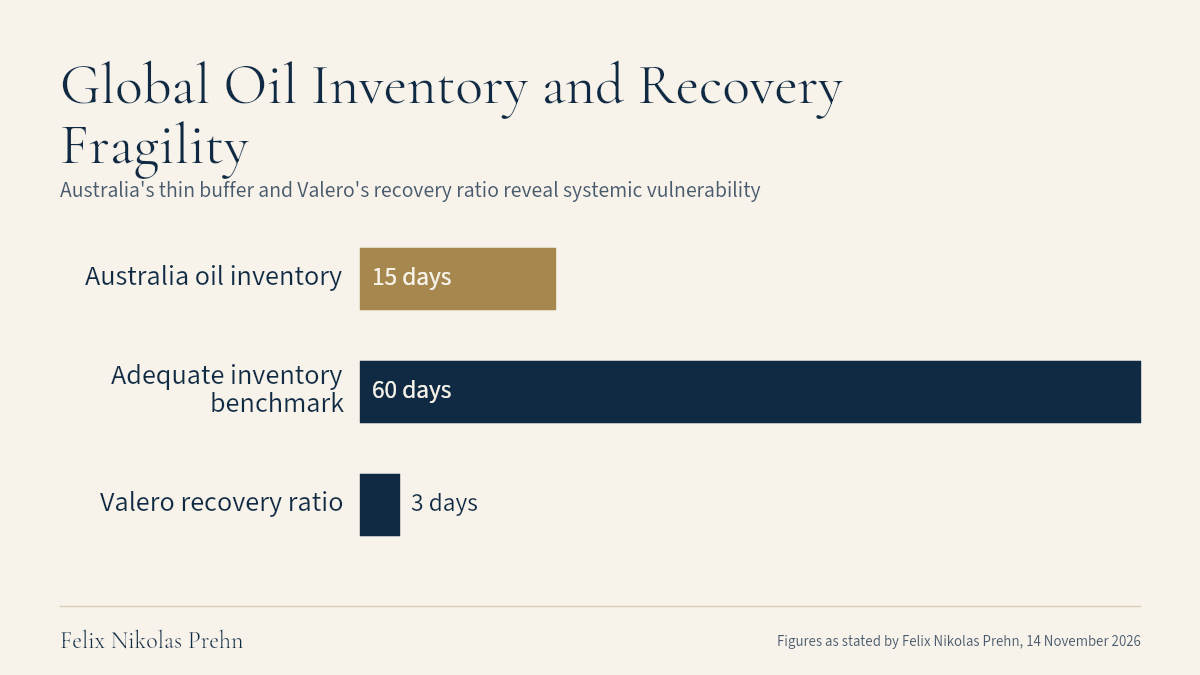
That's a difficult one because you know early in the crisis on their first earnings call after the crisis Valero who's clearly one of the best refiners in the world independent refining company fabulous stock by the way just been a huge success story over time uh and the key thing you look with refining is always just do they operate safely you know do they actually run the refineries and that's a key thing that these guys do at a massive scale but they said it would take 3 days to recover for every one day of outage and so you know if If we just stick with that rule, which was, you know, more or less off the cuff, it's going to take until 2028 to recover global oil inventories to where they should be.
One of the ironies of the situation here is the US is a major oil and gas exporter. So, this is very different this time that you have US in the position of major oil and gas exporter. In the 70s when we had similar crisis, US was a massive importer and it was hugely negative for things like the dollar when these things happened. As you've seen in these crises, the dollar has actually strengthened both Russia, Ukraine and Hormuz, which is a totally different um setup than previously. And you know, the bottom line is that um it'll take a while to just to recover back to normal because inventories are so low is the short answer, Phoenix.
Okay. So, it'll it'll take us maybe into 2028. But I think yeah, interesting. You mentioned the um US being a major exporter of oil and and gas nowadays bigger than Saudi Arabia and you know are they therefore the the actual winner out of this scenario in the US oil companies frankly yes somewhat I mean you know one thing is it's not outright negative for the US because it's a transfer of wealth within the US this is a point we've been making now it's bad for farmers you know it's bad for I debate how bad it is actually for consumers because as you referenced earlier without specifying the gasoline price, diesel price in Europe is pretty much double what it is in the US. So here people complain bitterly about $4 a gallon.
In the UK it's $8 a gallon on a normal day and you know it gets up to $10 a gallon. So you have just a fundamentally much higher price in Europe and that becomes much more painful. But of course people use oil much more efficiently in Europe. You know they drive less, they they have smaller cars. But the reality of the actual income effect of high gasoline prices in the US, I think, is relatively minor compared to the actual economic benefit of the strength of the oil industry that they get.
And the the money is being transferred kind of from the farm states to Texas, but it's not leaving the US. You know, it's all part of the great US economy.
And that's why I think this hasn't been as damaging. Now there has been something been floated um over the last few weeks and months which is a a diesel export ban by the US which is sort of a politician's answer to to things I guess. Um I think you called it a very bad idea. Can you explain your um sort of thought process behind that? Well, I mean, if you look over the last 20 years, US the US pulled out of coyote, right?
I mean, under Bush, they were like, you know, we're not interested in global climate agreements. And over the period, US uh CO2 emissions fell faster than almost any other country in the industrialized world. And the reason for that was the free market went out and provided a ton of cheap natural gas. natural gas so cheap based on free market activity, you know, just pure capitalist invest and try and make money from producing oil and gas in a free market private enterprise environment in the US where you have property rights and mineral rights. Um and the industry basically substituted coal in the US with very cheap natural gas at absolutely sustained rate which is a very long way of answering you but it's to say that when the government gets involved in these markets they're horrible at this stuff they just mess it up and if you look at what's happened in Europe it's been an absolute debacle the UK I just have my head in my hands I'm like what are these people doing you know this nonsense that gets taught you know the the UK's biggest power plant DRA X was built on a highquality Sheffield coal mine, right? It's deliberately there because there's a coal mine underneath it, Selby.
Actually, it might be Yorkshire. Apologies to English people who live around there. Um, but basically, it's deliberately designed to run coal. It currently runs uh wood pellets imported from the US because the wood pellets are renewable. But obviously on a CO2 basis, that's absolute garbage.
It's more CO2. Secondly, the wood pellets are not renewable in so far as they're just cutting down forests in the US. And thirdly, you use oil to transport the wood pellets. I mean, it's this kind of garbage and other stuff where you shut down nuclear in in Germany, you're just like you what, you know, it's like the one thing we've discovered that solves our energy problems is nuclear energy. But but what it does mean in the US is you have a free market.
And especially under the Republicans, there's no way they should be interfering as directly as they were proposing, particularly not in free trade. That's anti-Republican. It's unAmerican. And we were very vocal about opposing it. If you zoom out and you go back a few years, everyone's talking about the end of oil.
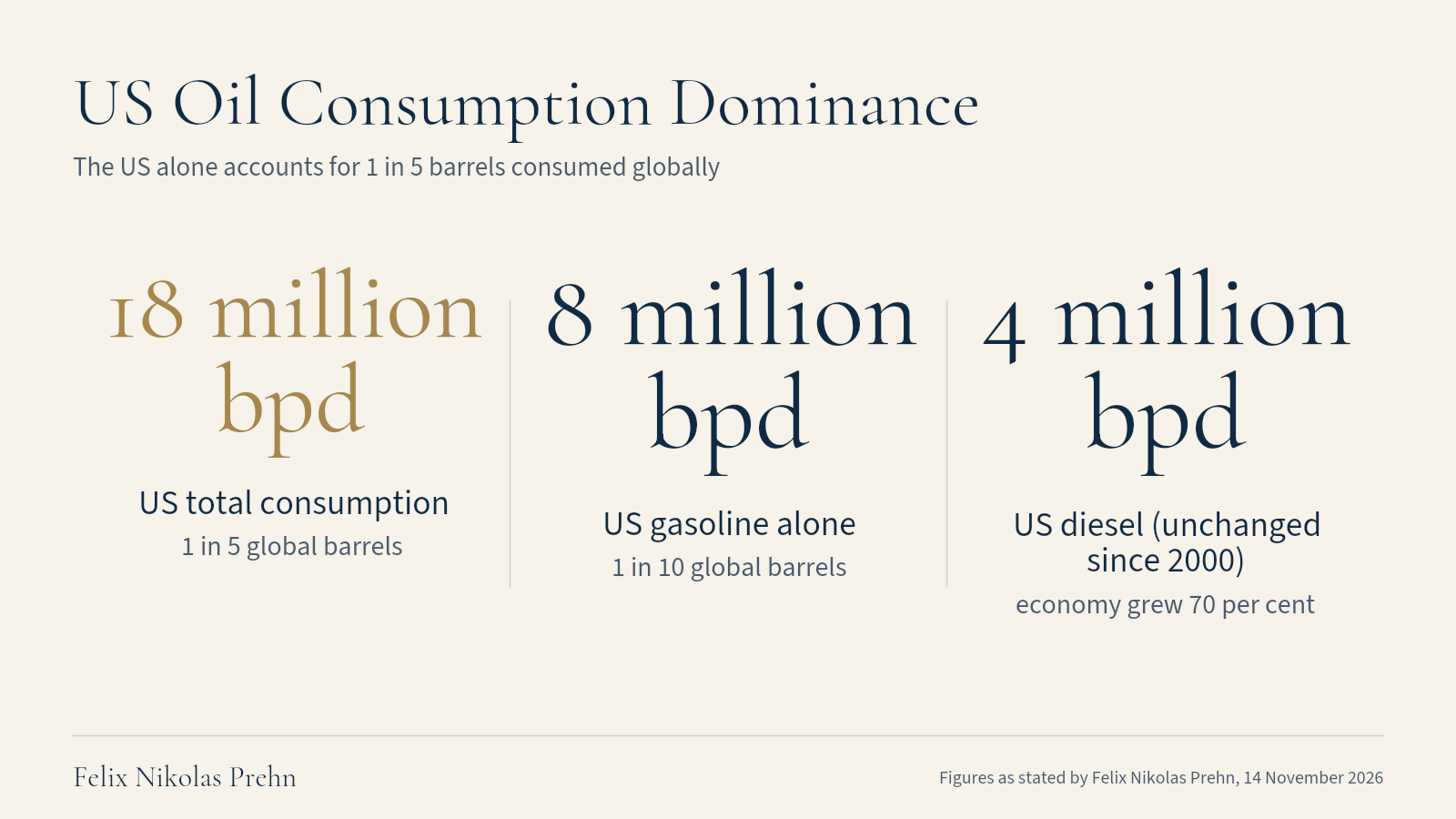
Um and here we are and we're all talking about oil as being the most important thing to shape economies and you know recessions and inflation and um you know financial markets move up and down every day because of oil. What the heck happens with the end of oil and we would have a much more rapid transition to the biggest single threat to the single biggest sector of the global oil market is US gasoline. That's 10 million. Well, it's 8 million barrels a day just in US gasoline where the US population is 333 million on 8 billion globally. 1 in 10 barrels alone is US gasoline.
And the US itself is 18 million barrels a day. So it's basically 1 in 5 million barrels. One in five of all barrels consumed as US. If you'd had a better penetration of EVs here, the situation that would have been a big part of the end of the oil age and for a lot of different reasons, it just has not really happened. We had a significant growth in Tesla sales.
Obviously, most of the other automakers could not make a EV to get out of their own way. Yeah. And ultimately Elon kind of went a bit nuts with Trump and stuff. So, he lost his core, you know, supporters. And then ultimately Trump ironically took away the subsidy for EVs and the whole thing's turned into a bit of a disaster quite frankly and everybody loves driving big gasoline vehicles in the US and that's the way it's going to be.
So I think one of the mega themes of the future will actually be a dichotomy where the US remains very oil intense and the rest of the world electrifies much more rapidly and I think that's very much been accelerated by all moves that people now have a further incentive to want to drive an electric car. So the vehicle, the car and particularly the the car in the US is an absolutely key element of it. On everything else, there's been remarkable efficiency. So if you look at it in 2000, the US was using 4 million barrels a day of diesel. That's the same level today.
Now on the one hand, that's flat. So we didn't substitute the oil. On the other hand, the US economyy's grown 70 per cent in that time. So your oil efficiency grew 70 per cent since 2000. So there has been a sort of end to the oil age.
But you have to keep in mind the scale of global population growth and the scale of global particularly the scale of global GDP growth and the fact that we've actually become much more oil efficient doesn't change the fact that just the sheer weight of the global economy and the importance of oil that you've referenced in how you run it means we're literally 100 normalised we would be probably at 105 million barrels a day of demand right now. I didn't think we'd ever see 100 million barrels a day in my lifetime because we thought you wouldn't be able to supply enough oil. But the reality is the US revolution supplied a lot of additional incremental cheap oil and that's why we've been able to make the market allow the market to get so much bigger. That that's the whole shell boom in the US. Yeah.
I mean that was a stunning turnaround. So what they did is they simply combined this existing technology which was horizontal drilling with another existing technology which was fracking where you blow up the reservoir at the bottom. when they put the the blowing up the fracking with the horizontal, they now drill five miles lateral, believe it or not, and then and then blow up the reservoir and that gives you a burst of oil production that can, you know, be be really significant and then you have a high decline rate, but if you keep repeating that, you can they've only recovered about 10 per cent of the oil in place in the perium. So, you know, they can keep doing that almost infinitely. So, that all allowed the market to grow bigger. And then as I said the alternates of which the biggest was really is really electricity has has really not penetrated as much as you might have hoped um in a lot of different ways.
You know I personally I think we should use natural gas. I think one of the big mistakes is to mix up fossil fuels because coal we shouldn't be using natural gas we should and it's just a more efficient and better way to run things. But essentially you're right in the UK. Exactly. the oil age and it's actually all shut down the North Sea which is the other boneheaded thing they did. But you know the bottom line is that the if you think about the scale of the global economy we've actually become a lot more oil efficient.
It's just that oil is is as you say very fundamental to everything we do and we haven't even mentioned the importance of oil in plastics. Um yeah packaging plastics and so on of course yeah that's massive massive use there too. Well, it's one of the ironies of the people throwing, you know, when they throw they throw paint at these beautiful paintings as if that's going to help the environmental agenda. But of course, the paint they're throwing is an oil product. Just saying.
Yes. Undoubtedly wearing some sort of polyester outfit, which is also an oil product. So, yeah. Um, that's quite funny. Um, so now if we step out for a second for people watching this and thinking, well, can I can I benefit from this?
How do I understand? How do I read the oil market? Where do I, you know, what do I really look at? What are the things that I really watch? Um, I trade a lot of things, but I never trade oil really.
Um, I'm always tempted, but I never really trade oil futures or anything else. Every time I um put a trade on an oil company, it seems to go the wrong direction for some reason. Um I guess it's just so very volatile, right? So what do you look at? Like you wake up in the morning.
I mean you've done this for 36 years. What are the things you look at? Well, it's actually I mean on a short-term basis it's it's about supply shocks, right? And so you just have to know where the major supply is, you know. So essentially there's three standout suppliers which is the US, Russia and Saudi.
So anything that happens around those guys, they're all in the 10 million type barrel a day range. So that's 30 per cent of oil supply from those three countries. It doesn't take long before you get into the nutters, you know. So basically the Middle Eastern stuff, your Iran, your Iraqs, they're in the 2 to 4 million barrels a day range. And then you have, you know, your UAE, 4 million barrels a day, etc.
What you'll actually discover is there's not that many nodes. you know there's only about 20 countries Canada that have Brazil that have significant production and it's not that hard to follow what's going on there right and then on the demand side it's also relatively straightforward because not much happens in Europe and so really what you're looking US demand and US supply where you have the best data because you have weekly very good government data that tells you what happened this past week in the US that moves the whole market and that's the key trading moment when we look at that 1030 30 on a Wednesday weekly DOE data releases big for the global market. No, I I appreciate it's a it's a very interesting uh take from you because obviously I can I can see one other thing that makes it just so difficult is that the entire market is set at the margin by as little as 100,000 barrels a day literally. So you have 100 call it 100 million barrel a day market. It's it's the final million barrels a day that sets the price because the inventories are structurally low. If you think about it, Australia coming into this crisis, it was revealed that they basically had, I think, 15 days of oil inventory.
And if you think about it, that's an insanely low amount. And, you know, high global oil inventories are considered to be sort of 60 days, you know, so you have almost no inventory in in this business. It's just it's incredibly efficient. And you know, people don't appreciate just how brilliantly the oil companies do what they do, you know, because they go out into 25,000 ft of water, you know, 3,000 m type depth to drill 5 km and eventually you just fill up your car and they spill almost nothing. You know, contrary to popular opinion, almost zero gets spilled.
Literally, it's a phenomenal job and people don't understand how difficult it is. But if anything goes wrong in that chain, when the classic and ultimate example is horm, all sorts of stuff go starts going badly wrong. And you know, basically, as we've agreed in this conversation, we're not out of the woods on this at all. You know, it's it's going to take a while to recover all the systems that are out of whack. I mean, one one last thought.
Now, some people are throwing around, well, Sweden oil will solve it all. Um, can you explain why that isn't going to happen? Well, it's legally extremely uncertain what on earth is going on there, right?
So, basically, as you know, you have, you know, as always happens with these sort of tinpot dictatorships, there's actually an underlying written constitution, you know, they're just not really following it that closely. But there's a lot of legal stuff in in Venezuela, particularly uh national patriarchy or whatever you want to call it of the resource. So the the state owns all the oil and gas and you can't really privately develop it within the constitution as it stands. They've done various laws that have allowed the big oils to get in there. But this it's it's just an extremely dubious situation when you've removed the head of states.
You have not had elections and um you don't have great law and order and everything else in Venezuela right now. I mean it's not exactly in great condition. Now the theory was what you do is you restructure the debt and then you have elections. So I think they do have a process uh in mind but at the moment these deals that getting signed it's about as high a risk a deal as you could take because you just don't really know which direction Venezuela is going to go in. If you take the assumption that the US can basically control Venezuela, which is going to be more questionable under the Democrats for sure, um then you know it's it's the scale of the resource there is arguably the biggest in the world, right?
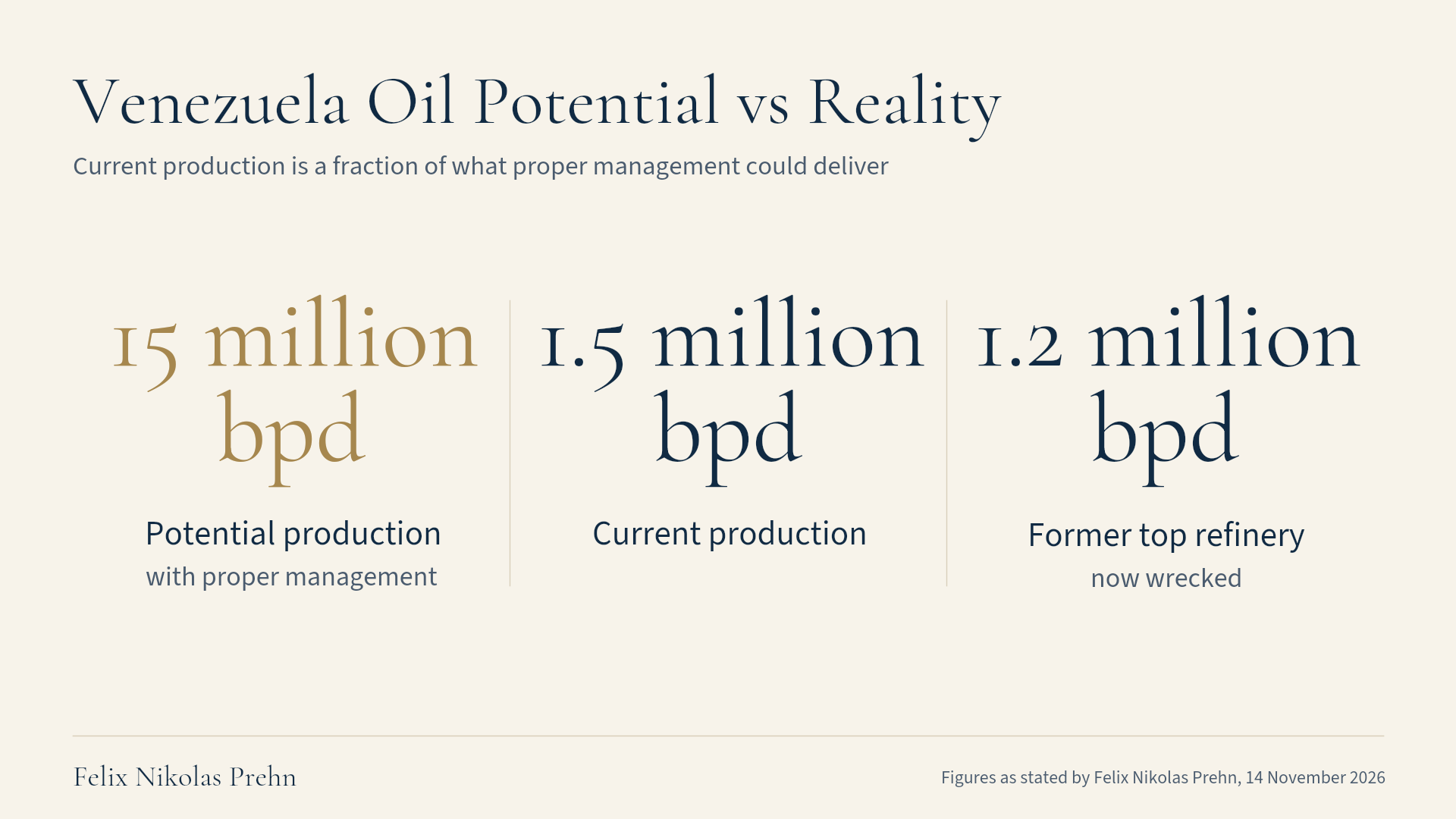
So by certain measures, Venezuela has by far the largest oil reserves globally, although it's heavy oil. Um they certainly have the potential to be producing, if you let Exxon run Venezuela, they could be producing 15 million barrels a day. No question. They're producing not one 1.5 million barrels a day right now to give you an idea. So they could be doing 10 times the volume with proper management.
They also wrecked what was formerly the number one refinery in the world in scale. They had a 1.2 million barrel a day refinery in Venezuela that the Chavez um essentially the the Chavez revolution trashed it. Uh they basically threw out all the payabase of workers and just had guys and girls in red berries come and run the stuff. And that's not how you run a refinery. It all blew up.
So the the industry is basically trashed very tragically there and you know I hope they can work it out. It's just legally extremely dubious and um that's a problem for major investment. Having said that there's been an announcement today that Exxon's made an agreement which is interesting because Exxon and Konico are owed a lot of money from nationalization by the Venezuelans. So there's clearly forward motion there and I think you know part of it is obviously because Trump wants people to get in there that they're they're making a lot of effort but we've certainly heard there's a private equity frenzy to get into Venezuela because the potential there is so huge and the oil is just perfect for the US refining system. So what you've seen is a huge discount in Canadian heavy crude because the Venezuelan stuff is taking their market.
So it's basically the same stuff, right? That heavy tarl like stuff. It's that it's that peanut butter stuff. Yeah. It needs to be upgraded basically before you can use it or diluted with condensate.
But the bottom line is it will it will be a growing area I'm sure and you know the Venezuela Venezuela under Maduro is and under Chavez at the end we're under kleptocracies you know and so getting rid of those guys is a good thing. It's just they there's a long way to go before Venezuela's back in you know proper shape which would be post elections once they are they have a full constitution. So, if there's a big left-wing, for example, win in Venezuela, I'm sure they'll reassert the fact that they don't want foreign companies, who knows what will happen, but you know, there's a lot of uncertainty for the amount of money that you might have to invest. So, you won't see massive investment there until it's clearer, but get the margin. It's going to be a growing area for sure.
Okay. Anything else you're watching in oil markets or global markets at the moment? Yeah, I mean AI, I mean we're energy and energy adjacent.
So we do everything in terms of what's happening globally in in energy and you know obviously the AI story is a huge story over here and it's you know very related to natural gas and and power generation and you know Jensen Hang's layer cake the bottom layer is energy. So you're seeing tremendous developments here in in gas fired power generation actually is one of the really most rapidly growing areas but for the shortage of turbines. So that's all very interesting and then there's a ton of engineering companies as well. Um you know guys like Eaton very controversial stocks now but you know for the past two or three years anyone that was involved in anything to do with you know GEV making turbines CEG constellation making electricity all these plays have been huge winners for the past couple of years and then really got you know been performing poorly this year. many of them are going to be absolutely crucial to the continued development of AI, which you know, we we have very rapid adoption on on Wall Street. So, I'm a big big user of AI.
I just cut my first $1,000 check to perplexity. Uh, and that's we're talking about for a day, you know. I'm not talking about But if you think about my budget as opposed to hiring someone, you know, which would cost me if it was $50,000 a horrible a horrible wage in New York would be $50,000, you know, is uh that would cost me $100,000 to hire someone with all the hassle and whether or not they were any good. I have a pretty big potential budget for AI. So there's a big understanding on Wall Street how how you know huge it can be but we haven't really priced it yet.
You know it's been free so far and whether or not everyone starts using it I think is a real open question. Finally you know and I've been sort of really darkly joking about this because sometimes oil and gas is very much out of favor and uninvestable. Suddenly it's data centres that have become public enemy number one from nowhere. I mean, nobody even barely thought about data centres a year ago. Suddenly, it's literally public en enemy number one.
And it's very relevant, obviously, with the Democrat blue sweep that we've just had, the Blue Nami, you know, as to exactly how we go forward with this stuff because you have, if you've seen the graphic of the Texas shift, you know, we've never seen anything like every single elected statewide official in Texas being a Democrat. It's absolutely mindblowing. And there is political capital because there's a real, you know, grassroots type level or or average person type level concern about data centres and whether or not AI is going to kill them kind of stuff, you know, it's a fear of new technology, isn't it? And also, it's just going to drive up energy prices. I mean, for for most people, which is kind of understandable.
It already has actually in some places, but yeah, it implicitly, yeah, it's it's going to it's going to be they're going to be competing. Um, you know, there's going to be price competition. Absolutely. And the US electricity industry has no track record for the past 20 years of actually growing. You know, you just had no need to grow historically.
So, the companies are kind of dopey. Although being America, they'll work it out really fast, but they they're certainly not really prepared. the systems like PJM, you know, which is the biggest data centre market in the world. They say 99 per cent of emails go through Lowden County, Virginia, which is the richest county in the US, by the way. As soon as you have rich people in the US, you have more lawyers and they don't want more data centres, you know, so it becomes really difficult and and you can oppose stuff down to the county level in the US because, you know, it's a democracy, right? So in China, you don't have environmental lawyers and um you know uh well I guess you do but you don't have environmental protesters and you certainly don't have the level of difficulty that you do in the US just to build basic infrastructure which you know they're address trying to address in Congress but it's still you can still oppose stuff down to the county level.
Uh if you don't want it built it'll probably not allow be allowed to be built. That means basically much of it will get built in places like Texas where it's much easier etc. So there's going to be a lot of regional differentiation here in terms of how stuff gets developed, which is why the Texas change to blue is so important because so much of the stuff was going to get put up in Texas.
When they put in the Texas moratorum, Google announced an 8 gawatt gas fired power plant. Now a big nuclear plant is 1.2 gawatt, right? So they're doing an 8 gawatt data centre in Texas. And then the governor Abbott announced a moratorum on the remaining currently unapproved projects which was 473 gawatt of projects. The entire US capacity base I told you earlier is 1,200 gawatt.
So you're talking about just in Texas just in Texas it would have been about half of all US installed capacity if all those projects went ahead which is pretty easy to say it's not going to happen right. It's going to be very interesting to watch how this plays out and at the moment interesting the price of computers coming down as well which is challenging the economics. So it's it's just a fascinating mega theme to watch and as I said I'm also a very heavy user of AI. So that's been a kind of an interesting experience because I feel like I'm working harder battling with AI right get it right. Um yeah I have a sim similar similar experience of that every day.
That's what I what I do every day. I battle with AI to get the data right. But um Paul, it's been a very very interesting conversation with you. Thank you very much for enlightening us and shining the light a little bit on oil and energy markets around the world. Um where can people find you?
I think for your viewers, we do have our own YouTube channel. I'm less um rigorous and and dedicated in the way that you are to to keeping it up to date, but we are making an effort to put out something weekly and it's for information purposes. We're not trying to make any money from it. We just want to get people better educated in energy. So my company is Sanki Research.
I'm Paul Sankey and Sankey Research has a YouTube channel where you can see free videos which are more or less me off the c cuff talking about what happened in the past week or 10 days or so in global energy. Amazing. Thank you very much for your time. It's a pleasure. Thanks.
Right now I think we're going through some sort of weird phase transition. And normally when you get bad economic news or you get bad jobs data that people are going to fly to safety into the bond.