
The Hidden Crisis: Diesel, Not Crude
Oil prices have nearly doubled in 2026. Diesel prices feed into freight, food and manufactured goods. Diesel trades above 200 dollars a barrel in many places.
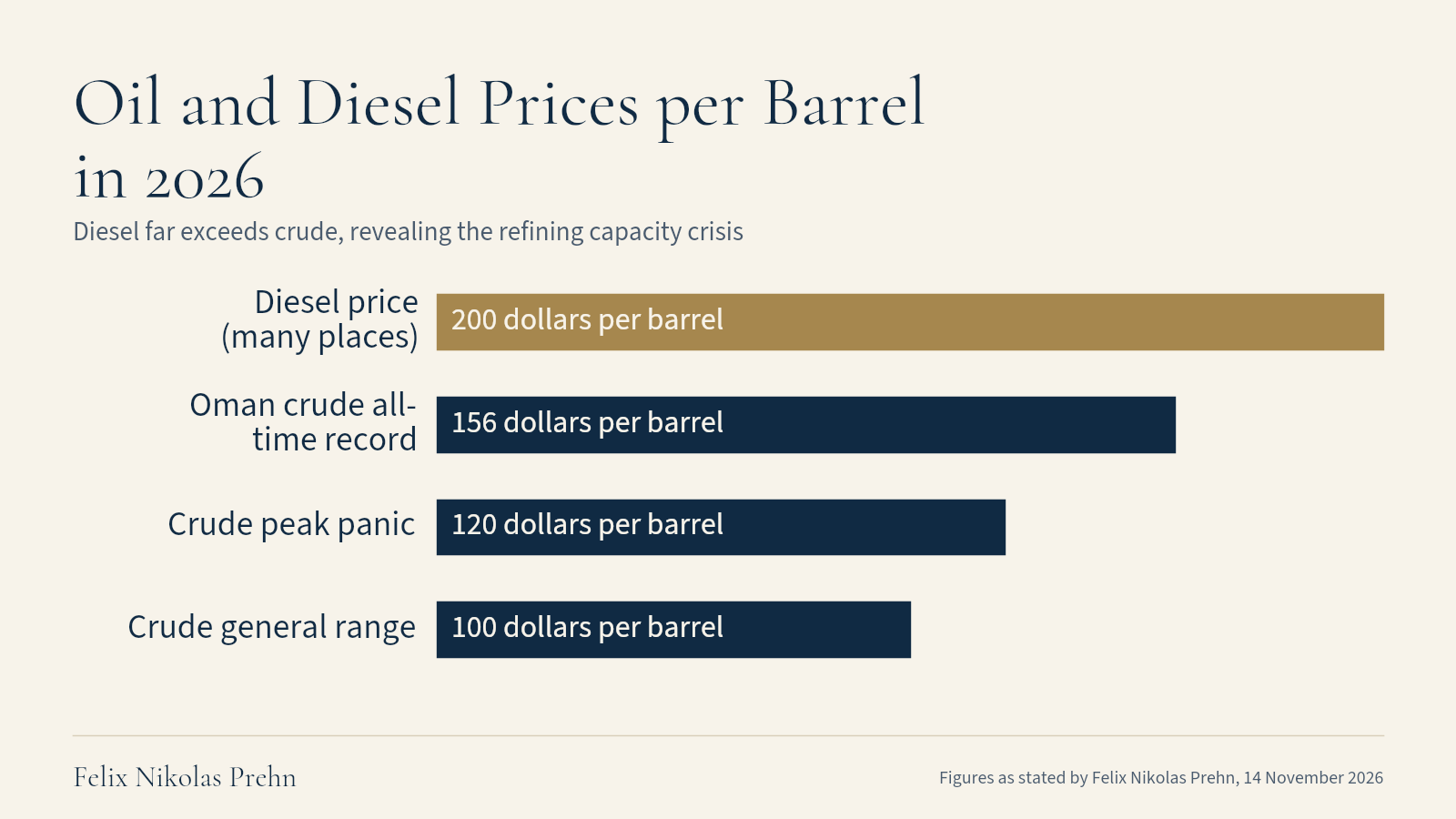
Crude prices remained closer to 100 dollars a barrel, reaching about 120 at the peak of the panic.
Oman crude printed what Paul Sankey describes as the all-time record for any widely quoted market price in history, at 156 dollars a barrel. Sankey has spent 36 years inside the oil market and was three times the number one oil analyst on Wall Street. Refined products are far more expensive than the raw commodity would suggest, as the spread between the Oman print and broader benchmarks shows.
As Venezuelan crude displaces Alberta's heavy grades in export markets, Canadian barrels now trade at a discount of as much as 35 dollars to Brent.
Diesel, far more than crude, is where the economic pain concentrates. Prices remain high because the world has lost refining capacity and cannot replace it quickly.
Why Diesel Matters More Than Crude
No consumer fills a car or fuels a jet with crude oil. Crude must be refined before anyone can use it.
A refinery boils crude under pressure. Gasoline separates near the top, asphalt at the bottom. Middle distillates (diesel, jet fuel) come off in between.
American gasoline consumption alone is 8 million barrels a day. Total American demand is 18 million barrels a day. One in 5 of all crude consumed globally goes to the United States.
Diesel fuels freight trucks, container ships and cargo aircraft. Oil's energy density, the amount of power packed into a given weight, makes it irreplaceable over long distances.
Electricity is heavier per unit of energy and must be reconnected to a grid. Jet engines, container ships and long-haul trucks cannot run on batteries at current technology; diesel is the centre of global transport costs.
The Refining Bottleneck
Two forces destroyed refining capacity in quick succession.
The longer-running cause is the war between Russia and Ukraine. A shift toward much more advanced Ukrainian drones allowed strikes on Russian refining infrastructure, sometimes at distances of 1,200 kilometres.
Ukrainian drones proved capable of hitting processing plants deep inside Russian territory. Renewed attacks have forced some of Russia's largest refineries to halt or slash output.
The second blow came from the Strait of Hormuz. The disruption there shut in about 6 million barrels a day of processing capacity, starving Asian refiners of crude oil.
CentCom official numbers state 95 per cent of tankers are getting through the Strait, meaning 5 per cent are not making it. A 5 per cent loss rate on vessels is commercially devastating.
In Felix's view, the Q8 refinery was supplying 60 per cent of Heathrow's jet fuel before being cut off.
Refineries had already been closing for years because they were uneconomic, too expensive to run, or casualties of bankruptcy and COVID. Drone strikes and the Hormuz disruption then removed further capacity.
Record Demand Meets Shrinking Supply
In February of 2026, world oil demand hit 108 million barrels a day. At that rate the world burns through 1,300 every second.
Inventories were already dangerously low before the crisis. Australia was revealed to have had roughly 15 days of oil inventory coming into the disruption, against 60 considered high.
Oil markets are priced at the margin. The final 1 million barrels a day of supply sets the price for a market consuming 108 times that volume. When inventories are structurally low, even a small shortfall moves prices violently.
Valero, one of the largest independent refiners, stated it would take 3 days to recover for every 1 day of outage. The ratio implies global oil inventories may not normalise until 2028.
Diesel prices have not fallen even as some crude flows have resumed through the Strait. The Russia-Ukraine situation remains unresolved, with Ukraine bombing refineries again, and shipping through Hormuz is still highly dangerous.
The US Advantage and the Export Ban Debate
The United States, Russia and Saudi Arabia each produce in the 10 million barrel a day range. Together they account for about 30 per cent of oil supply.
America's position as a producer and exporter has changed the economics of oil crises. When the US was a massive importer, oil shocks weakened the dollar.
The dollar strengthened during the Russia-Ukraine and Hormuz disruptions. High oil prices transfer wealth within the US, from consuming regions to producing ones like Texas, rather than sending dollars abroad.
A proposal has been floated for a 90-day ban on US diesel exports. Felix argues that when governments intervene in commodity markets they distort prices and misallocate supply, and that such a ban would run contrary to free trade principles.
America's record is instructive: after pulling out of the Kyoto Protocol, US CO2 output fell faster than in almost any other industrialised country. The free market provided cheap natural gas that substituted coal, without government direction.
In 2000 the US was using 4 million barrels a day of diesel. The level is the same today, while the US economy has grown 70 per cent in that time. American consumption is not the binding constraint, because the global shortage of refining capacity is.
Venezuela: Potential Giant, Present Mess
Venezuela has by certain measures the largest oil reserves globally. Under proper management it could produce 15 million barrels a day. Actual production is 1.5, exactly one-tenth of that potential.
Venezuela formerly had a 1.2 million barrel a day processing plant, the largest in the world by scale. The Chavez revolution wrecked it. Experienced workers were thrown out and replaced with unqualified staff.
Equipment failed throughout the complex, and production collapsed. Venezuela's oil industry has not recovered.
Legal uncertainty makes large-scale investment extremely difficult. Elections have not been held. Law and order is weak, and the country's political direction remains unclear.
Cheap heavy crude from Caracas has pushed Alberta's grade to a large discount.
Private equity interest is reported to be intense, given the scale of the resource. Large-scale investment will not flow until the legal and political picture clears. Without proper elections, legal protections for foreign capital remain absent.
What Comes Next: AI, Energy, and the Long Recovery
Gas-fired power generation is expanding at a pace that compounds the pressure on fuel supply.
Google announced an 8 gigawatt power plant fuelled by natural gas in Texas. A large nuclear reactor produces 1.2, making Google's single facility nearly 7 times that output.
The Texas moratorium covered 473 gigawatt of unapproved projects. Total American installed capacity is 1,200. The unapproved Texas projects alone would have added roughly 40 per cent to that national total.
Opposition can happen down to the county level in the US, and much of the development will concentrate in states where building is easier. Regional differentiation will shape where energy infrastructure is built.
Global oil demand hit all-time records despite decades of efficiency gains. Global population expansion and GDP gains have overwhelmed improvements in oil intensity.
The US shale revolution, combining horizontal drilling with fracking, supplied cheap incremental barrels that allowed the market to grow far larger than analysts once thought possible.
The shale boom added crude supply but left refining capacity unchanged. Crude can be sourced from different producers. New processing plants take years to build, and operators were closing them for economic reasons long before the current crisis. High transport costs will keep feeding inflation for as long as the refining deficit persists. On Valero's ratio, that means 2028 at the earliest.