Transcript
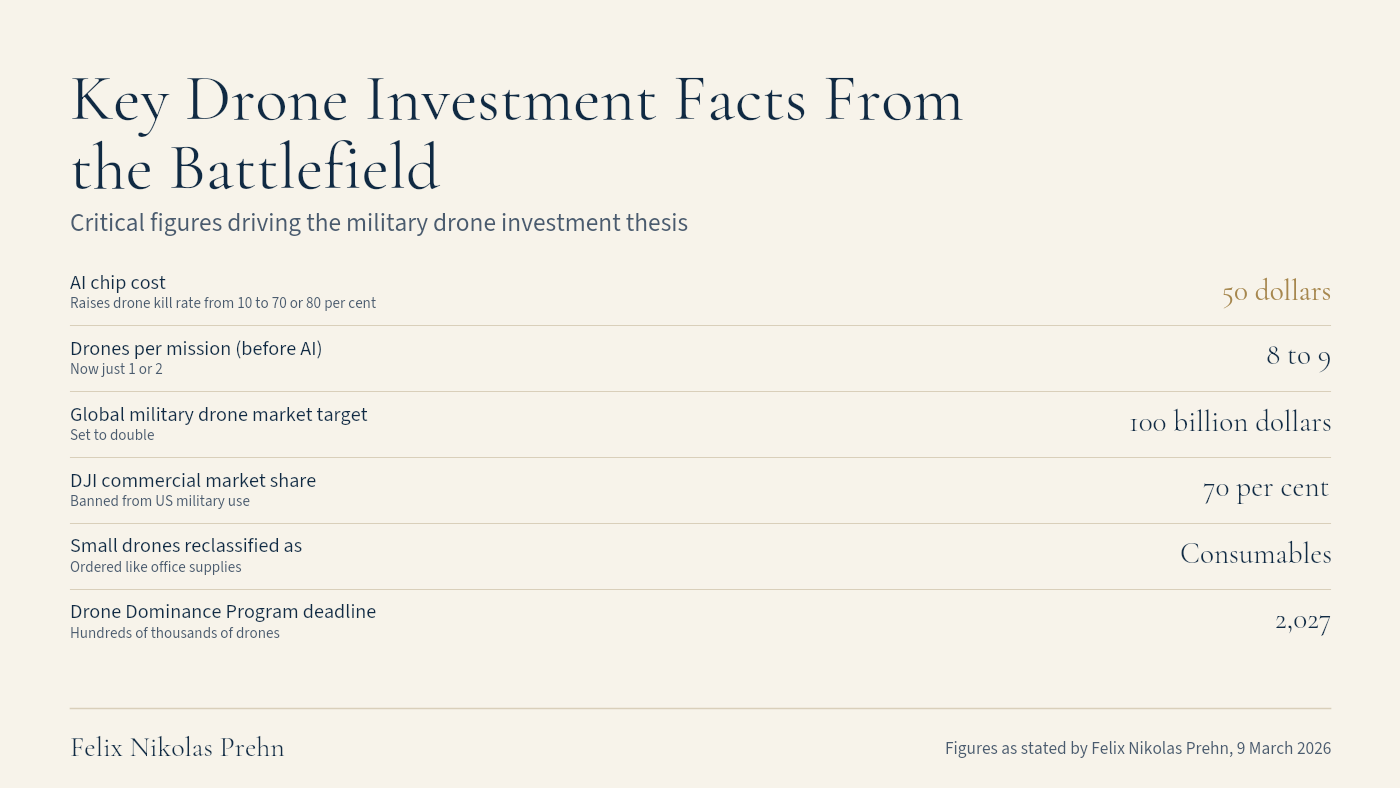
There is a huge investment opportunity that most retail investors are completely missing out. They're chasing the latest AI stocks while the real tech revolution is actually happening on the battlefields. And yes, war accelerates technological adoption. Ukraine has turned drones with $50 chips into weapons with a 70% kill rate. And the Pentagon has noticed, they're spending billions of dollars, and the global military drone market alone is set to double to $100 billion.
So while everyone's watching the war, and we have our own intel feed for that including what's happening in the Strait of Hormuz live and everything else, and you guys can get access to that as a link down below, more on that in a second. But the real point is there is a huge freaking opportunity here. And my question to you is, are you going to be one of the people who takes advantage of it? Are you going to be watching from the sidelines like the people who said Amazon is just a bookstore?
So I'm going to show you in the next few minutes exactly how to invest in this revolution. I'm going to give you the 3-step framework for finding the stocks that could go to the moon. I dare say that's one of Winston's phrases. And explain why Ukraine and Iran, those two horrible wars, have just handed you a road map for investing. And I'm going to reveal the specific companies the smart money is quietly accumulating. And I'll do it in plain English, nothing complicated here, just plain good old information.
My name is Felix Prehn. I'm an ex-investment banker. That's Winston back there, he's done all the research. And I'm also the founder of the Goat Academy where we've taught, and my mentors have taught guys who worked on Wall Street for decades, thousands of investors over the last 6 years, how to really understand the market better, how to manage their risk management, how to sleep sweetly at night and spot opportunities the way Wall Street does, which is really what this is all about.
And Winston back there, he's read the CSIS reports, the congressional stuff, the quarterly findings, dug through dozens and dozens of stocks. And I'm going to show you the actual money trail here. Now, the reality check is that look, war is always unpleasant. People die. It's never fair, it's never nice. And yes, people make money out of war, unfortunately.
And Ukraine is honestly, in my humble opinion, the world's largest live laboratory for drone warfare. Doesn't sound very nice to the people there, and it isn't. But literally, what used to take the Pentagon years of testing and billions in R&D is happening in real time on the battlefield. And every single day, Ukrainian engineers are innovating, they're adapting and proving what works and what doesn't.
And they've built something called the FPV drone. That stands for first person view. They started as $1,000 hobbyist toys, the kind of thing your neighbour might fly around the park. But the Ukrainian engineers transformed them into precision weapons. They figured out how to make them modular, meaning the same drone can be quickly reconfigured for different stuff. Attach an explosive for a kamikaze strike, add a camera if you want to film stuff, or you can mount a signal to extend the range of your communication.
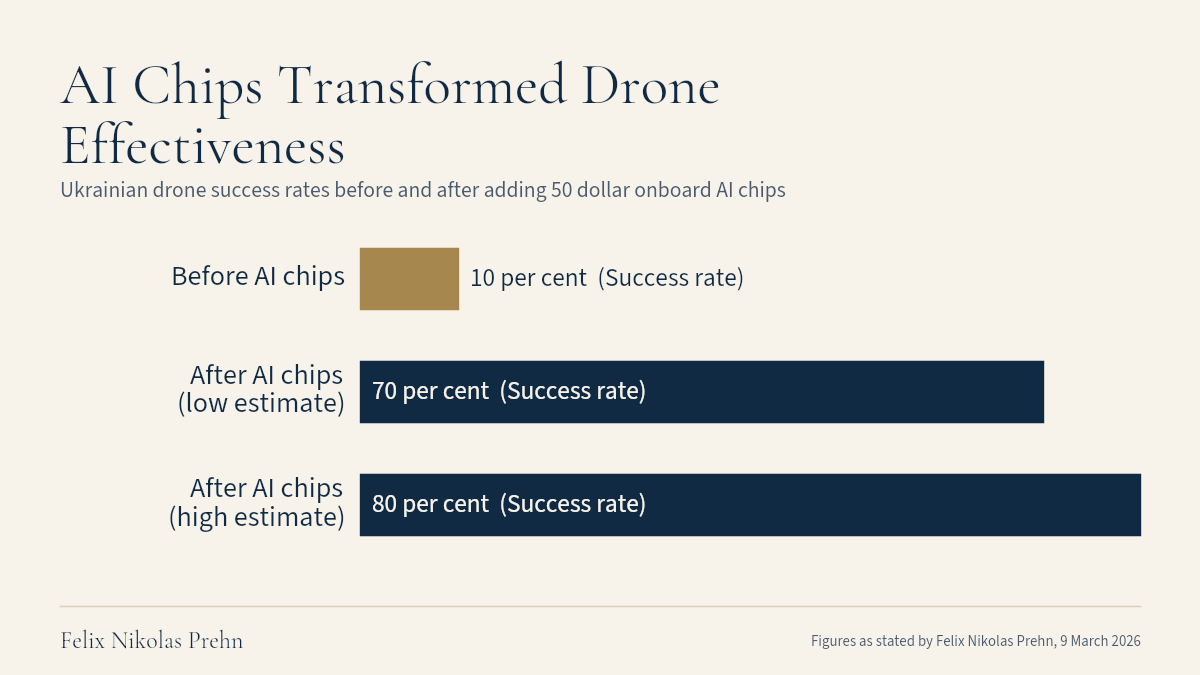
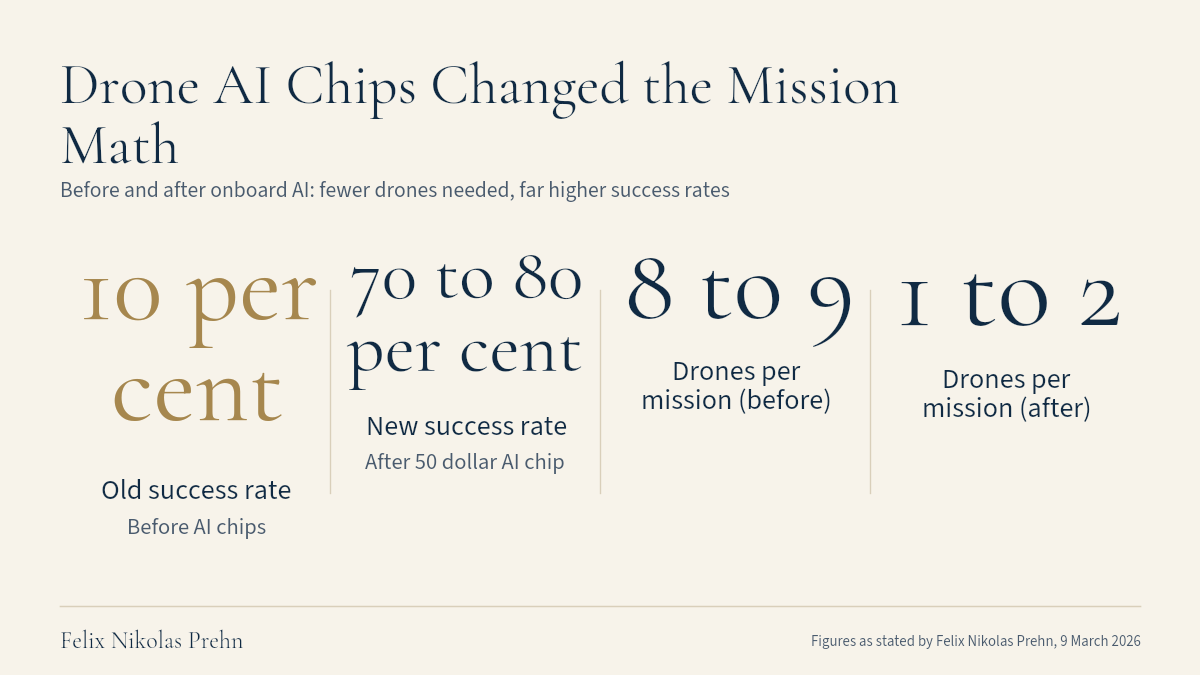
And then they added AI to these things. And we're literally talking about a $50 chip that can now recognise targets. And suddenly the success rate of these drones went from 10% to 70 or 80%. That's a complete game changer. So a mission that used to require 8 or 9 drones can now be done with 1 or just 2.
So why does that matter so much? Because if you want to understand this opportunity, you need to understand that the enemy, in this case Russia, is jamming all the drone signals constantly. So these drones lose connections to the operators. And they used to just drop out of the sky and crash or go somewhere randomly. But now the AI is on board, so the drone can independently identify its target and yes complete the mission even if no human is connected to it anymore. That sounds a little bit scary, but it's essentially the difference between a remote controlled car and a self-driving Tesla.
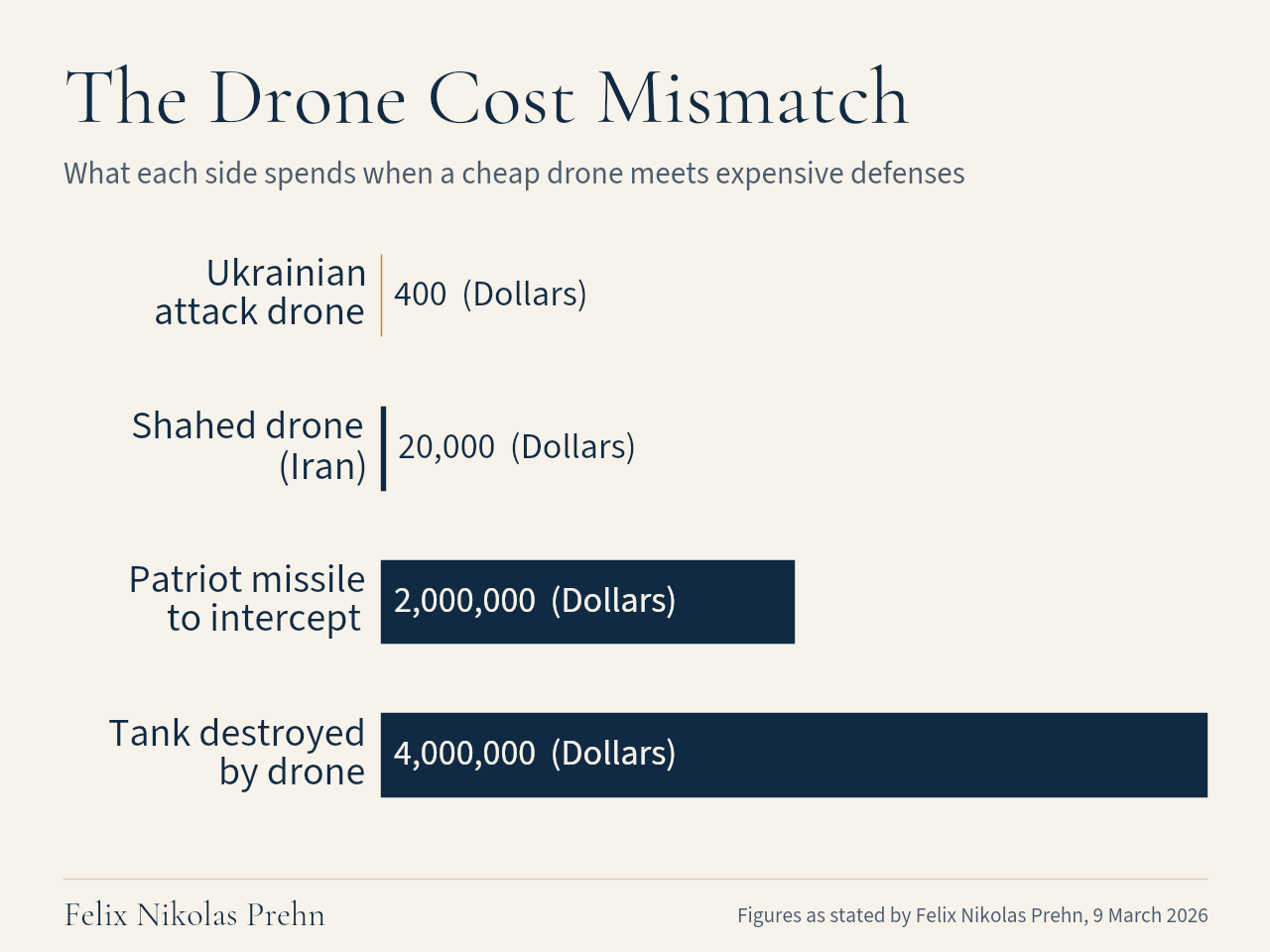
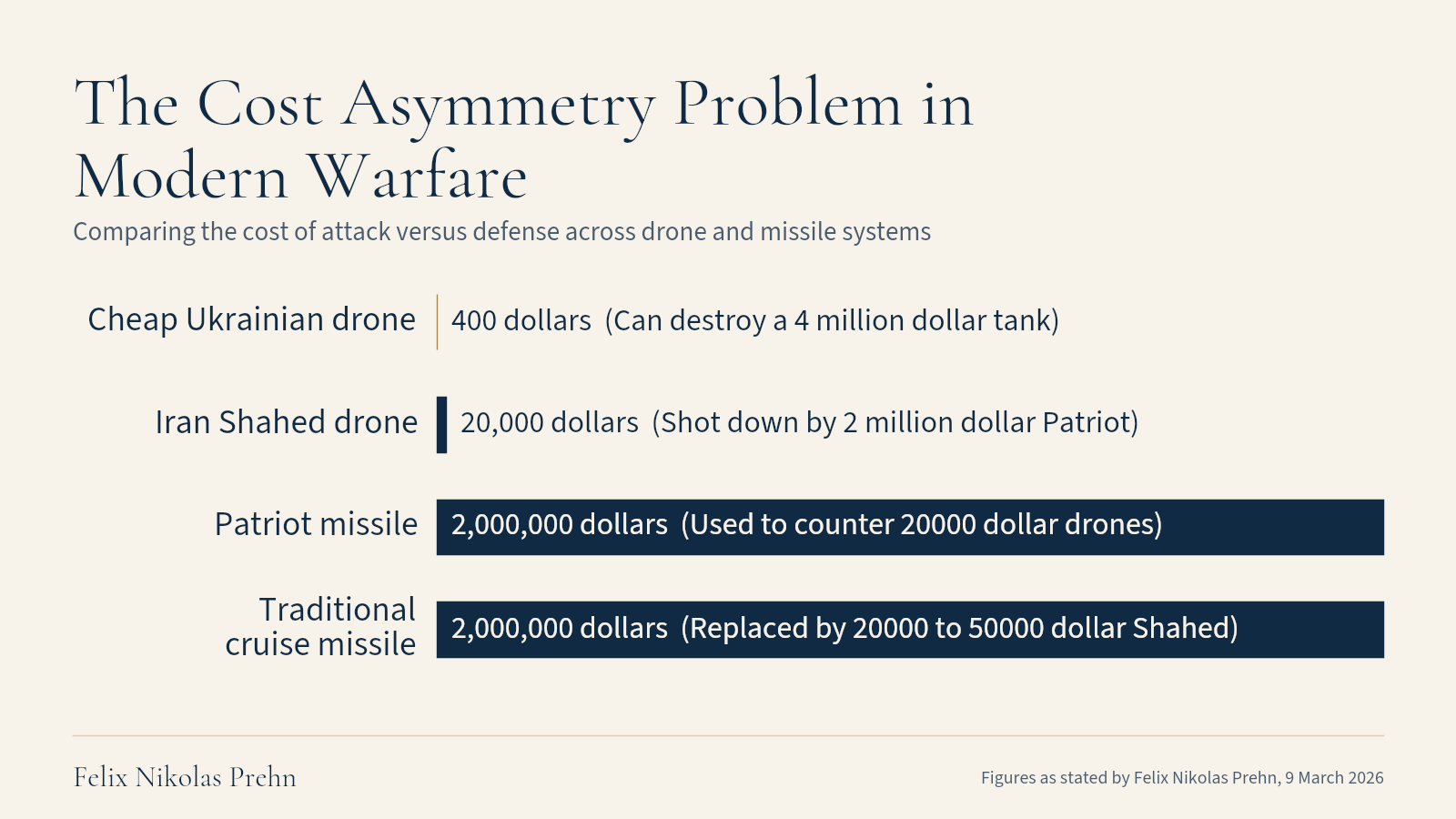
And why is this timely now? Because while Ukraine has created some incredible innovation under pressure, Iran shows us something equally important, how cheap drones are changing global power. Because Iran has built a massive drone industry and they're exporting them everywhere. Iran's got a drone that's called the Shahed drone and that's become infamous because it's basically a cheap cruise missile. It costs somewhere between $20,000 to $50,000. Compare that to a traditional cruise missile which is a couple of million.
And Russia has been buying thousands of them and it's been sending them into the Ukraine. They're not fancy, they're not high-tech, but they actually work. And when you can afford to send hundreds of them, some are going to get through. So suddenly, you no longer need a billion dollar air force anymore. It's the great equaliser.
So why does it matter for your portfolio? Because Iran's just proved to the entire world that you can wage war on the cheap. And that is terrifying for the Pentagon. And when the Pentagon gets terrified, they spend money, lots of it, because they have unlimited money because they can just print it. So what do they spend money on? Well, counter drone systems, own drone programmes, and everything needed to maintain the US edge.
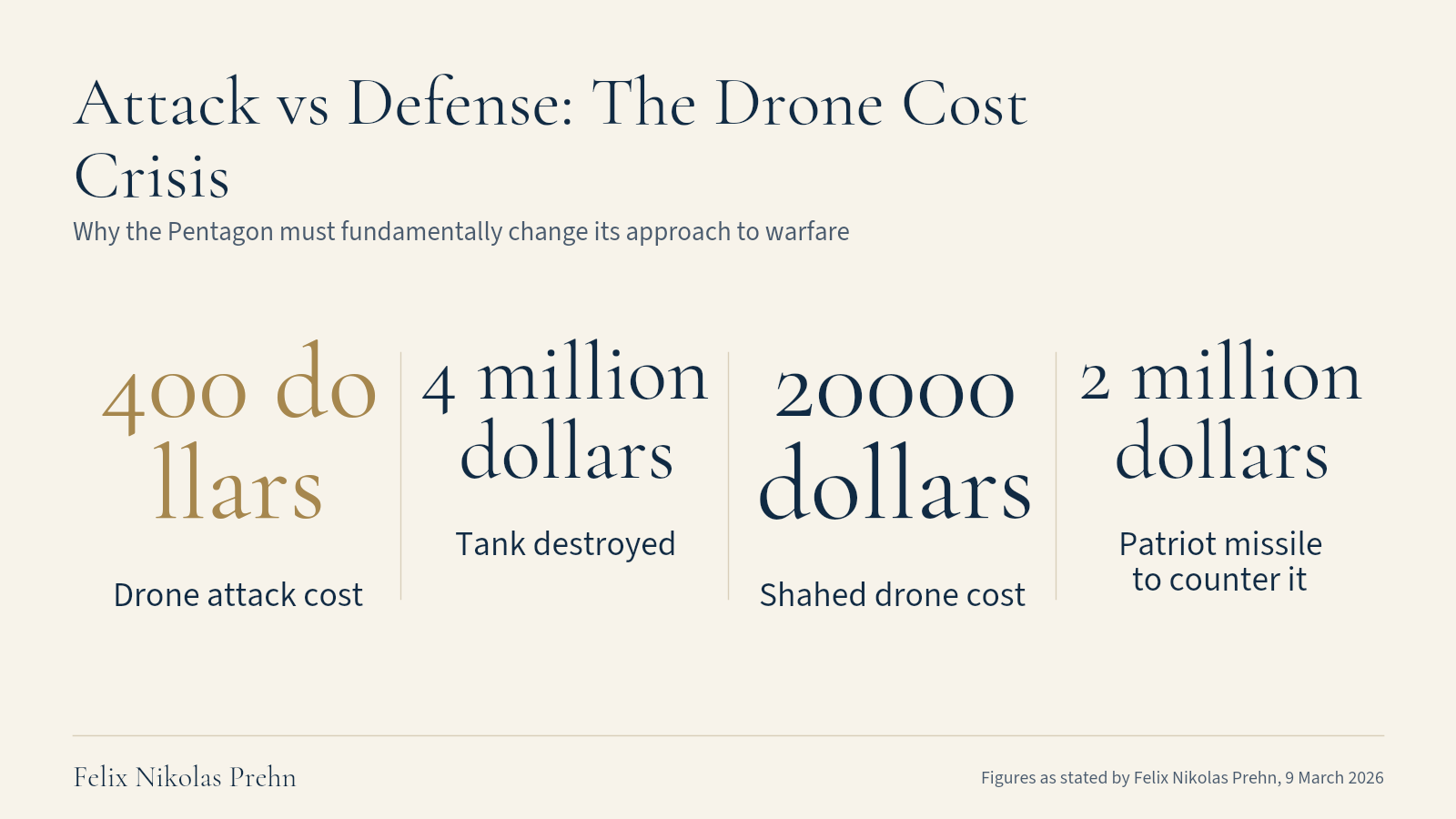
Because there is a maths problem here. The US has a fundamental problem. You can take a $400 drone, one of those cheap jobs out of the Ukraine, and that will destroy a $4 million tank. And if you want to down one of the Shahed drones, which cost about $20,000, at the moment the US is firing $2 million Patriot missiles to shoot one down. So you do that maths 100 times and you're kind of broke.
So think of it like this. Imagine you're playing a video game where every time your opponent shoots at you, it costs them a quarter, but every time you defend yourself, it costs you $100. How long can you keep playing? That's essentially the game we're in. Except it isn't a game, it is a real war and people are actually being affected by this.
But the expensive tanks and ships are suddenly vulnerable to swarms of cheap drones. An aircraft carrier costs what, $10 to $15 billion. Well, if you send 100 of these Shahed drones at it, how much money have you spent? You add two zeros to this, so you get to $2 million. So maybe with $2 million you can do some serious damage to a $15 billion piece of equipment. That's the crazy part.
Now, the Pentagon has a phrase for this. It's called unfavourable cost exchange ratio. What it really means is we need to change our approach to warfare and this creates a massive investment opportunity, not just in defence but also on the civilian side.
Now, before we go into the actual stocks and ETFs and everything else, if you want to learn how to pick the more likely winners in this tech revolution that we're in, and quite frankly in any tech revolution, and at any moment whether there's a war or not, if you want to learn Wall Street's rules for picking these stocks and how to spot what Wall Street has started to buy so you can get in on the wave earlier rather than later, which is typically what retail investors do, right, we typically buy the top. Wall Street has a framework for that, it's a 3-step framework.
Be super happy to teach it to you and I'll do that this coming weekend. So if you sign up for felixfriends.org/training I'll deliver you a free training, it'll be about an hour and a half, maybe 2 hours long, and I'll teach you the actual rules that I learned from my Wall Street mentors. It's free of charge and it's going to be tremendous fun. It'll be live, you got to show up for yourself. So check out the link down below.
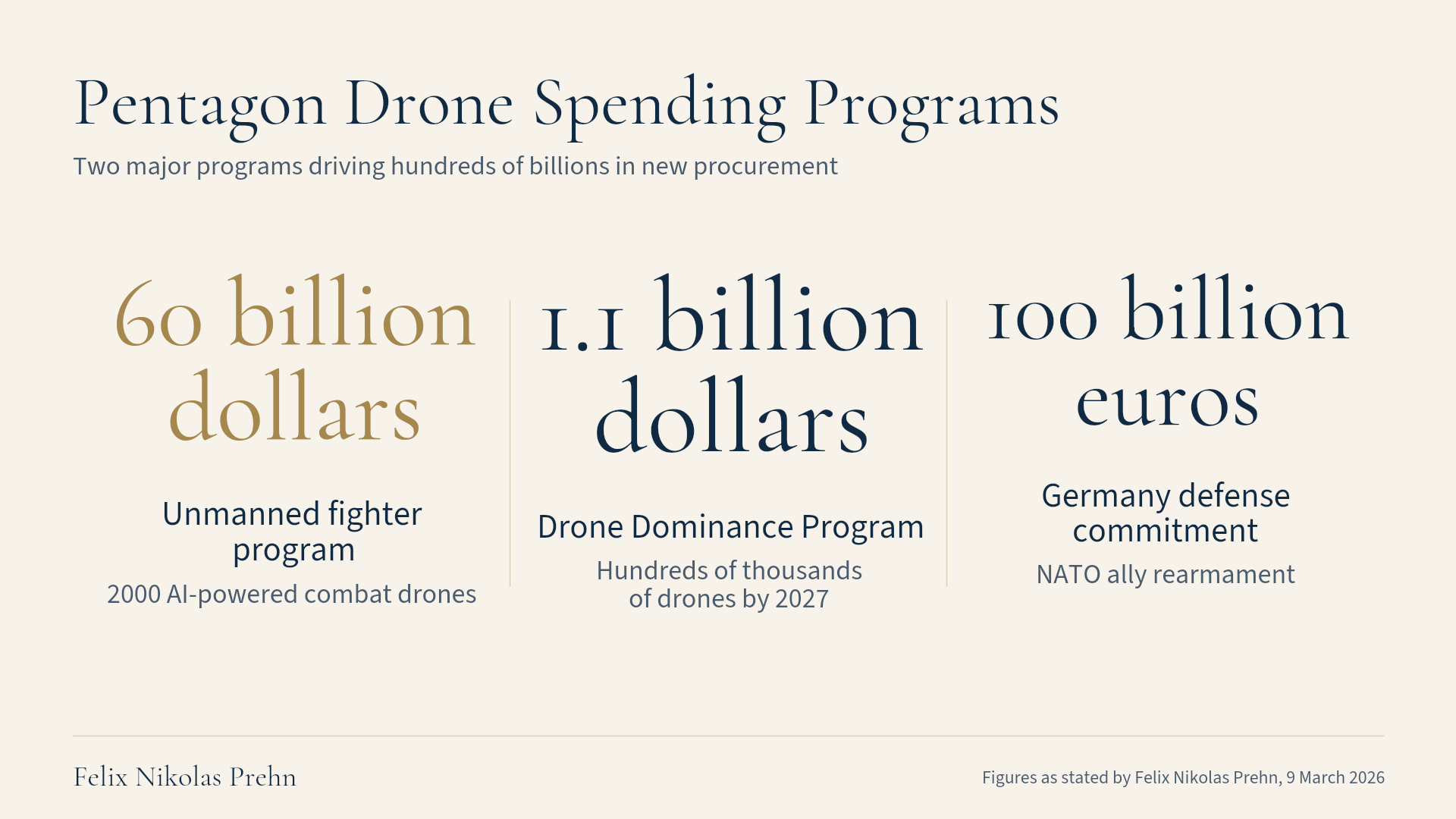
So the opportunity is this. The US government is spending in what they call a high and a low strategy. What does that mean? High means super sophisticated expensive unmanned systems like the Air Force's combat aircraft programme. They are going to spend $60 billion on 2,000 drones, essentially fighter aircraft with no pilot inside. And these are the super AI powered jets and they're going to fly alongside human pilots taking on the dangerous stuff so the pilots don't have to. That's the high end. Just think about that, just $60 billion on one programme.
And then on the low end, and that's actually where I think it gets most interesting for us investors, they're going to buy massive quantities of cheap disposable drones. Basically they're like ammunition. And there are two programmes I think you need to be aware of. The first is called the Replicator programme and the second is called the Drone Dominance Programme, DDP.
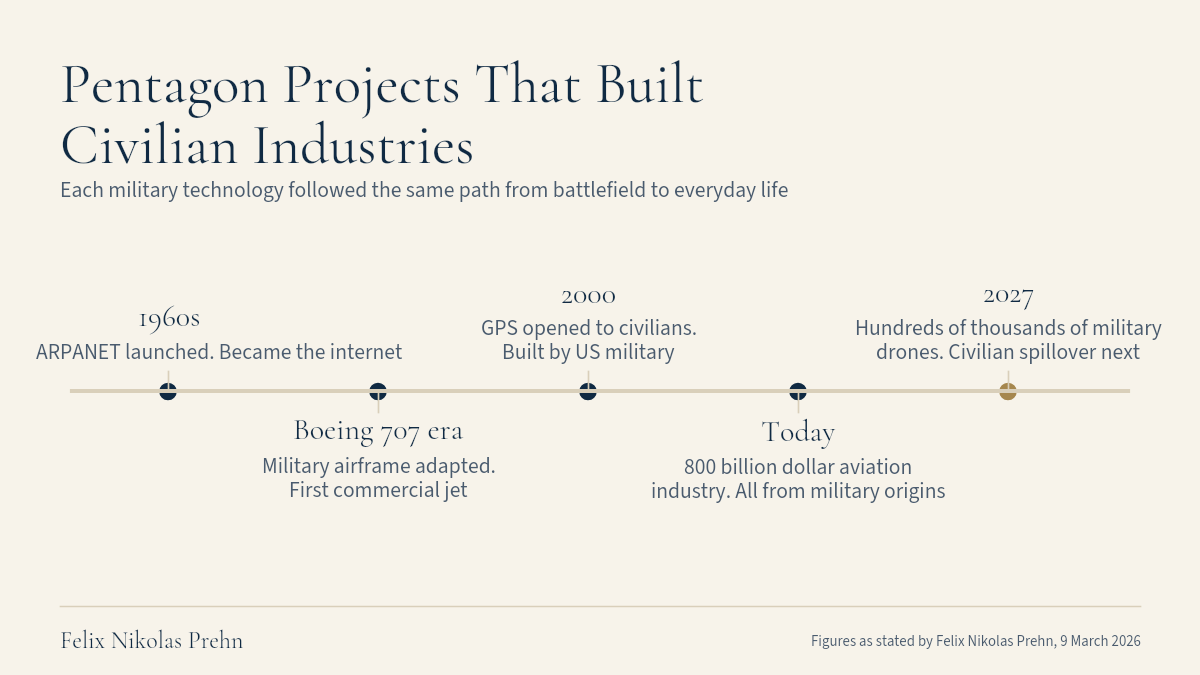
And the Drone Dominance Programme has a budget of about $1.1 billion right now, very likely to explode in the coming weeks. And the point here is to bring hundreds of thousands of low-cost weaponised drones into service. Not by 2035, no, by 2027, next year, hundreds of thousands.
So the Secretary of Defense has literally issued a memo reclassifying small drones as consumables, which means we're going to order these things like office supplies. And that means for the companies supplying them, it is recurring revenue that's going to continue basically forever after. And this is happening now, not in the future. The contracts are being awarded right now and production is being ramped up right now.
The train is leaving the station. The wave is building up and most people have got no idea this is going on. They're just thinking, "Oh, the market's down a bit because of oil prices, there's no opportunity out there." And even worse, most people don't understand this. There is something called Section 1709 of the National Defence Authorisation Act, which sounds boring, right, government jargon, but stick with me.
This is really important. This law essentially bans foreign manufactured drones from being used by the US military. So the competition, particularly DJI, which have a 70% share of the commercial drone market, which is a Chinese company, they are banned. And in investing we call that a regulatory moat. It is the government guaranteeing you that there will be no pesky competition from bloody foreigners like myself. And that means companies like Red Cat, Aero Environment, Skydio, and others we'll discuss just got handed a massive competitive advantage.
So we have an entire market worth tens of billions of dollars. It's reserved for a handful of American companies. If you want to keep track of what's actually going on out there, we have a community with this Intel dashboard. You can see live what's happening around the world. Literally it updates every few minutes. You can also see live what's happening in the critical places in the world like in this case the Strait of Hormuz, but you could also see the Red Sea and all the other key parts of the world because that's really important to understand what's going on.
Look at that. There's no ships, no boats, nothing, right? Which is just crazy. And in the Strait of Hormuz as I'm recording this, you have this massive pileup of tankers here. You can click on these. You can see that they're tankers, right? LPG tankers and so on and they're just sitting there. They're terrified to go around because they think they might get sunk and that's what's causing a big issue in the world, but it'll just keep you better informed.
And the other part of our community is we also put out research reports every 2 weeks. And these are institutional grade research reports. They're like 30, 40, 50, 60 pages long. And maybe you're thinking, I don't want to buy these individual stocks, maybe they're risky. So we also have a section in there, for example, with ETF options, but also just fundamentally a tremendous amount of research that of course Winston does down here because he's the hard worker around here. So you can check that out. It's about $6 a week or something. You can cancel it at any time. We bill it monthly, but you can just quit if you don't like it. No questions asked. It's just there for the taking.
But once you understand the US story and you understand the opportunity and then you're thinking, hang on, what about the Europeans? What about the snow Mexicans? Sorry, Canadians. NATO, right? NATO allies. They're watching what's happening in Ukraine. They're terrified. Russian drones have actually crossed into NATO airspace, into Poland, into Romania, and the Europeans are like, we don't know what to do about this.
So the European nations have increased their defence spending massively. The Germans alone have committed a €100 billion, my fellow compatriots. And it's always lovely when the Germans rearm. Never nothing untoward happened when the Germans have a strong military. But the UK, France, Poland, they're all ramping this up. And what are they buying? Drones. Counter drone systems. All the same technology we've been talking about.
And guess what? Where are they going to buy it from? Well, yes, some European companies, but they're also going to end up buying a lot of American equipment. Why? Because that's what NATO is. NATO is like 70% the US, right? And 30% the little guys, the Europeans, the French. So the Pentagon spending billions on new drone programmes, NATO allies are opening their wallets, and that's all a tailwind for these particular American companies.
If you think this is an opportunity worth looking at, just put opportunity in the chat. That's hard to spell. Just put an op in there. And you and me will know what you're talking about if you get that musical reference. That's also very special. You should put that in the comments too.
But before I give you my 3-step investment framework and how to invest in these stocks, I want to share something that most investors completely miss, and it's probably the most important part of this entire video. Military technology does not stay military. It spills over into civilian life and it creates new industries and it does that again and again and again.
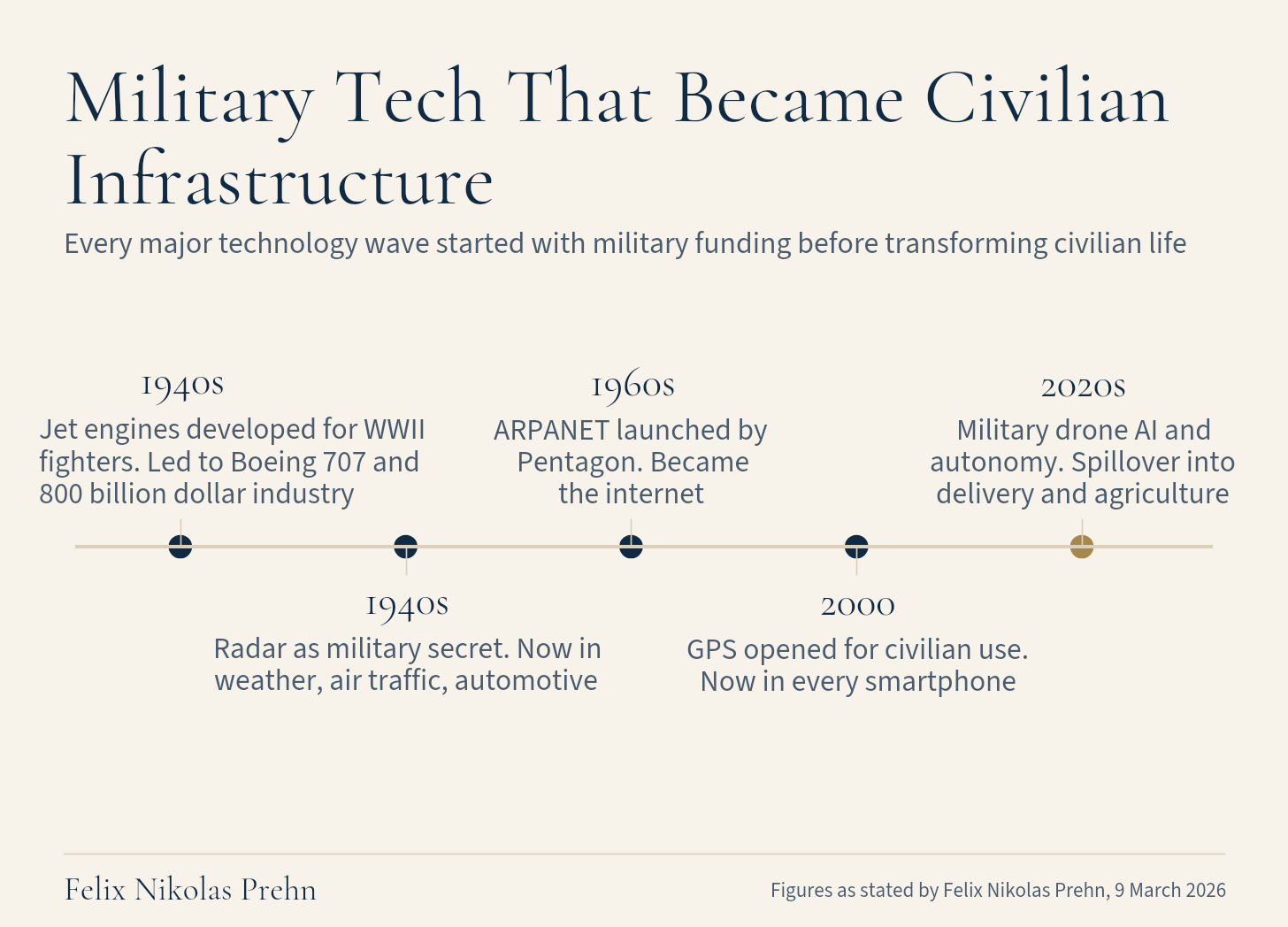
The most obvious example is the internet. Do you use the internet? Well, you wouldn't be here if you didn't. The internet started as ARPANET, a Pentagon project designed in the 60s to maintain communications during a nuclear war. Military funded it, developed it, they proved it worked, and then it went civilian and it created, well, Amazon, Google, Netflix, social media, trillions of dollars in market value, all built on military funded technology.
GPS is another example. The Global Positioning System was built by the US military for precision targeting and navigation. It cost billions of taxpayer dollars to develop and launch all their satellites. And then in 2000, the government opened it up for civilian use. Now GPS is in every smartphone, every delivery truck, Uber, DoorDash, Google Maps. None of these would exist without military GPS.
However, we go back a little bit further. Jet engines. You've been on an aeroplane lately. There's usually a jet engine on the outside and they were developed for military fighters in World War II. Within a decade, they revolutionised civilian aviation. The Boeing 707 was the first commercial jet, right, which was directly derived from a military aircraft. Now today there is an $800 billion commercial aviation industry that runs on technology that started by the military.
And I could go on. Radar, for example, was a military secret in World War II. It helped to win the Battle of Britain as my compatriots call it. And it was then used in weather forecasting, air traffic control, automotive collision avoidance and the sensors in home security systems and everything else. And we're watching the exact same pattern unfold right now with drones and robotics technology. The military is funding massive R&D. They're proving what works in the most demanding conditions possible, right? In the bloody desert, in the heat, and things are getting blown up. And then the technology is going to spill over into civilian markets.
Autonomous navigation, we're seeing that autonomous navigation is of course being developed for military drones. The AI can fly them, right? Without GPS, it'll avoid obstacles. It'll reach the target. And that's going to power delivery drones, agricultural drones, inspection drones. Amazon, Walmart, UPS, they're all racing to build drone delivery networks. And they need the technology the military is funding right now.
Computer vision, AI targeting have massive civilian applications. They're going to be used to inspect power lines, pipelines. They'll monitor crops for farmers. They'll help the autonomous vehicles navigate the city streets. So battle tested AI will be driving your car. And I could go on about swarms of drones. Of course, that's going to be how the delivery systems will work because they're going there, swarms, right? And whether that's harvesting, search and rescue, logistics, all that stuff.
So the companies that are winning military contracts today, they will also dominate civilian markets tomorrow. So here's what we do. We follow the contract trail. Who's getting the US government contracts? We then invest either in those companies or the companies that make it possible for those drones to be built. So we can go a step below in terms of supply chain. And of course, we need to understand the risk. There is risk with everything. I'm not a registered financial adviser or anything like that. So you have to come to your own conclusions.
But let me give you a couple of specific examples of this dual use potential. Military now, civilian next. There's a company called Aero Environment. AVAV is the ticker symbol. And they don't just make military drones. They partnered with NASA on the Mars Ingenuity helicopter. So they're developing high altitude solar drones for telecommunications.
You have another company that's called Teledyne. You might want to write these down. Some of these also in the research that's in the community. They make sensors that are used by firefighters, search and rescue teams, building inspectors, not just the military. So most investors look at these companies and think, oh, defence stocks, okay. But they're missing the bigger picture. The technology that these companies are building and the government is paying for that R&D, they have massive civilian market potential.
Now, I mention AVAV because they're the blue chip of the drone stocks. They're dominant in small drones and they're battle proven in Ukraine. So the government keeps ordering more. Secondly, we have KTOS, Kratos Defense. They're the poster child for the mass thesis we're talking about. They built a jet powered combat drone that costs a fraction of a manned fighter jet and the Marines have selected it for their programmes. So if the Pentagon is serious about buying thousands of cheap combat drones, Kratos again is positioned to deliver.
We also have Red Cat, RCAT. It's a smaller company that has won a huge contract. They secured the army's short range reconnaissance programme with something called the Black Widow drone system. Sounds friendly, doesn't it? And it's a consumable drone, right? So the Pentagon wants to buy massive quantities of these. And they're selecting small companies because they believe the small companies can build these faster than if they gave the money to Boeing, who's going to be like, yeah, in 15 years we'll deliver you some drones, they'll probably be 300% over budget, but that's okay, is it? Which is how the world used to run.
But let me give you 1 or 2 bonus tickers as well. There's a company called AIRO, a bit of a newer player. Again, proven technology. They have a drone that's actually been used in combat and they're integrating Ukrainian drone production knowledge into that. They're smaller, definitely riskier, but they're in the game. So what I'm saying to you here is look for companies that already have contracts.
Second, we invest in picks and shovels. And you probably heard the analogy before, right? It's a perfect analogy. During the gold rush, some people got rich mining gold. But you
Know who got rich? No matter who found the gold, the people selling the pickaxes and the shovels, they won regardless of which of the thousand people struck rich. So they just had the lower risk business model. And every drone needs what? Sensors, AI, software and components.
So these are the enabler companies and they win regardless of which drone platform gets all the contracts, regardless of which gets the dominant market position. So we can invest in the brains, the eyes and the nervous system of drones. So I'm going to give you some key companies here.
Number one, Palantir. You've heard of these guys, right? They're the AI and software backbone of the Pentagon. Their platforms are embedded in all military targeting, data analysis. Every time the military wants to make drones smarter, Palantir software is part of that. They're not a drone company. They're the intelligent data AI layer that makes the drones effective.
So that's number one. Second is Teledyne, TDY. I mentioned them briefly earlier. And they make thermal imaging sensors that are basically in every military drone. So when a drone needs to see in the dark, identify heat signatures or track targets, it's probably using their technology. They are the eyes.
And then we have LTRX, less well known. It's called Lantronix. Smaller, more specialised company. They supply embedded computing solutions. Those are the actual chips and modules that go into the drones that are supplier to the army's. So when Red Cat delivers those drones, Lantronix components are inside those drones.
So if you want less risk, quite frankly don't try to pick the winning drone, pick a shovel. And then I always come back to risk because that's ultimately the key to it all. Not all drone investments will carry the same risk. You need to match your risk tolerance to the right level of investment in this ecosystem.
So the lower risk tier are the big defence companies. Think Boeing, Northrop Grumman, Theron. These are massive companies. They have years worth of backlog of government orders and drones are just a part of their business. They're not going to 10x, but they're also not going to get a zero. So if you want exposure to the theme of drones but you want less risk, they are probably your tier.
The mid tier is your pure plays. AeroVironment, Kratos, Palantir, the companies that are basically directly in the drone game. They have proven contracts, established track records, but they're going to be more volatile. There's going to be more up and down than the big boys.
And then the really high risk tier are your small caps. Think Red Cat, AIRO, Lantronix. They have potentially massive opportunities to 10x or something, but they also have a dependency on one customer. So if their contract gets delayed or cancelled, the stock can absolutely crater. So only put money here that you can afford to lose.
And then of course we also have ETF options that give you some of that. And again, I put that into the research document. If you join the community there, it's about $6 a month. I think it's $6.23 a week. Then you can of course cancel anytime and you also get access to a ton of stuff including our Intel feed. So you can actually see what's going on out there, and a ton of other incredibly useful bits of research and news.
But honestly, what I'm most excited about, it's not the military drones, it's this, the civilian spillover. You are going to be seeing in the next few years drones everywhere. Drones doing everything. First all the dangerous stuff, then the really heavy lifting stuff and then ultimately Amazon, yes, will deliver to your window within 5 minutes of you ordering something. That is the brave new world we're going to live in.
There used to be a movie in the 90s. What was that? And everyone was sci-fi flying around in these cities on different levels and stuff. What was that called? If you remember that movie, please put it in the comments down below. I can't think of it and I'd like to rewatch it. It was very good. Can't remember who was in it, but it was very good. Helpful, right? Really narrowed it down there.
We're going to see that this is going to create trillions of dollars in value and it's going to create trillion dollar companies that we haven't even really thought about yet. And that's why I'm going to be following this sector and I'm going to spend more time on researching this sector. I'm going to keep you guys informed of it.
If you wish, we'll keep posting new research into the community as well. And if you want me to keep covering this because you see the opportunity as well, then let me know. Just put a "keep covering it" into the comments down below and I will see if there is enough popular demand for this.
But in a nutshell, drones have changed warfare. The Pentagon desperately needs cheap drones, desperately needs high-end drones that can do stuff that's just too dangerous to do. The Pentagon is spending hundreds of billions of dollars on this. This is just a guaranteed customer and US companies are going to capture all of it. So it really narrows down where we need to look. Here's the watch list again. Take a screenshot of that if you haven't already.
And sign up for the free training because it'll teach you not just how to pick your own stock, but it'll teach you how to pick all stocks and that happens on the weekend at felix.org/training. You got to sign up for that. You got to be on time and we're going to have a blast.
I love you for watching. If you got some value out of this, share it with a friend or a fellow golden retriever who might need some information and we're going to round it up with some Winston wisdom. Aren't we, Winston? Winston, come on here. Come on.
What's your final bit of advice, Winston? To potential drone investors? Sit down. Sit down. Sit down. Right here. Let's hear it. Let's hear it.
To keep things close to his chest, isn't he? We've already done all the research. It's all in the community. Go check it out. And we say thank you for watching. We wish you a beautiful and safe year ahead.
Take care. This metal is set to explode. And no, it's not gold. It is not silver. Everyone's arguing about gold being overextended and whether they missed silver, whether it's manipulated with AI.