
The Battlefield Laboratory
Ukrainian engineers turned hobbyist drones costing around 1000 dollars into precision weapons. The addition was a 50 dollar AI chip capable of recognising targets.
In Felix's view, that chip raised drone success rates from 10 per cent to 70 or 80 per cent. A mission that used to require 8 or 9 drones can now be completed with 1 or 2.
The improvement matters because of electronic warfare, as Russia consistently jams drone signals. Drones that lost their connection to operators used to crash or drift off course.
AI on board lets a drone identify its target independently. It can complete the mission even without a human connection.
Ukraine has become a live testing ground for drone warfare. The US armed forces are closely observing its rapid adaptation.
Iran illustrates a different point about the economics of drone warfare. The Shahed drone runs between 20000 and 50000 dollars. A traditional cruise missile carries a price tag of a couple of million.
Russia has purchased Shaheds and launched hundreds into Ukraine. The drones are not sophisticated, but volume compensates.
When large salvos are launched at once, some will get through. Iran and the United States are the world's largest drone exporters. Iran's cheap production model has spread rapidly.
Felix argues that Iran proved to the world that war can be waged on the cheap. Cheap warfare alarmed the Pentagon.
The response has been a large increase in defence spending. The expenditure is underwritten by sovereign currency issuance.
The Cost Asymmetry Problem
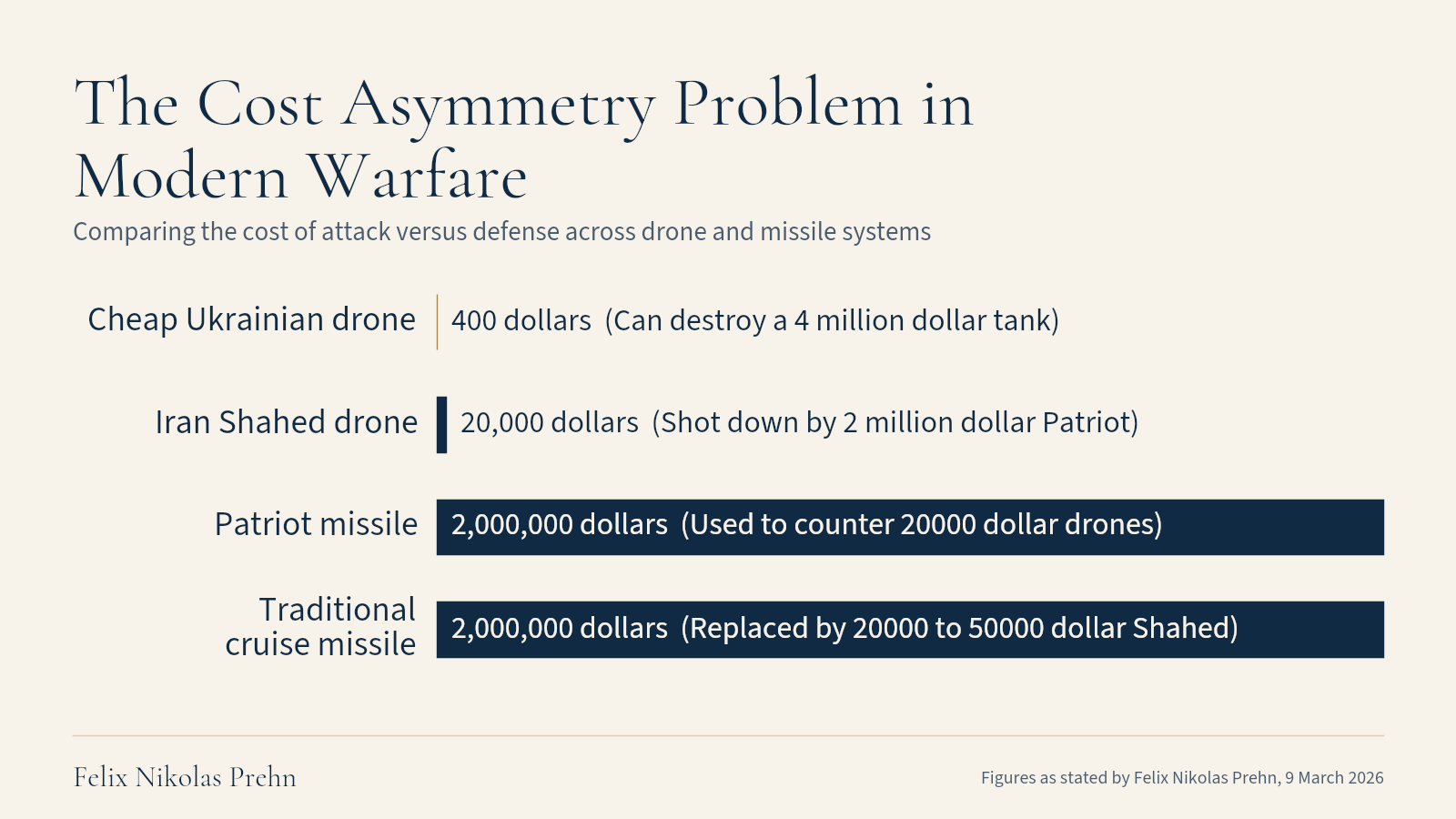
The cost gap between attacker and defender is wide. Felix argues that a 400 dollar drone from Ukraine can destroy a 4 million dollar tank.
Felix argues the US fires a 2 million dollar Patriot missile per intercept. The target is a single 20000 dollar Shahed drone. Over dozens of engagements, the bill on the defending side accumulates far faster.
The Pentagon calls this an unfavourable cost exchange ratio. Tanks, ships and interceptor missiles are losing their value against cheap drones sent in volume.
Felix argues that the mismatch forces a change in approach to warfare. Expensive manned platforms cannot survive when an attacker spends hundreds of dollars per sortie.
Each intercept costs 100 times the weapon it destroys. The Pentagon recognised the disparity and began spending accordingly.
The Market Opportunity
The global military drone market is set to double to 100 billion dollars. Pentagon spending reflects urgency at the high and low ends of the capability spectrum.
At the high end, Felix notes the US Air Force combat aircraft programme. It plans to spend 60 billion dollars on 2000 unmanned fighter drones.
Headlines confirm the Pentagon is building up drone capabilities. Some observers describe the starting point as close to zero for cheap drones.
At the low end, the Drone Dominance Programme has a current budget of about 1.1 billion dollars. Its goal is to bring hundreds of thousands of low-cost weaponised drones into service by 2027.
The Secretary of Defense issued a memo reclassifying small drones as consumables. They will be ordered like office supplies.
The reclassification converts one-off contracts into recurring revenue. The memo sets no end date for the programme.
Production is being ramped up and contracts are being awarded in the current cycle. Temporary funding measures could delay some new military programmes.
Regulatory Moat
Section 1709 of the National Defense Authorization Act bans foreign-manufactured drones from use by the US military. The primary target is DJI, a Chinese company. In Felix's view, DJI commands a 70 per cent share of the commercial drone market.
The United States is also moving to restrict Chinese-made drones more broadly, citing security concerns. In investment terms, the ban functions as a regulatory moat (a government-imposed barrier that eliminates foreign competition).
Redcat, AeroVironment and Skydio gained an advantage. The legislation removed their largest competitor from the procurement process.
The ban reserves a large share of military drone procurement for a handful of American firms. Some of those firms are already receiving Pentagon loans to expand domestic production capacity.
The supply crunch created by the DJI ban has made that expansion urgent.
European Defence Spending
The spending impulse is not confined to the United States. Russian drones have crossed into NATO airspace, entering Poland and Romania.
European governments watched the conflict in Ukraine and concluded they were unprepared. In Felix's view, Germany has committed 100 billion euros to defence spending. Other European nations are increasing their budgets, and the purchases centre on drones and counter-drone systems.
European governments are funding the same categories of technology as the Pentagon. NATO is urging its defence industry to increase production and is preparing strategies involving drones and AI.
Felix argues that allied governments will buy American equipment. The United States accounts for about 70 per cent of NATO's collective defence expenditure.
American drone firms therefore stand to gain from allied procurement budgets as well as domestic ones.
Not every ally may meet higher spending targets. Defence budgets within the alliance are rising.
Drone procurement is a growing share of each.
The Civilian Spillover Pattern
The internet, GPS and jet engines all began as defence projects.
ARPANET was a 1960s Pentagon project. Its purpose was to maintain communications after a nuclear attack.
The armed forces funded development and proved the concept. The technology then moved into civilian use.
Amazon, Google, Netflix and the social media industry all run on that military-funded infrastructure. GPS was built by the Pentagon and opened for public use in 2000. It now runs logistics, ride-sharing and mapping services.
Jet engines, developed for fighters in the Second World War, reshaped civilian aviation within a decade. The 800 billion dollar commercial air travel industry runs on technology that started with the armed forces.
The Boeing 707, the first successful passenger jet, came directly from a military airframe. The armed forces are funding drone development and proving what works in combat.
The Supply Chain
The Pentagon is selecting small companies for drone contracts rather than awarding them to legacy prime contractors. Felix argues the reasoning is speed: the Pentagon believes small firms can build drones faster than a company like Boeing, which might take far longer and come in well over budget.
AeroVironment partnered with NASA on the Mars Ingenuity helicopter. The company operates in military and civilian markets simultaneously.
Redcat secured the army's short-range reconnaissance programme with the Black Widow system. The Pentagon wants to buy it in large quantities as a consumable.
Small-cap drone stocks carry concentrated risk, because they depend on a single customer. If a contract is delayed or cancelled, the share price can collapse. One lost programme can wipe out most of a firm's revenue.
An alternative investment thesis focuses on the supply chain. Every drone requires sensors, AI, software and components.
Companies that supply those parts win regardless of which drone platform secures the dominant contracts. Lantronix supplies embedded computing chips and modules that go inside Redcat's drones.
Felix describes these as 'picks-and-shovels' companies. Lantronix and firms like it supply enabling components and profit regardless of which manufacturer wins.
The drone market is set to double to 100 billion dollars, and every unit sold requires sensors, chips and software. Revenue for component suppliers grows with the fleet, not with any single contract.
Each of those defence projects spawned a civilian industry worth far more than the original programme. The Pentagon opened GPS for public use in 2000, and it now underpins ride-sharing, mapping and delivery services worldwide. Wartime jet engines gave rise to an 800 billion dollar air travel market. The armed forces fund development and prove the technology in combat. The armed forces fund development and prove what works in combat. Civilian markets then absorb the results at scale.