Transcript
Right now your retirement portfolio is being repriced. And what really pisses me off is that these guys, JP Morgan and co, they're telling and explaining to their customers exactly what's happening. They're sending out the data. They call it international market intelligence. Of course, this doesn't go out to retail investors like you and me. But I was literally just coming back from tennis and I was reading this on the way back and I thought people need to understand this.
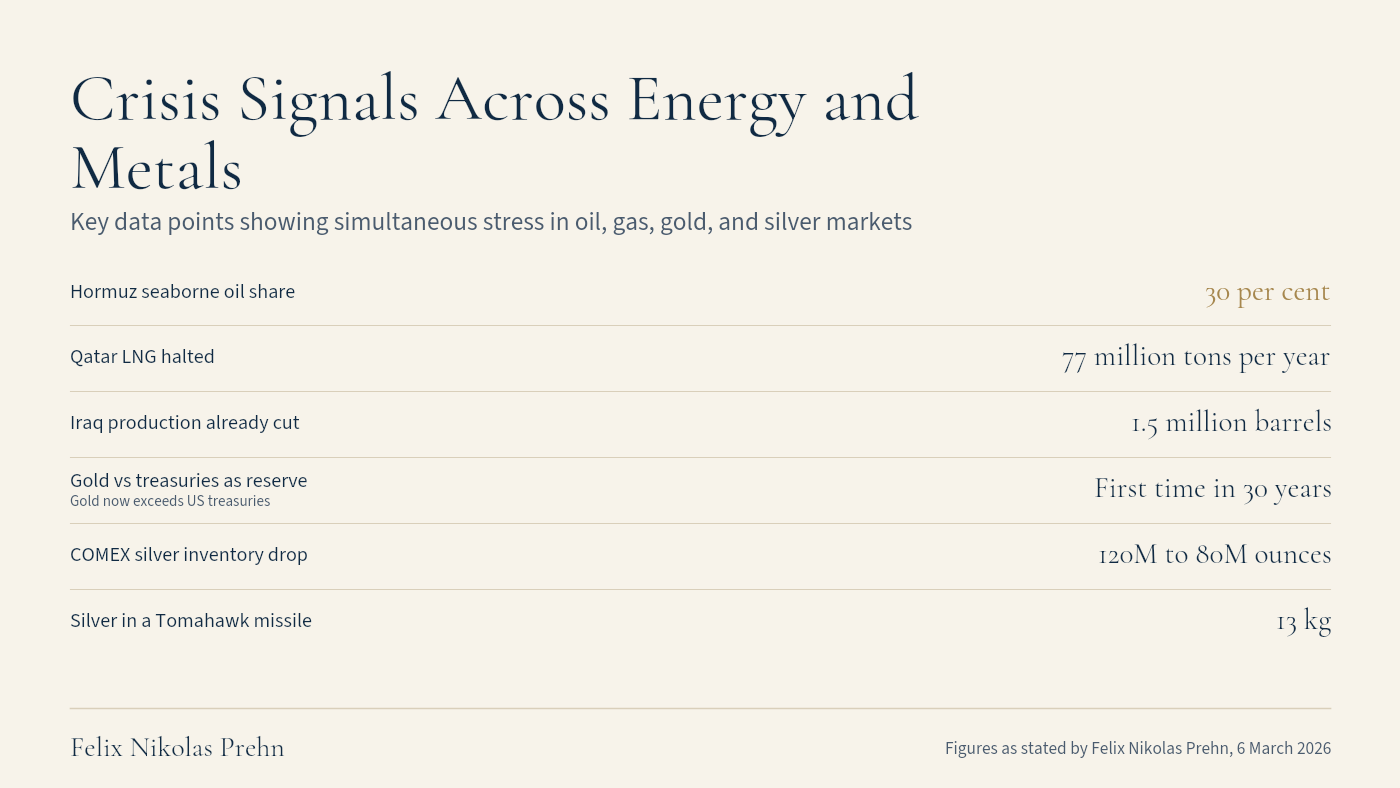
So we're making this video. We're making it quick, we're making it snappy. Winston of course has done all the research because this straight off Hormuz, where 30% of all the world's oil that travels by sea goes through, is effectively closed. And JP Morgan's report says we are 3 days away from commodity chaos. Not 100 days, months as mainstream media is saying, but 3 freaking days. And what we're witnessing here is potentially the largest wealth transfer in decades. And most retail investors are absolutely unprepared.
So the question isn't if this affects your portfolio, it's whether you'll be on the winning side or on the losing side of this event. So my promise to you is very simple. By the end of this video, you'll understand exactly what's happening, why central banks are panicking behind the scenes and governments, and the specific moves you can do and make to protect and potentially grow your wealth.
My name is Felix Prehn. Apologies for the tennis outfits. That's Winston back there with a tennis ball, very happy. And I used to be an investment banker. And we're also the founders of the Goat Academy where my retired Wall Street mentors, guys who've worked in big investment banks, run hedge funds, they teach regular investors like you. And we've taught thousands of people over the last 6 years. I'm also the co-founder of Trade Vision where we get data from and much much more.
And I'm also going to show you what's really happening here because this is the way I monitor that. And I'm going to show you also how you can get access to that if you wish. And we're going to break down for you what the smart money or the big money perhaps better described is doing and what you should consider.
The Strait of Hormuz vessel transit is basically at a standstill. You don't believe me? We literally have a tracker for that. And this is the Strait of Hormuz. You don't see any freaking vessels going through here, right? And the one or two that are maybe going to, they are cargo ships. They are not oil vessels, which is what you would expect. So on both sides of the strait, you have this big pileup of vessels here and there and there. And you can watch this live.
So actually, we're going to build this out, this intelligence kind of macro gold, silver, oil kind of intel dashboard. And this was going to be a premium thing, but I'm going to throw it in to our existing community. It's $6 a week. You can cancel anytime you like. If you go join that right now, you'll keep access to this forever at that price. And if you don't, well, you're going to pay for it more later if you wish.
But yeah, we basically keep track of really what's happening. It's live and only how it impacts mining and gold and silver and energy and oil and the military stuff that's happening around the world. And of course, it isn't just the Middle East. There are other, you can see these flash points here. They're colour coded by gold, silver, copper, what it's affecting. But of course, there is also other stuff on there. Mines in Russia, strikes around the world, blockades in Peru. This stuff actually really matters if you want to understand metals. So there's a link down below if you want to get access to that. Just check it out. If you hate it, you just cancel it. No questions asked. There's a link down below in the description.
So the official story is that transit in the Strait of Hormuz is officially or temporarily rather disrupted. But basically they're saying we have no idea how long this will last and nobody wants to risk their tankers getting blown up. Insurance got cancelled. So the JP Morgan storage countdown is this. Some countries have just days not weeks before they run out of oil and gas.
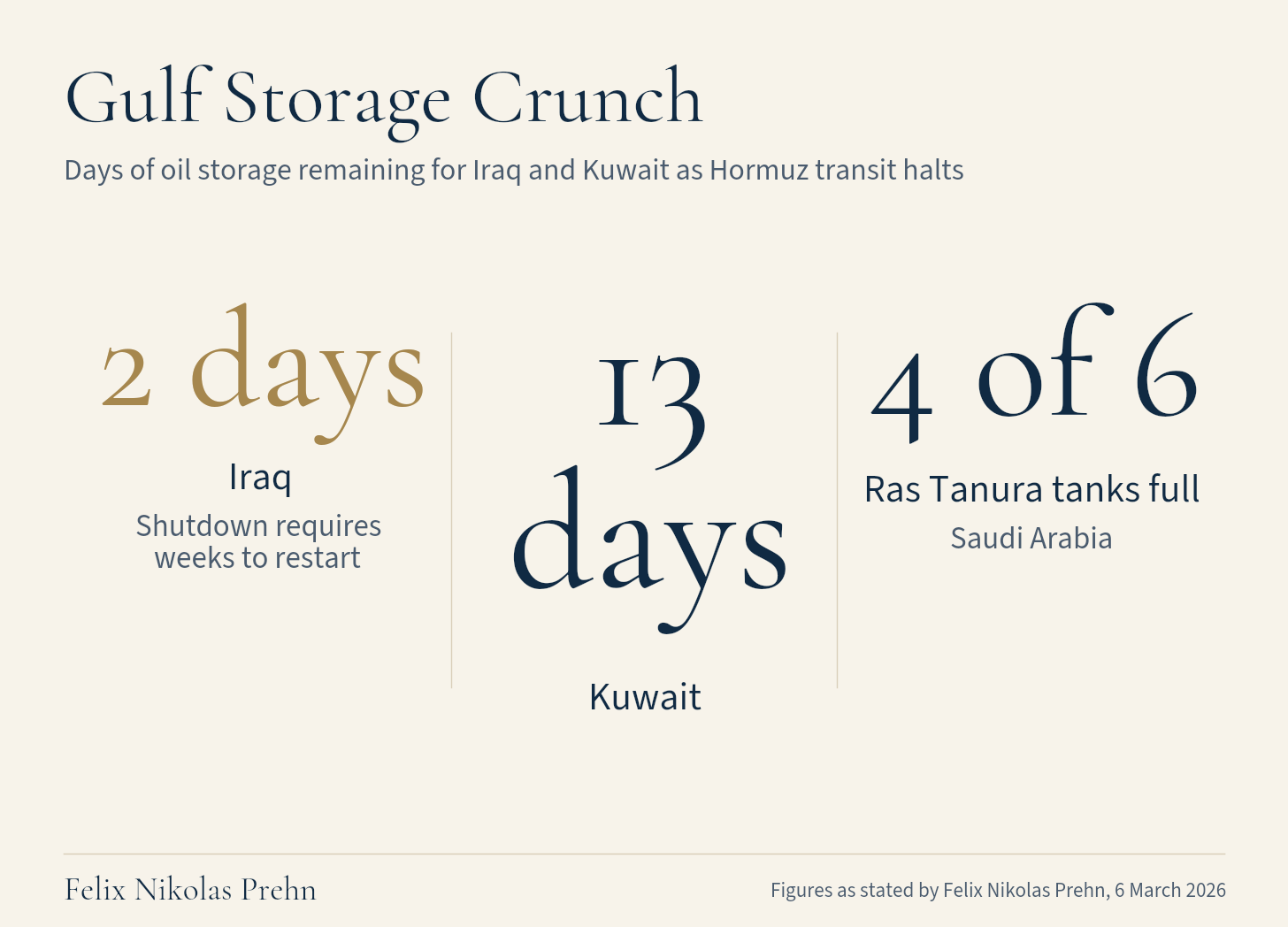
And if I give you some numbers here, Iraq has about 2 days of storage remaining. After that, they need to shut down nationwide oil production. Once you shut it down, it takes weeks to bring it back online. Kuwait about 13 days remaining. Saudi Arabia's Juaymah, I'm mispronouncing that undoubtedly, terminal is running out of capacity. 4 of the 6 tanks at the Ras Tanura refinery are full.
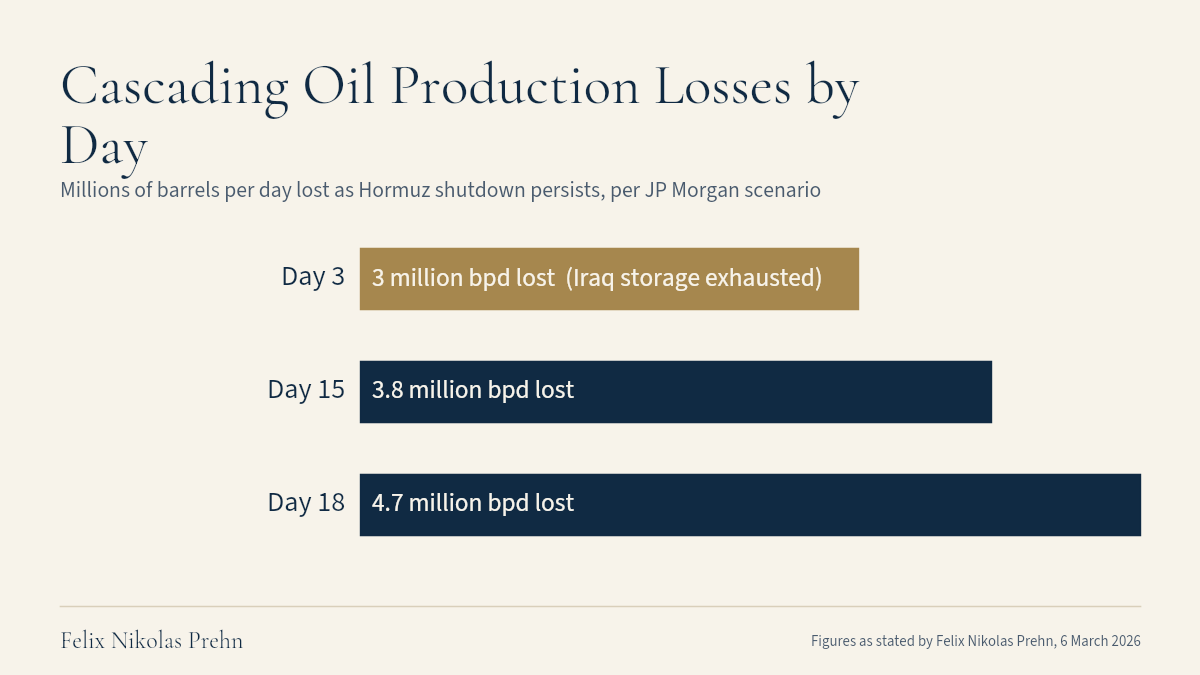
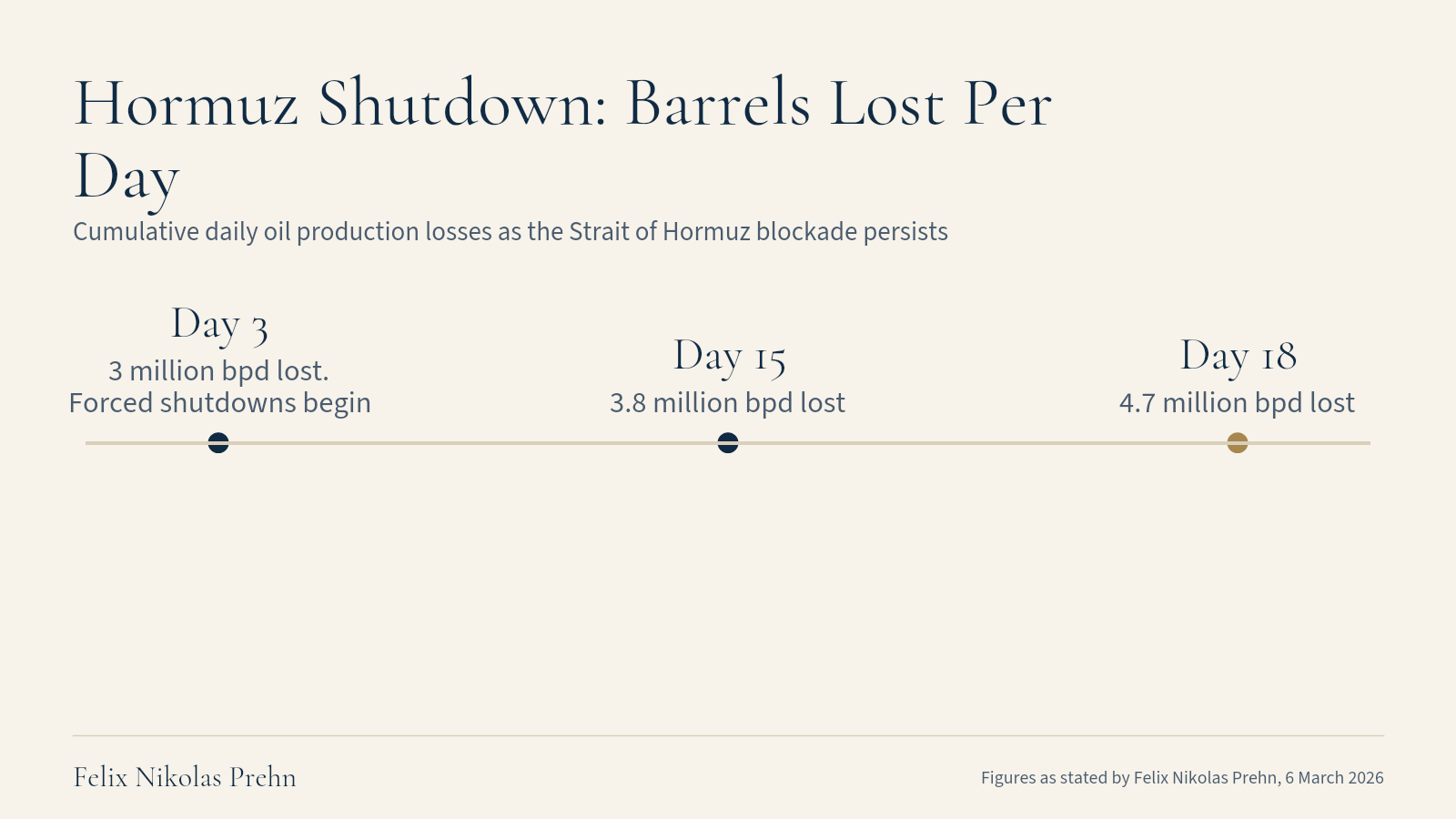
So what happens 3 days from now? We're going to get a monster forced shutdown of oil production. This is literally in 3 days because this has been going on for a few days, right? We lose 3 million barrels per day. On day 15, we lose 3.8 million barrels per day. On day 18, we lose 4.7 million barrels per day. Iraq's already cut production by 1.5 million barrels.
So let me tell you why this is a real freaking problem, which is why I'm making this video in my tennis outfit. I apologise for the scruffy, sweaty clothes. You see, demand can restart instantly when product arrives, but supply shutdowns, they take weeks to implement and weeks to undo. It's like turning off a massive industrial machine. There isn't a switch that turns it all back on.
And we're seeing more drone attacks. So this refinery here, refineries obviously matter. We're seeing drone attacks, partial shutdown looms. You're going to hear a lot about these funny names in the Middle East. The Qatar operations are halted. Halted. That is 77 million tons per year of liquefied natural gas. We have fires in the UAE's hub after drones struck stuff off the Kuwait coast. We have a tanker explosion causing an oil spill.
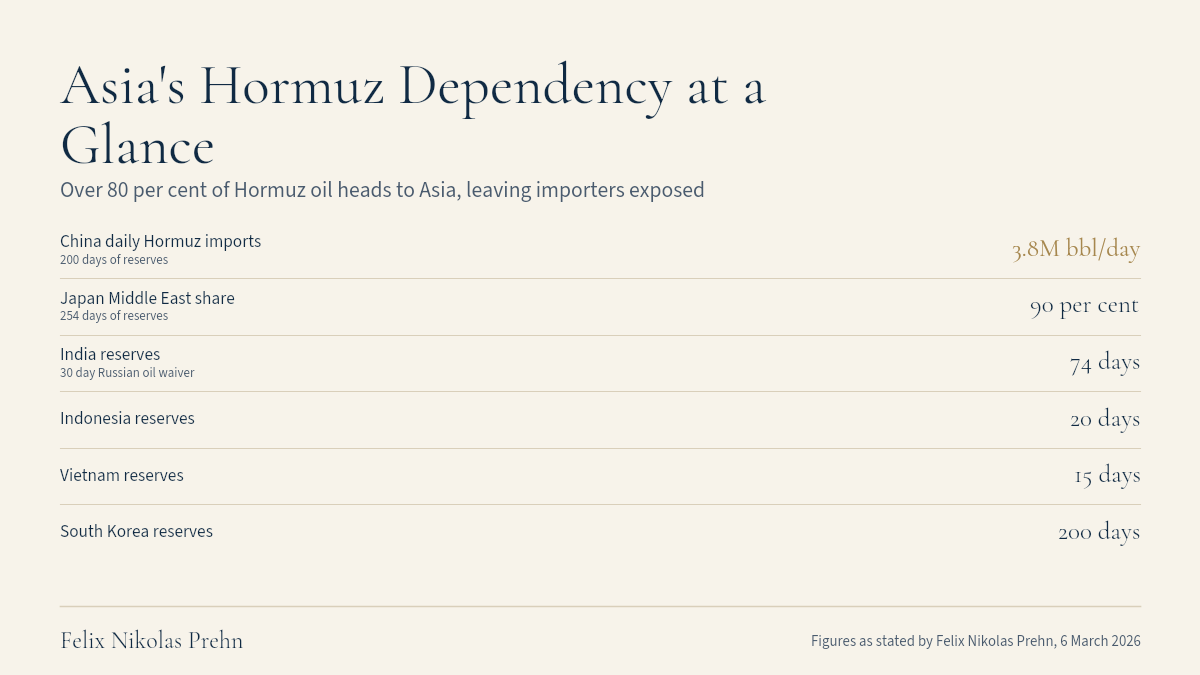
Now, if you're seeing this the way I'm presenting it to you in mainstream media, or maybe not, put an MS in the chat and I'll know what you're talking about because I don't think this is being covered appropriately. So does this affect you? Yes, but somebody else gets hit first, but it has a knock-on effect on you. Over 80% of the oil that goes through Hormuz is destined for Asia, right? China imports 3.8 million barrels per day through that strait.
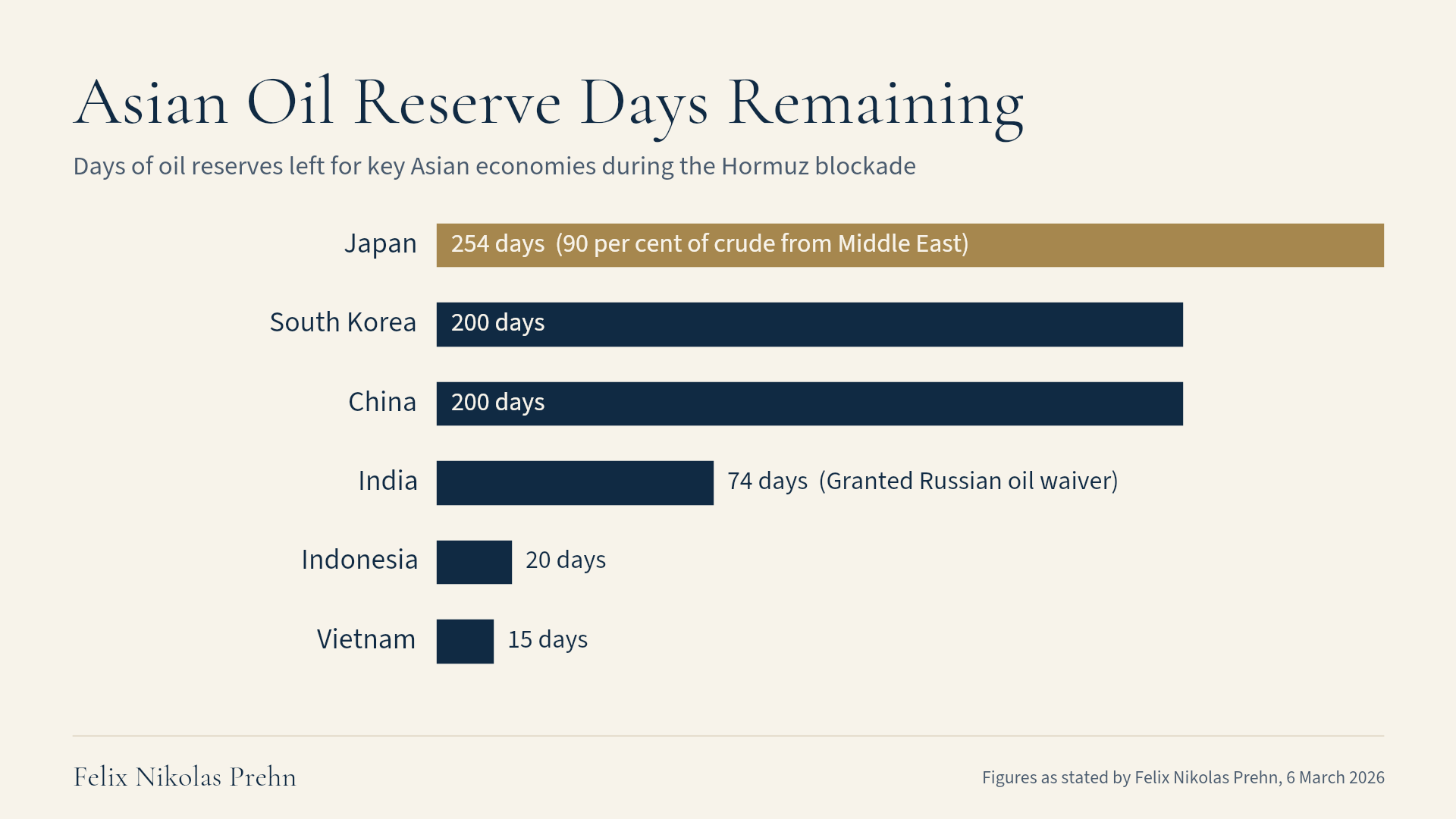
Japan has 254 days left. They are the stockpilers of the planet because in 1979 they got embargoed and they ran out of oil and gas and they really didn't like it. South Korea has about 200 days left. China has about 200 days left. India, we can add to this list, has about 74 days left.
And it's so serious that the Trump administration just gave India permission to buy Russian oil, right? Russia, the country that's fighting Ukraine and that the US is basically fighting through the Ukraine. They're saying it's okay to buy Russian oil because otherwise you guys have the lights go out and we can't have that. Right? Most Asian countries like Indonesia have only 20 days of reserves. Vietnam 15 days of reserves.
Now maybe you think it doesn't matter to you. A lot of the stuff you buy comes from countries like Indonesia and Vietnam if you're in the US or you're in Europe. And maybe you think it's going to be fine, the big countries, Japan, they've got 254 days of oil reserves. But 90% of their crude comes from the Middle East, 70% of that goes through Hormuz. So Japanese refiners, the guys who turn the crude oil into stuff you can actually use, they're already urging the government to release government reserves.
So how do these reserves actually work and why does it impact you? Well, think of it like a bathtub with the drain open. You can fill it from your reserves, but you're depleting those reserves every single day. So once reserves drop below critical thresholds, countries start competing for all the alternative suppliers and that drives up prices everywhere else including the US and Europe and everywhere else.
So the first step, and we're there, low reserve countries are panic buying from non-Gulf sources and that pulls supply from markets that the US also uses. And then you get intensified competition for those oil suppliers. The price spike causes inflation. It's going to hit your tech stocks and everything else. And then all countries at the same time start drawing from their national reserves. But that actually unsettles the market more because we're now seeing the safety buffers are getting smaller and smaller and smaller.
Let me ask you this. How many days of reserves do you think the average American household has in their gas tank at home or their home heating? Put a number. How many days or how many weeks? Put it in the comments down below. Let's see what people are thinking. This is not a doom and gloom video. This is an I'm understanding what's actually going on in the world and I'm a grownup video.
But there is a point here where if this escalates further and we get more of the storage facilities in the Gulf being full and therefore we get production shutdowns and therefore oil prices go up, there's going to come a point when you may want to sell some of your stocks because we had a pretty good 3 years, right? We had a beautiful run. We had 25%, 24%, 18% of the S&P the last 3 years. Pretty much everybody's made money. Are you going to want to watch that go down into the negative territory? Hand all those profits back to the lovelies on Wall Street. I think not.
So how do we deal with that? Well, there is a very simple set of sell rules that Wall Street has because they don't go to the office every morning going, "Should I sell? Should I? Should I do it? Should I buy the dip? Should I sell?"
"Oh my god, what's happening?" It was just the average retail and they stop. So Winston tells me, "Winston, hey, what do you think?"
If you want to learn those rules, then Winston and I are going to host a live training this weekend. It's free. And we're going to teach you the Wall Street selling rules that my mentors taught me, guys who've worked in investment banks for decades. These rules have been around for 50 plus years. They haven't changed very much to be honest. And it's what makes us sleep very well.
It's what makes us just not be worried about this because I know when certain points get hit, my automated sell orders would kick in. I don't really need to do anything. Of course, I have a great risk manager and this guy here. So you want to learn that? Sign up down below in the comments. Felixfriend.org/training. It is free. We're going to go for about 2 hours. It's on Saturday evening if you're in the US. And if you are not, elsewhere, well, maybe you want to stay up for it because it's important.
It's the one thing that allows you to realise gains, paper gains, if you're just holding it, right? At some point, you're going to want to sell stuff because stuff doesn't go up in a straight line. If you just have an S&P index fund, you can pretty much forget about selling. But there's also some smarter things you can do, but if you hold individual stocks, even if you own just one individual stock, you're going to want to have some sell rules on that.
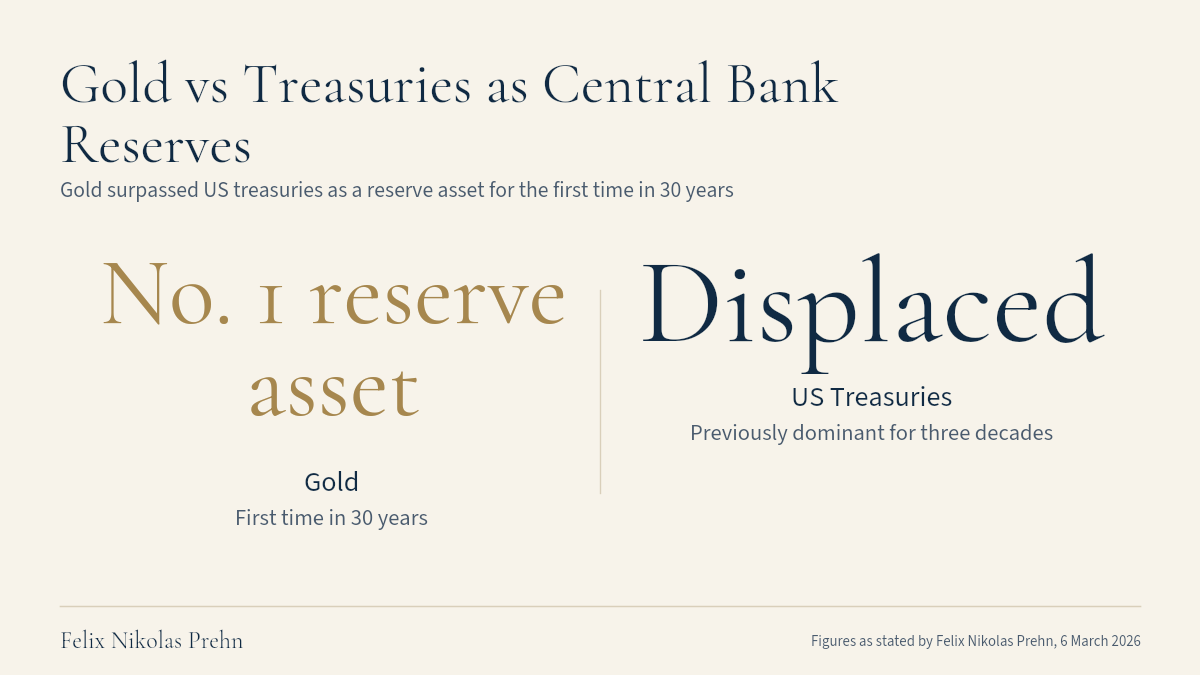
Now, what's really key, and I'm going to try and put a chart on the screen here for you. Gold has now exceeded US treasuries, US government debt as a reserve. So all the central banks in the world now own more gold than their own US treasuries. This is the first time in 30 years. So literally for 30 years the US treasuries were the safe haven of choice for central banks and guess what, central banks are literally voting with their vaults.
So they are saying, these are the people who print money, right? What are they doing with that money? They are buying gold. Now, of course, central banks are saying, "Oh, we're just diversifying. It's risk management and all that." But essentially, what it means is we don't trust the US dollar like we used to, and we're not betting our nation's future on American paper that they're just printing because I can tell you they're going to print a lot more of it because of this war.
And of course for the last 30 years the experts told us that gold was some sort of barbarous relic and you should be in bonds. It's much safer and better. Those were the guys who were issuing the bonds by the way and they're quietly stockpiling gold. Right. So if you have a golden retriever you might want to think about doing something with the gold. Don't you think Winston? What do you think? You're all for gold aren't you? Yes. He says gold is best.
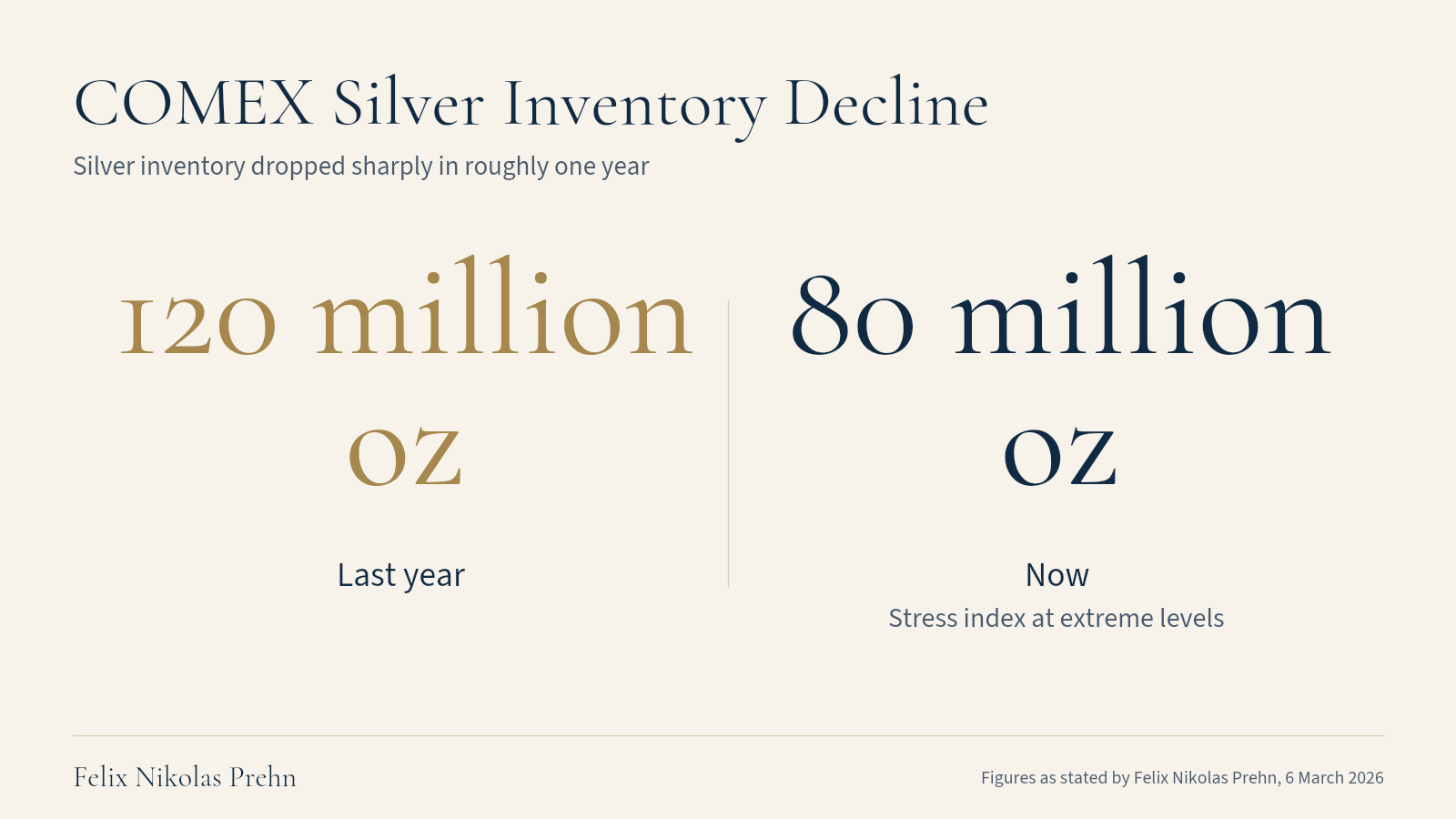
But what happens when gold goes up? What else goes up? Well guess what? Silver goes up and if you look also in our same community that you can join down below, look at the COMEX silver stress, it's extreme. I mean literally extreme. What does that mean? They're running out of silver, right? Gold to silver ratio is actually not that elevated. Silver is a little more expensive in China than it is in the US which kind of makes sense.
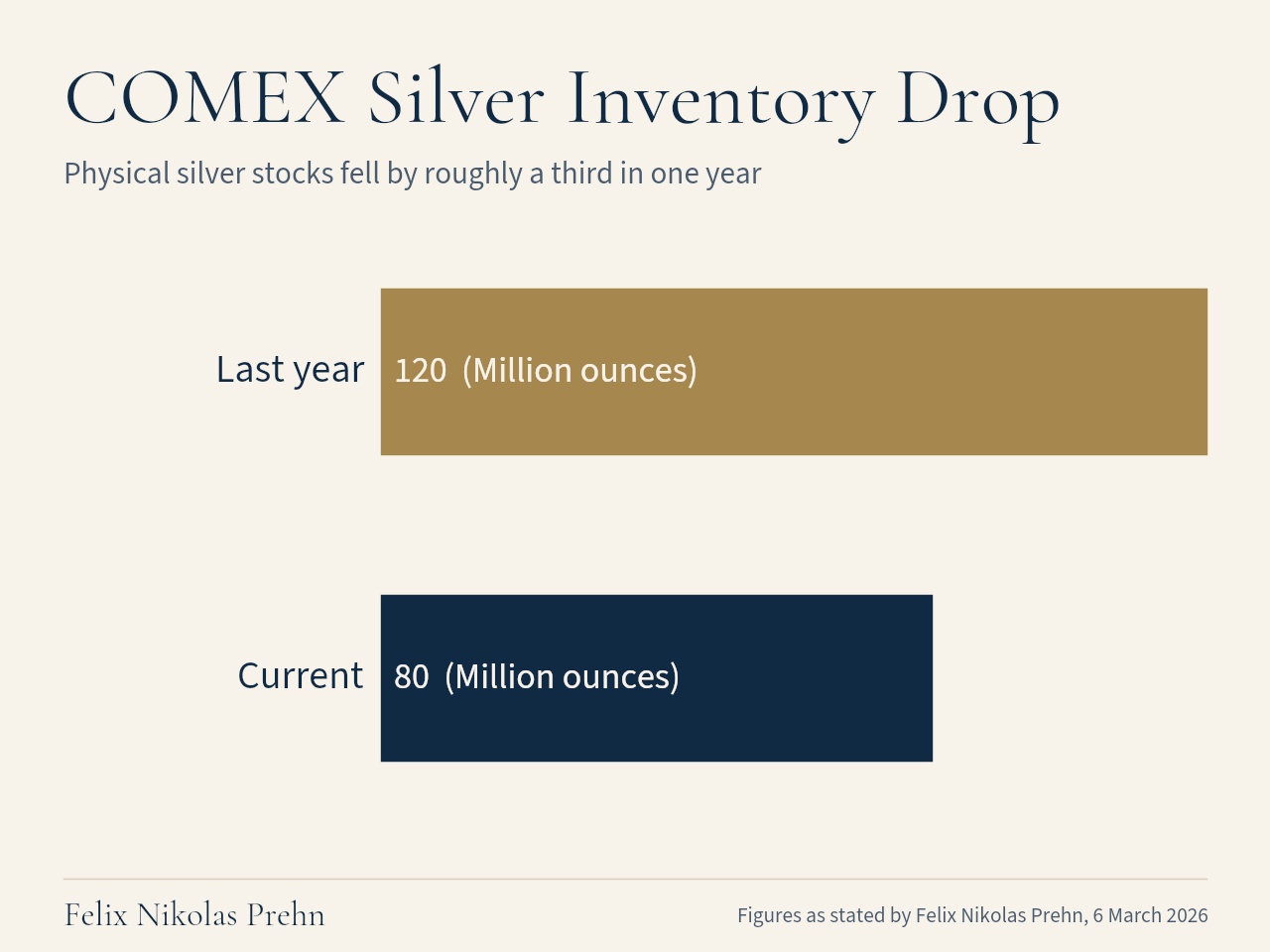
But look at the inventory at COMEX of silver. It was 120 million last year, now it's only 80 odd million ounces. They're literally running out of this stuff. So the stress index is the highest I've seen it for a long time, a really long time. And that's something that I'm watching very carefully.
So how does it work? Well, silver has industrial demand, right? Solar panels, electronics, medical. Every missile that's being fired right now has silver in it. Lots of it. I'm told a Tomahawk cruise missile has 13 kg of silver in it. If one's landing near you, I hope you're right. You might want to go and take the silver out. Actually, that's a terrible idea. Don't do that.
Now an oil crisis also impacts the supply chain. Industrial silver supply tightens. The whole energy transition thing, the whole AI thing, everything is going electric requires massive silver inputs. And historically, when gold moves significantly, silver eventually follows. Often, it's a lot more volatile. So it often has potentially much much higher upside.
And what my Wall Street mentors told me, some of them were actually metal market makers. They say, "Look, silver is a leveraged bet on gold without using any leverage." Right? So I'm not saying you should buy it. I'm not saying you should trade it. I'd be very careful with that because it is very very volatile. But I quite like it. Even Winston is tolerant of silver, aren't you? You still prefer gold. Of course you would because you're a golden retriever.
So before we get into the US government's response to all of this, how they're trying to deal with this. If you're finding this valuable and you want to learn more about when to sell, join me live on Saturday. We're going to host a free training where Winston's going to break down exactly what the institutional rules are for selling stocks, metals, ETFs, absolutely anything because the rules are all the same and they're not really rules that retail investors get taught very often. And that's why we love teaching it because it's so valuable.
But let's look at what's been announced. The Treasury, so the US government's finance head honchos are expected to announce a measure to combat rising energy prices. How are they going to do that? They're going to use the oil futures market. This is a quote from an insider. And basically what it means, market intervention.
So what does it actually mean? It means the government isn't just going to release physical oil from its 400 million barrels oil position. They are literally considering trading in futures. So the government is going to become a trader not just a regulator. And the very government that tells us that the market's efficient, it's private, it's self-correcting is going to step in to correct the market. Right? Kind of bonkers, isn't it?
That's happening here. And at the same time, the US is considering invoking the Defense Production Act. What does that mean? Well, they want to accelerate offshore drilling specifically for Sable Offshore Corp. That thing is a traded instrument. It's in California. And why? Because the toad loving state of California, nothing against California, but they are very environmentally conscious and they want to check how the toads identify and if it might harm them. I don't know that. I'm joking, obviously.
But this would override state permitting. So this is usually something that's reserved for wartime or national emergencies. And it shows you how serious this government views the crisis, right? Because California has some crazy strict permitting and this would be massive. A huge unprecedented federal override.
And then we've got this. Remember the Russians? They're supposed to be the enemy, right? Guess what? There is a 30-day temporary waiver issued that allows Indian refineries to purchase Russian oil and the government says it'll not provide significant financial benefit to the Russian government. How does that work? So we'll allow our ally India to buy Russian oil because the alternative is India runs out of oil which would be a freaking disaster.
So it tells you how serious this is without them telling you how serious this is. Right? So even if the oil is Russian, we're going to be okay with that. What do you think about that? Is that smart or is that smell of desperation? Put it in the comments. Smart or desperation, or just an S and a D.
So what are the immediate risks, Winston? What are the immediate risks? Well, oil is already at pretty elevated levels. If the shut-ins accelerate, a $100 plus oil price is very possible and that flows through your gas, your heating, transportation, food, manufacturing. So inflation will come just when inflation seems under control. Thanks for the poll, Winston. Energy is embedded in everything we make. Literally everything.
So central banks will once again be forced to fight inflation or prevent a recession. And inflation goes up, guess what? All the high-risk stocks are going to get pummelled. So what do we do? Well, first of all, let me tell you what not to do. Don't panic sell. Don't chase the headlines after stuff's already happened, assuming it'll blow over quickly. Because if you ignore the fundamentals of investing, position sizing, risk management, and you're just hoping for a quick win, it's usually not a good way to do it, right?
I've been very conservative this week. I told my students as well, just take a chill pill. Doesn't matter if we buy a per cent higher or lower. I'd rather have clarity on where this is going. And at the moment, the clarity is becoming a heck of a lot less clear, which is why we have 2 critical warnings on our Intel dashboard here and a ton of stuff flashing, particularly of course in the Gulf of Hormuz here. You can literally see live what the heck's going on there.
Smart investors do their risk management before a crisis happens, not after. Now, you might not have that luxury because you're just getting started. So come and learn with me on Saturday. But just don't be that typical retail guy, the reactive guy, right? Emotional decisions following mainstream news media which is usually too late. And that's literally why we've created Goat Academy to give regular investors access to institutional thinking and institutional strategy. So to understand those frameworks, that's super super important.
And maybe just let me know in the comments what's your biggest concern right now. Is it inflation? Is it a crash? Is it energy prices? Put your answer down below in the comments and we might make a video on the most popular ones down below.
Zoom out for a second, it's always a good thing to do. This isn't just an oil crisis. It's an acceleration of the de-dollarisation trend, central bank gold accumulation. And the COMEX paper versus physical gold and silver issue is more critical than ever because when the central bankers, the guys who print all the money and cause all the inflation, when they're buying gold, well, it tells you something, doesn't it? But in my opinion with metals, think in months and years, not in days and weeks. Understand the macro before making those decisions.
So, what have we covered here? The Hormuz crisis, 3 days until forced shutdowns cascade. Asian countries are getting hit very rapidly. Domino effect gets kicked off for oil prices. Gold exceeds treasuries for the first time in over 30 years as a reserve asset. And the US policy is pretty aggressive.
The Treasury is going to intervene in the market. We get the DPA, a wartime act. We get a Russian waiver to sell oil to the Indians and that creates a ton of risks and a ton of opportunities for retail investors. You want to learn those actual protection rules which is always how we start. Protect first then we go into opportunities, join the live training on Saturday and learn those institutional selling rules.
And if you want to monitor what's going on here live as we are, then just join the community down below and all the tools we have in that a try. As I said, it's about $6 a week. You can cancel at any time. We also give you a daily summary of what's going on in gold and silver prices and so on in metals markets. So, it's very much a metals focused environment, but there are some stock tools in there, for example. If you're wondering whether a particular stock, Microsoft is still fundamentally a good stock, just type it in there and it'll give you all the cool numbers out there. It'll give you whether it passes our rules, and you can learn those as well.
And I hope that you feel a little bit better informed than you did at the beginning of this video. If you do, share it with a friend or a golden retriever. And Winston, any final thoughts from our gold risk manager? He says, "I think we should have some snacks." I think that's what he's thinking. More tennis balls. Wish you guys a beautiful and safe and better informed and better skilled year ahead.
All the best. Gold just did something it hasn't done since 1979. And if history repeats, and it always does, what comes next is literally unthinkable. But scroll through social media right.