
A disruption in the Strait of Hormuz, through which 30 per cent of all seaborne oil passes, does not remain a local event. Energy, metals, and reserve assets all move in response.
Storage buffers in the Gulf are measured in days. Production losses cut supply to Asian refineries and drive inflation in the West.
Central banks respond by shifting their reserves away from dollar assets. A JP Morgan report estimates the timeline for commodity chaos at 3 days.
The Strait of Hormuz Standstill
The Strait of Hormuz has become, in practical terms, impassable for oil tankers. Insurance for tanker transit has been cancelled.
Shipowners are unwilling to risk the destruction of a vessel. Attacks on Gulf energy infrastructure, including a tanker hit by projectiles off Qatar, have compounded the disruption.
Recent reporting is contradictory. Some outlets have described a partial recovery in oil flows through the Strait, while others report a resurgence of attacks and continued shipping disruption. Felix argues that transit remains too dangerous for commercial tankers without expensive military escort, and that the effective closure persists.
The Storage Countdown
Iraq has about 2 days of oil storage remaining. After that, Iraq must shut down nationwide oil production.
Kuwait has about 13 days of storage remaining. 4 of the 6 tanks at the Ras Tanura refinery in Saudi Arabia are full. Storage capacity is the binding constraint, because producers cannot keep pumping oil if there is nowhere to store it.
Once production shuts down, restarting it is not quick. A forced halt resembles turning off a massive industrial machine with no quick way to reverse the process. A full restart takes weeks.
In Felix's view, Saudi Arabia and Kuwait have already begun cutting production because storage is full. Some reporting from late 2026 suggests Middle East exports have partially rebounded, but Felix maintains that the capacity constraint remains the central risk.
Cascading Production Losses
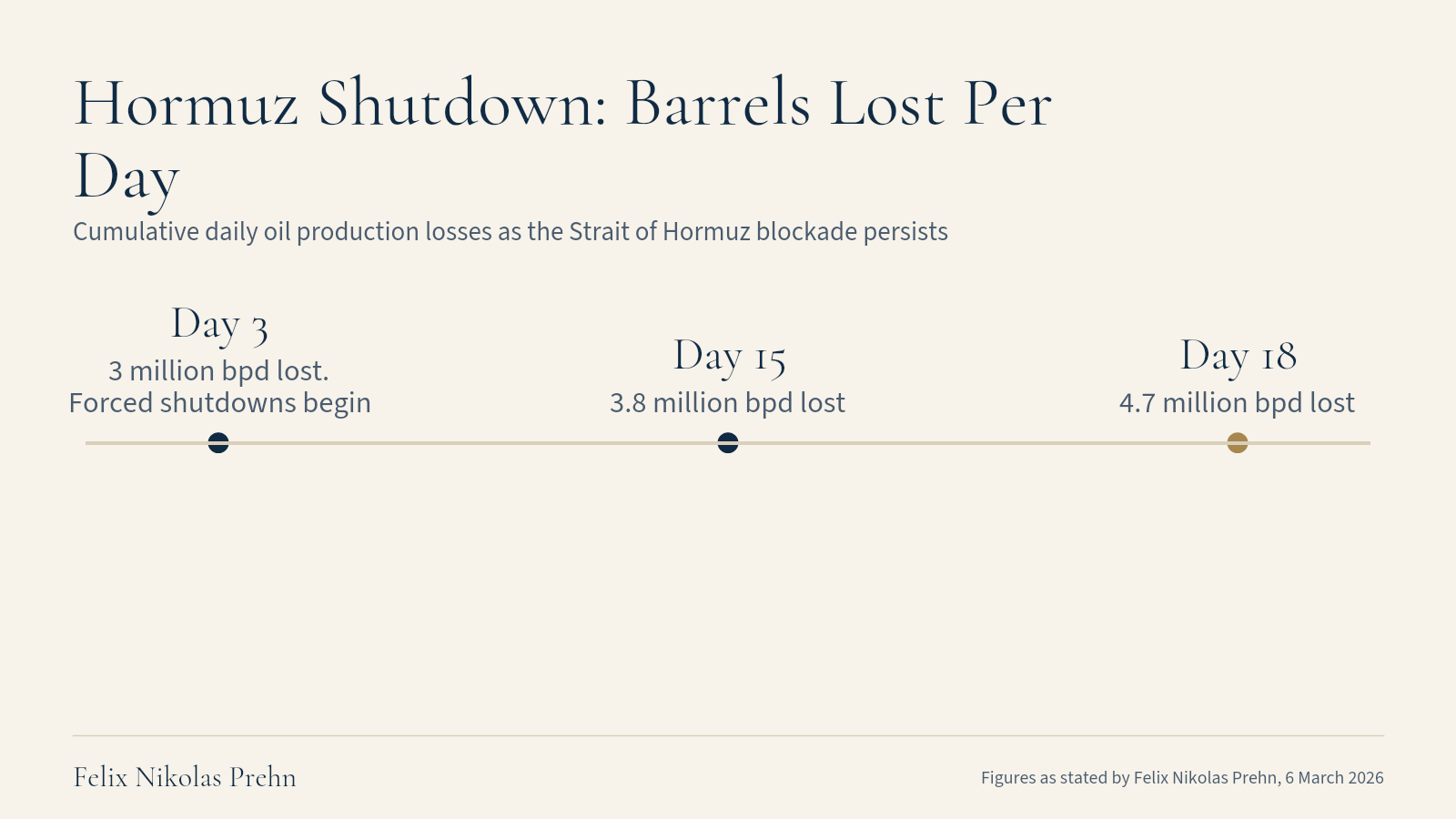
The production losses follow a clear schedule. On day 3 of forced shutdown, 3 million barrels per day of output are lost.
On day 15, output lost reaches 3.8 million barrels per day. At day 18, the figure reaches 4.7 million barrels per day.
Iraq has already cut production by 1.5 million barrels. Supply takes weeks to restore once a shutdown begins. The deficit grows with every additional day the Strait stays closed.
If the shut-ins accelerate, a price above 100 dollars per barrel is very possible. Oil price rises flow through petrol, heating, transport, food, and manufacturing. Energy costs feed into every manufactured good, from food to electronics, and price growth returns just when it appeared to be under control.
Inflation driven by energy costs hits high-risk stocks hard. The S&P 500 returned 25 per cent, 24 per cent, and 18 per cent over the last 3 years respectively. Returns of that size are vulnerable to an inflation shock driven by energy costs.
Qatar's operations producing 77 million tons per year of liquefied natural gas have been halted. The LNG market is already facing demand cuts, and the loss of Qatari supply removes one of the world's largest gas sources when alternatives are scarce.
Asia Bears the Brunt
Over 80 per cent of the oil that passes through Hormuz is destined for Asia. China imports 3.8 million barrels per day through the Strait.
Japan has 254 days of oil reserves, but 90 per cent of its crude comes from the Middle East and 70 per cent of that goes through Hormuz. Japan built that stockpile after the 1979 embargo, when it ran out of oil and gas.
South Korea has about 200 days of oil stockpiled. China has about 200 days of oil reserves.
India has about 74 days of oil reserves. The Trump administration gave India a 30-day temporary waiver to buy Russian oil.
Without the waiver, India would run out of oil. The waiver applies to India alone and is not permanent.
Indonesia has only 20 days of oil reserves. Vietnam has 15 days of oil stockpiled.
Once reserves drop below dangerous thresholds, countries begin competing for alternative suppliers.
Governments with thin stockpiles bid for non-Gulf supply, diverting barrels from the United States and Europe. The competition drives prices up everywhere.
Governments then draw from national reserves, shrinking safety buffers and unsettling markets further.
Reports confirm that Hormuz disruptions are affecting Asian supply. India's crude supplies have been cut, and some Gulf producers have sold large volumes to Asian buyers in an effort to maintain flows.
Gold Replaces Treasuries and Silver Tightens
Felix argues that gold has exceeded US treasuries as a central bank reserve asset for the first time in 30 years. For three decades, treasuries were the safe-haven asset of choice for central banks.
In Felix's view, the shift reflects a loss of trust in the dollar. Central banks expect Washington to print far more currency because of the war.
Headlines confirm that central banks are buying large quantities of gold, though some institutions have moved in the opposite direction. Kazakhstan sold gold as treasuries became more attractive, and central bank buying retreated briefly in mid-November.
Felix argues that the expectation of further dollar issuance is itself a reason for central banks to diversify into gold. Sanctions, meanwhile, give countries a reason to look for alternatives to the dollar, making the currency powerful in the short term and weaker over time.
COMEX silver inventory was 120 million ounces last year. That figure has since fallen to around 80 million ounces.
Felix argues that COMEX is running out of silver. Headlines do not confirm extreme stress in the silver market, but Felix maintains that the drawdown in physical inventory is a signal worth watching.
Silver has industrial demand. Solar panels, electronics, medical devices, and missiles all require it.
A Tomahawk cruise missile contains 13 kg of silver. The energy transition and the expansion of artificial intelligence mean everything is going electric.
Electrification requires massive silver inputs. An oil crisis disrupts the metal's industrial supply chain at the same time.
Silver has historically risen when gold moves higher. Silver is more volatile and, in Felix's view, has potentially much higher upside than gold.
The US Government Response
The US government has about 400 million barrels in its strategic oil reserve. Washington is considering two interventions.
The first is trading in oil futures markets, a step that would make the government a market participant rather than a regulator. The second is invoking the Defense Production Act to accelerate offshore drilling, overriding state permitting in California. The Act is reserved for wartime or national emergencies, and its invocation signals how seriously the administration views the crisis.
California has strict permitting requirements. A federal override would mark a considerable expansion of executive power over energy production.
Felix argues that the government's willingness to intervene in futures markets and invoke wartime legislation reflects the severity of the supply disruption. Headlines have not confirmed that the Treasury is actively trading oil contracts or that the Act has been invoked. The IEA has agreed to release oil from strategic stocks, but the broader interventions Felix describes remain under consideration.