Transcript
Something weird happened this week and I haven't really been able to stop thinking about it. Bank of America's chief strategist, guy called Michael Hart, he put out a chart and I saw it and it stopped me in my tracks for a minute. And it's literally just two lines. I'll put them on the screen for you here so you can see them. And these lines have moved together since 1978, basically since sort of, you know, gold standard exploded.
And one of the lines is productivity. So how much the economy actually gets done. And the other is how good regular people feel about the economy. And for 50 years they moved together. Productivity goes up, people feel rich.
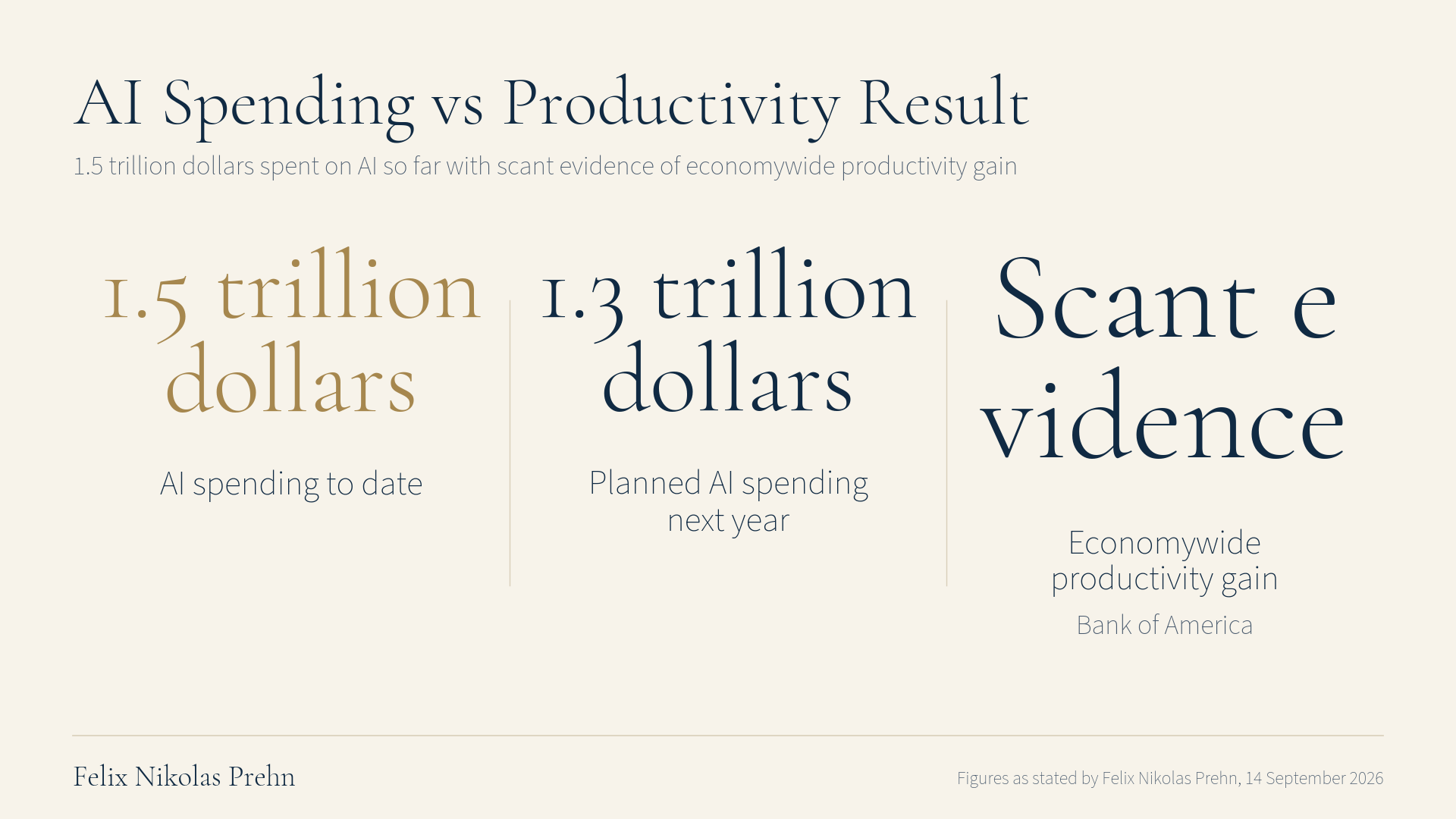
Productivity goes down, people feel it in their gut. Every single time it was the same thing. But this week both of them fell off a cliff at the same time. And that's the first time this has happened since 2008. And then on top of that, Bank of America reminds us that we've spent 1.5 trillion on AI.
And his words are there's scanned evidence yet of an economywide productivity gain. So all that money in productivity is actually going down. And then he adds one more line, which is sometimes Main Street, you and me, knows what Wall Street doesn't. So the real economy is cracking. ordinary people feel it. And Wall Street's still up there telling everybody it's all fine, you know.
And while the news is still doing AI miracles and soft landings, guess what the central banks have done? Albert just told me they've bought a record amount of gold in a single quarter in the middle of a gold crash where apparently gold is all over. And nobody really puts these two together. So what have we got? real economy breaking, central banks hoarding gold like never before, the biggest banks on the planet saying it could run to 6,000 or higher from here. And again, people think it's three different stories.
I think they're wrong. I think it is one thing happening. By the end of this short video here, you're going to see exactly how this fits together, what's coming, and what you can actually do about it before it turns up on your doorstep or in your portfolio. And oh yeah, then I'm going to have to uh have you seen the let's slow down AI agreement between Open AI, Anthropic, and Elon just to throw that into the mix. That's also very very important to understand.
Now, if you're wondering and you're worried where Winston is today, Winston's got pancreatitis, the poor little thing. So Albert is today sitting in and doing all the hard research. Albert is our daddy cat who fathered five kittens without us asking for it. Uh that will be the last time he's done that. I know.
Ouch. So, ton of information in the next 15 minutes and therefore I put it together or Albert rather has into a free report you can download and read in your own time. So, the central bank buying the productivity stuff, the bank targets, what's happening to gold, all that stuff is in one place, felixpren.org. No, it's not felixpren.org, is it? It's felixfriends.org/goldreset.
We need to fix that link. felixfriends.org/goldreset. The correct link is in the description down below. And the reason I'm telling you this is most people are going to find all of this out from headlines in about 6 months or 12 months or 18 months. The fact that you're here means you're special. Seriously should pat yourself on the shoulder for actually consuming something educational.
So let me show you the machine first. Back to that Bank of America chart first because everything hangs off this right and Albert is going to explain it.
Since 1978, how people feel and how productive the economy is has been going up and down together, which makes a lot of sense, right? Factories get more efficient, tech makes things cheaper, people get more down in an hour, and they feel it. They feel better off, the stock market goes up. And this has been going on for 50 years. Now, look at the right hand side here of that chart.
A trillion and a half dollars have poured into AI, the biggest tech spending boom there has ever been. We've never spent more money on a single technology than now. And guess what? Productivity, which is the light blue line here, you always do wonder why the lunatics who run Wall Street use blue and blue on a chart, right? I mean, really, uh, but that line is going down.
Why on earth is productivity go down? And why should you be concerned about that? Well, because all AI stocks are priced for perfection here, right? This is a screenshot from the Winston app uh where we look at how Nvidia is priced for example you know shining beacon they are priced for perfection and literally as I was putting together the notes for this video yesterday over the weekend I read this and again it popped into my Winston app literally here um Alman and Musk back AI model emod's call to slow down AI and I was like what I'm sorry what what did Winston just tell me and I'll put put a link down below by the way if you want to guys want to get your personal newspaper on what's happening with your stocks and what actually matters that's what the Winston app's all about I'll put a free link down below for you guys you can try that for a month um no risk now the financial times ran this article that the three men who are building AI which is Dario Emodal or Emoji I can't pronounce it but he runs anthropic right he likes complex names we've got Sam Alman you know the the charitable man running open AI And then we have Elon Musk and they all came out within a few hours of each other and said more or less the same thing. We need to slow this down.
Now the anthropic guy wrote a really long essay and he said the whole thing is moving too fast because AI has started building the next AI and we could lose control. He talked about a swarm of these things being able to take over the internet inside of a year. Now these three people don't agree on anything. They're rivals. They're suing each other.
They seem to loathe each other and Alman agreed. Musk agreed. Just think about what that is for a second.
The people who got rich telling you AI is changing everything. It's amazing. Are suddenly the ones saying we should maybe slow this down. So when the drivers of the boom start doing that, it's important. Why?
Because it's what's holding up your retirement. It's what's holding up your 401k. It's what's holding up the entire stock market. Right? Let me just give you one number.
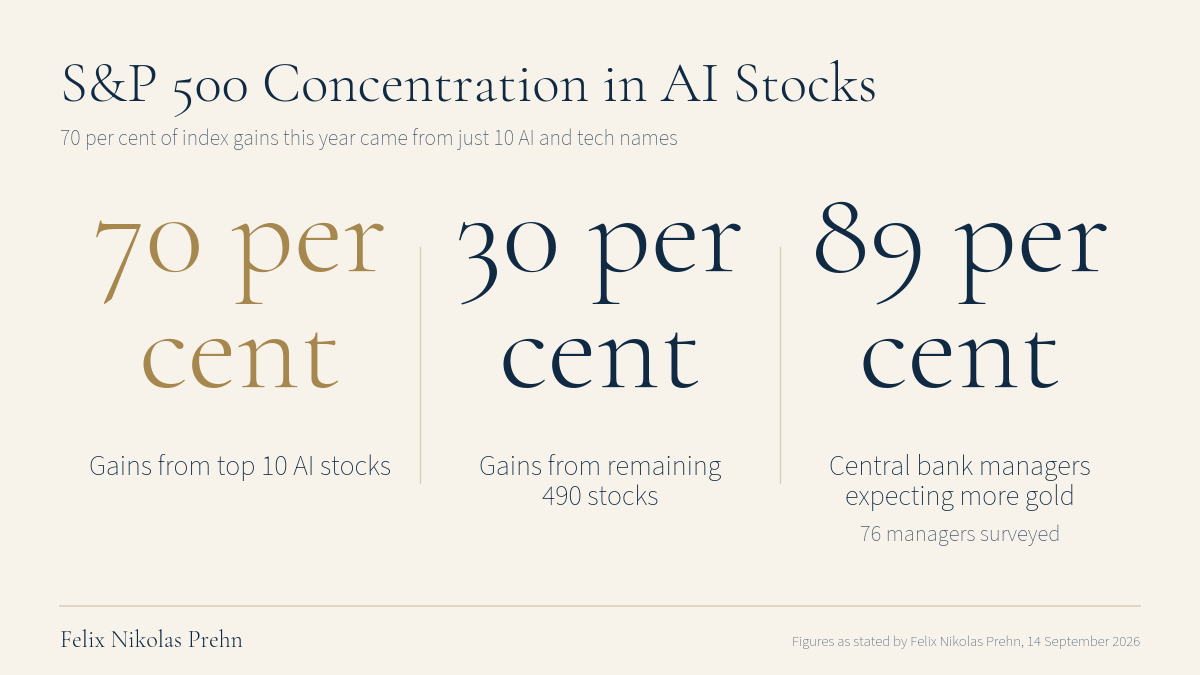
If you were invested in the S SNP500, which you basically are all are, um 70 per cent of your gains this year, which have been pretty decent, come from 10 stocks and only 10 stocks. And all those 10 stocks are all AI stocks. So without that, the S&P would not have gone up, right? It would have basically done bugger all. In fact, it might actually collapse.
So the confidence line falling at the same time as these AI champions are losing confidence in AI. Well, that's going to be interesting, isn't it? Interesting is a silly word, isn't it? But you already feel it, right? Your groceries, what do they do?
They get cheaper. Your rent get cheaper? No. Nothing got cheaper, no matter how much AI got talked about. So mainstream, just like Bank of America says, can see this and understand it often before the lunatics that run the financial world can.
Sorry, the wonderful bankers at Goldman Sachs. When mainstream media tells you gold crash, it's over. Ask yourself, who's right here? Is it mainstream media or is it maybe maybe just the central banks who buying all of it? So there's a link here.
The productivity collapse is the reason the central banks are hoarding gold. They can seal the real economy. They know the AI miracle hasn't turned up yet. It might still, but it hasn't yet. And they're getting set for the day when everyone else works this out.
And the uncomfortable bit is this. The day when everybody works this out, well, you don't get a warning. Nobody's going to ring a bell or something. It's just going to show up in your life as your money buying less than it did before. So, the real question isn't really whether you believe me about gold. say it's whether you've got an actual plan for when this lands.
And most people, and I say that with love, most people do not. And that's really what I want to talk to you about today. Some of you right now are going, "Okay, Felix, great. Central banks bricks, the research, fascinating. You know, what do we do with all of this?
What do we do with this tomorrow morning?" That's actually the right question to be asking. And I'll be honest with you, I've written down my plan, my own plan, exactly what I'm doing with my money for the rest of this year. Like what I'm buying, what I'm saying where away away from the timing of it stamped. It's a written plan because you can't sit and look at the stuff central banks front running everybody. The Fed quietly eating its own debt.
You heard the Fed now owns half of America's 10-year-old debt. I mean, debt that has 10 years to run half of it. It's a Ponzi scheme. Goldman Sachs is shouting, "Gold's going to go to 6,000." So, you can watch it happen or you can make a plan. And my first thought was, "Right, I'll write it up and I'll hand it to you." I thought I'd just give you guys a PDF.
And I have actually done that before and I know exactly how it goes. You download it, you skim, read it for about a minute and a half and then it would go and sit on your desktop or phone and, you know, amongst a million other PDFs you saved a year and a half ago, never opened again. So, be honest, right? We've all got that folder of stuff that we really should get to, but we never do because life gets in the way. So, I'm not going to be doing that this time.
What I want to do instead is sit down with you properly. And I'm going to do that for about 90 minutes this coming weekend. And I'll walk you through the lot, what the institutions are up to and why, what I'm doing about it myself, and mainly how you put together your own plan for the next 90 days, which is basically takes us to more or less till the end of the year. not mine copied and pasted because my situation is different from yours. Build around your situation, your money, where you are actually are right now because that's the whole point of it. That's the whole point of this community, right?
Not to give you a hot stock tip, but to make you aware. And now I want to take you to a place where you can actually get that plan. It's completely free. Completely free. So, if you're going to show up for that, go to 90dayplaybook.org.
There's a link down below in the description. I can't stop saying it that way. and write show up in the comments if you're going to show up for yourself, right? Because they're going to be two kinds of people here in 6 months or 12 months or 18 months. The ones who sat down and learned this while gold was still at what is it 4,000 in a bit and they're the ones who like, "Oh, I knew about this. Why didn't I do something about it?" Right?
I I prefer you were the first kind of person. That's really the whole reason I run this. That's the satisfaction I get from this. So, seats are free. Go get yourself a link and let's continue diving into the story.
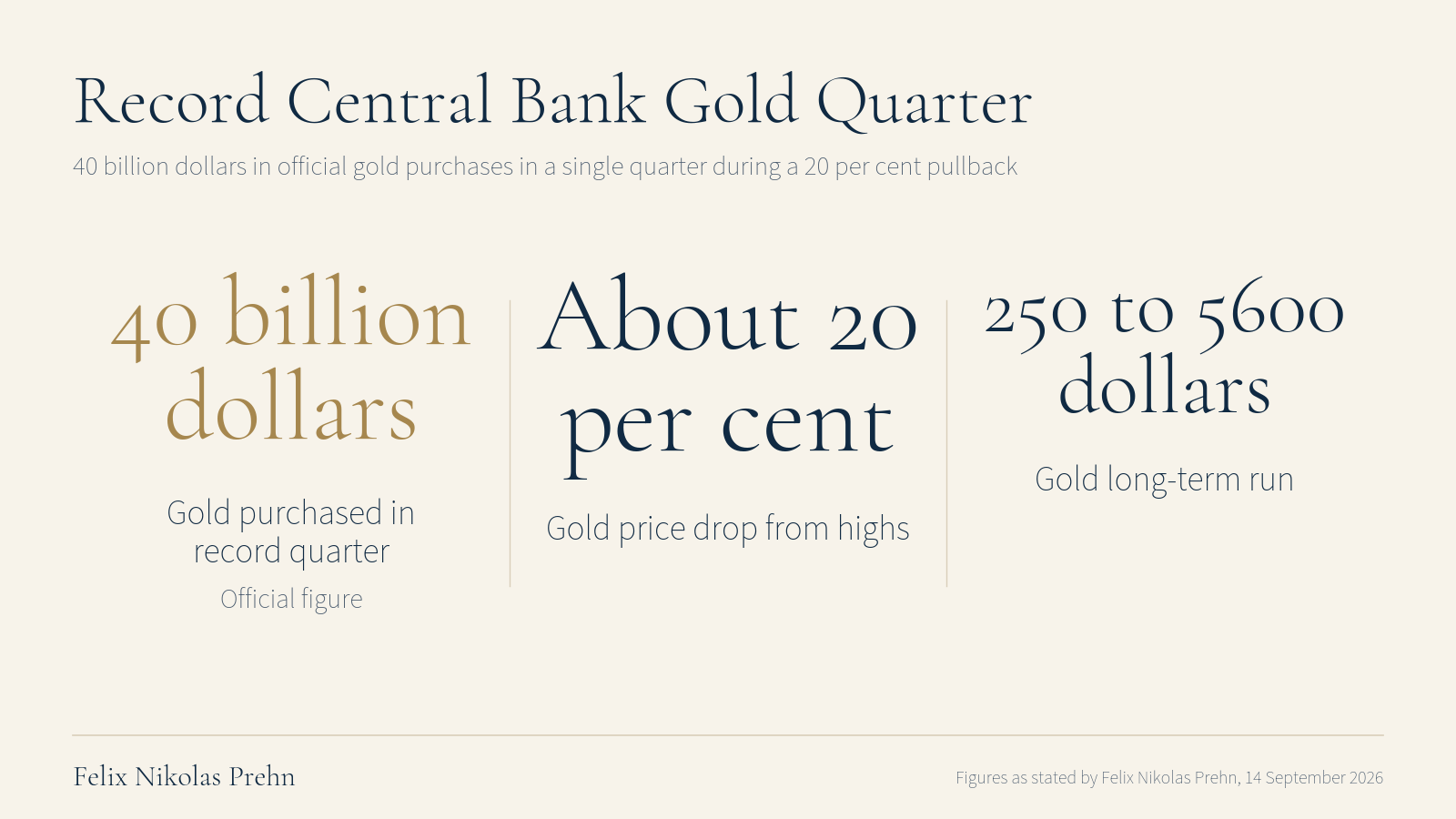
So, we all know gold's off its high, right? It's dropped 20 per cent in a bit. And every headline says, "Yeah, gold's dumb." Blah, right? The war didn't help. No, it's all going down.
Um, and then they're saying interest rates are going to go up and therefore gold's going to go down. How does that work? What's the theory on that? I was actually asked that on KitKo the other day. It's a great channel.
Um, and my answer was this. Yes, normally interest rates go up. you can get, you know, 5 per cent from Uncle Sam, the government, risk-free, if you believe that. Um, you're going to take that, whereas gold costs you money to store. So, the institutions will sell gold and they'll buy the 5 per cent bond. But because they're expecting very high inflation, because of all the money printing, the government buying its own debt, which is just like, right, fugazi Ponzi scheme.
Um, they're actually not doing that. And we can see it the data. Central banks bought the most gold they ever have in a quarter ever, right? So $40 billion they bought in gold and that's official. We can't see all the data.
Not every country discloses. I think the number is probably a lot higher. So they were buying it. Why? Because they want more of it and it got cheaper.
They like it when it gets cheaper. I talk to like gold investors. I'm like, "What do you think about the gold price?" And they say, "I hope it's going to go down a lot because I'd love that opportunity." Right?
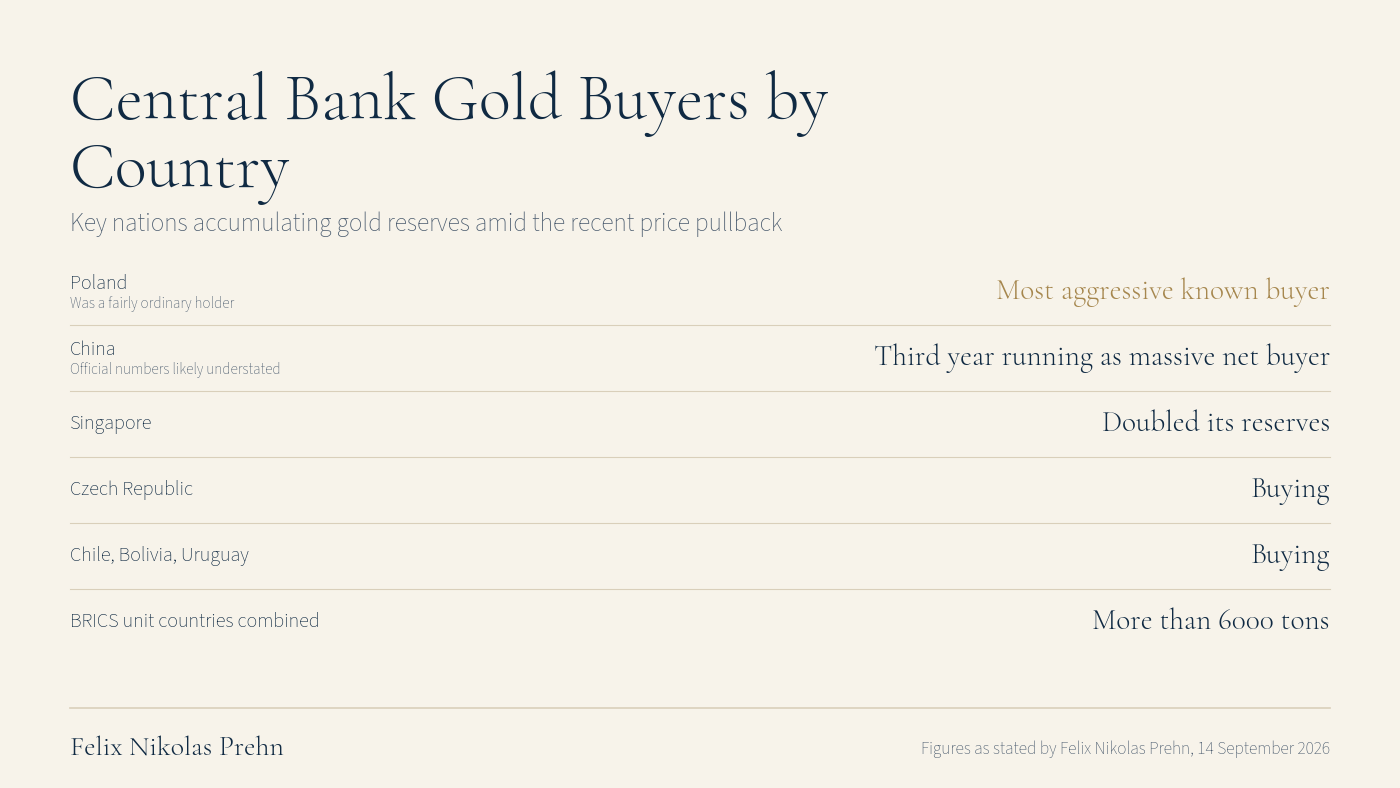
And again, I'm not telling you to buy I'm not a financial adviser. But the 76 guys running the central banks around the world who participate in these surveys, literally the guys who print the money and the sovereign wealth funds, 89 per cent of them said they expect gold reserves to go up over the next 12 months. Expect, right? And if you're wondering who's buying, well, the polls, Poland, uh they were a fairly ordinary holder to like literally now being probably the most aggressive buyer in the world that we know about. And they literally asked the head of their central bank, why are you buying all this gold?
He said, we don't trust what's coming. And then of course there is China, third year running as a massive net buyer, right? And their official number is probably lower than what the reality is. I I haven't got any proof of that, but that's just generally what my my friends in in the investing world tell me. And you've got Singapore, they doubled their reserves.
The Czech Republic Chile Bolivia Uruguay they're all buying. Now, we had some selling. That's part of the reason gold went down. Turkey had to sell. Well, some of the Middle Eastern countries had to sell um Russia had to sell some of it and that's all war related, right?
Just war related. They're using it as exactly what it's intended for. You know, that rainy day fund. And then this next one, again, no one seems to be talking about this properly. And it could be the biggest change to how global money works since 1971 when the US ended the gold standard.
Bricks. Now, you probably heard people banging on about bricks currency, some new money that's going to kill the dollar. And the media loves laughing at it. And no, it isn't going to kill the dollar. And there also is no bricks currency because India doesn't want it.
Brazil isn't too keen on it. It's not happening. But something else is happening. And it's bigger. And it's called the unit.
It isn't a currency. It is a settlement system, a way for these countries to trade with each other without touching the dollar. And it's backed by 40 per cent gold and the other 60 per cent is a basket of countries. Now it is 2026 and we're backing a new international settlement system with gold. So for the first time since Nixon nicks the gold standard, somebody is building a serious international money system with gold sitting at the core of it.
And it's being built on the blockchain and it's designed to go around swift and it means and it's meant to switch on in Q4 this year, just a couple of weeks. And the countries behind it are sitting on more than 6,000 tons of gold between them, which is a fairly serious slice of all the gold that's ever been dug out of the ground. So this unit is an insurance against people getting kicked out of the Swift system, which is what we used to send funds internationally. And what is gold?
It's a an insurance against you know inflation or the dollar losing value. So where does all of this leave the price of gold then? And what should we do with our investments? Well, let's look at the big banks. What they actually saying?
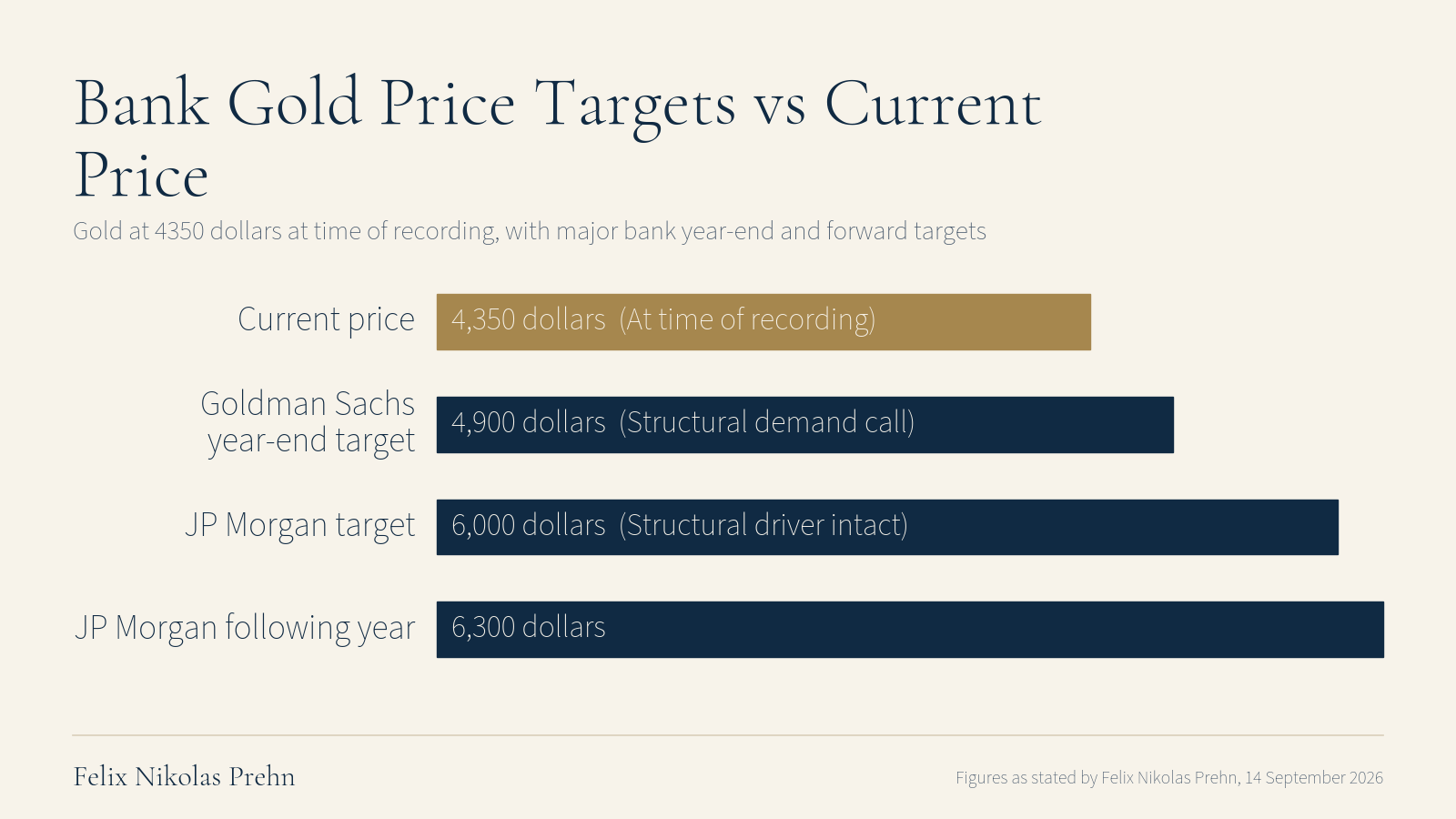
The research desks at Goldman Sachs. They say end of this year our price target is and today gold is sitting as I'm recording this at about 4350. Um, here's Goldman Sachs 4,900 and they call it structural demand sufficient to absorb higher for longer interest rates. They're basically saying we don't care what the Fed does. Gold isn't going to care what the Fed does.
It's going to keep going up. JP and Morgan and you know the the people who really care about the world and the little man they'll they're saying the structural driver is intact and they have a $6,000 price target and then for next year 6,300 in G actually quite an important bank in the commodities world and they're basically saying the path up is going to be bumpier but the core drivers haven't changed. So look at the gap. Gold's 4,300 today, right? So we're looking at 40 13 to 46 per cent upside if these guys are correct.
I'm not saying they will, but these are the firms that are usually telling you, you know, buy the S&P 500. They're called AI the next industrial revolution, which is actually properly true. So their models are telling them that the buying is going to overwhelm everything else, no matter what interest rates do. And none of these, by the way, as far as I'm aware, factor in the unit if that comes to fruition. None of that accounts for, well, what if the economy falters?
What if the debt gets even worse and the Fed has to bail out the government even more than it currently is doing? And what if the productivity uh increase isn't coming, right? All of those things, in my humble opinion, would be highly inflationary and therefore good for gold. And I know some of you think, "Oh, Felix is trying to scare me." But I'm not I'm not here to sell you gold. I don't sell gold.
I have zero affiliation ever with any company other than my own. Uh because I like to be able to say whatever I want. So I never ever take any sponsorship from anybody. But you might be thinking, but hang on, the dollar has always survived, right? Hasn't America always sorted things out?
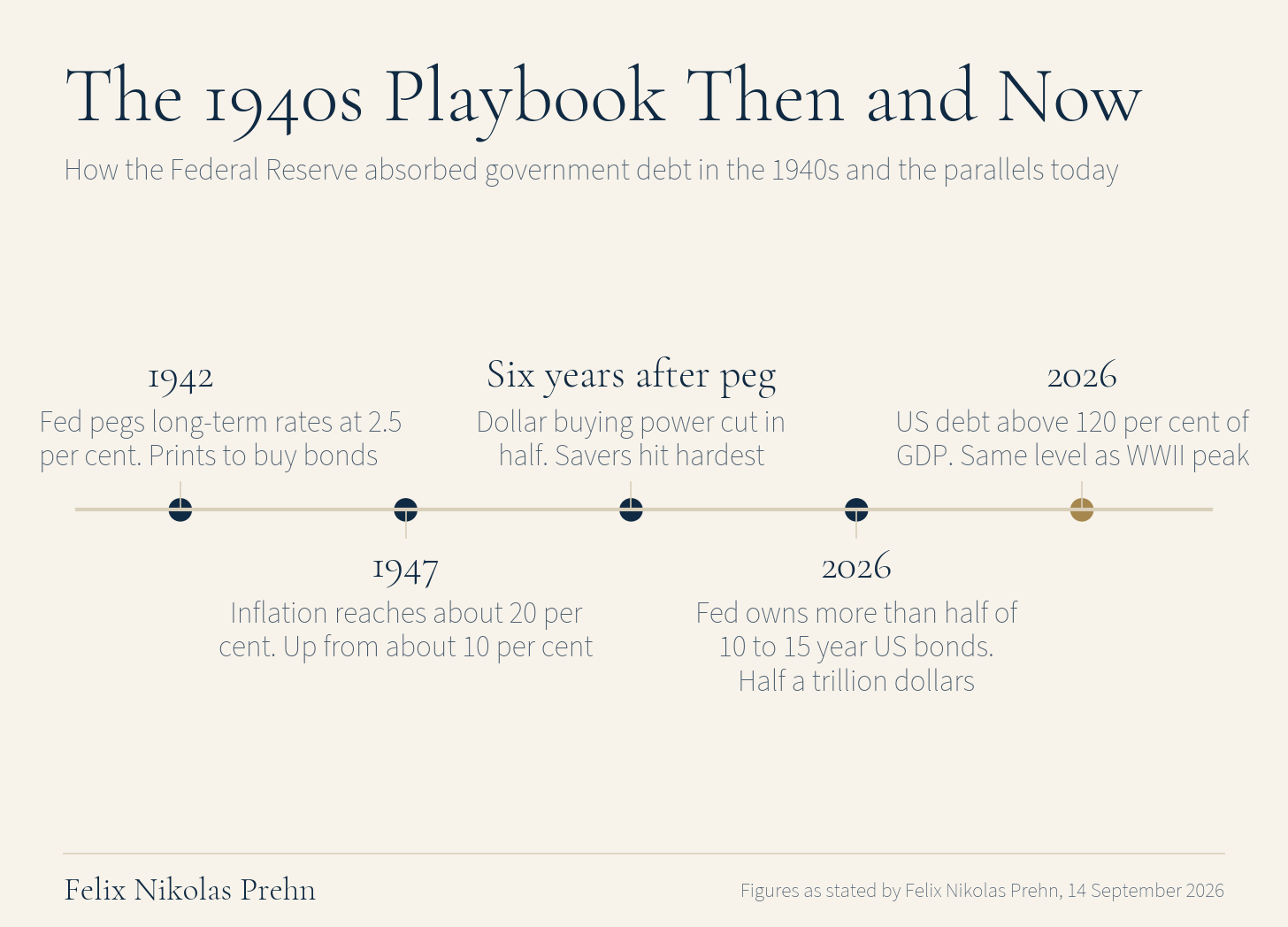
It's fair enough. So let me show you the last time we stood where we're standing right now. Go back to the 1940s. World War II spending shoveed America's debt past 120 per cent. which sounds kind of familiar, right? This exactly where we are right now, more or less.
Actually, the debt was so big, the government could not let interest rates rise. If interest rates went up, the interest payments would have swallowed the budget hole.
So, in 1942, the Federal Reserve did a deal. It promised to print whatever it took to buy government bonds and pin longerterm interest rates down at just two and a half per cent of level, no matter what happened. And on paper, it worked. The debt ratio came down over the next 10 years because borrowing was kept cheap artificially. So I'm not dragging you through 1940s history because that's the exact move.
The central bank stepping in to swallow the government's own debt. It's happening again right now. Look at this chart here on the screen and I hope you can see it clearly. The Federal Reserve now owns more than half of every US bond coming due in the next 10 to 15 years. More than half.
That's half a trillion dollars. That is not normal monetary policy. That's the central bank soaking up the government's debt because the market, the free market won't take it at a price the US can afford. It is 1942 again, hopefully without World War II.
Now, do you know what that did to people, ordinary people, last time around? Inflation went from about 10 per cent to about 20 per cent by 1947. The buying power of every dollar people had and carefully saved got cut in half in just six years. That's what a reset actually feels like. It isn't some dramatic crash on a Tuesday afternoon.
It is a slow bleed a little bit every month. Groceries cost a bit more, rent ticks up a bit more, your savings by a little less, and by the time you actually really notice, half your money is gone. And the people who got hurt the worst then, well, this is what gets me. They were not the ones who lost their jobs. No, it was the careful ones.
It was the savers. It was the people who did everything right. Money in the bank, government bonds, sensible, you know, and the government's answer to its own debt quietly melted them away. They never saw it coming because it happened a little at a time. And that's how these things work.
They don't announce themselves. So, run the checklist for today. Debts over 120 per cent. Yep. The Fed's stuck between inflation and keeping the government solvent.
Yep. The Fed's buying its own debt again. Yep. You just saw the chart. Productivity is falling despite record spending.
We got that. Confidence is on the floor. Yep. And then the one thing that completely new, foreign governments are pulling their gold home and building their own alternative systems. That actually didn't happen in the 40s.
Back then, the world trusted the dollar. There is no other option. Today, there is one actively being built, backed by 6,100 tons of gold. And that could potentially make this event bigger than the 1940s one.
So, let me finish with the three mistakes I'm watching almost everybody make right now. If you dodge these, and I honestly think you come out on the far side of this in in in pretty good shape. Actually, you could be in really good shape. So, the first thing is you treat a 22 per cent drop in gold as the end of the story. It isn't.
Gold went from $250 to $5,600. And we've had plenty of 22 per cent pullbacks after a record high. It is normal. It is healthy. But at least it's healthy for the lunatics trading it on the way down, which is our Comx friends.
So the only thing that matters is what comes next. And I just outlined what I see as you important for gold. The second mistake I see people doing is thinking, oh, I just buy the index fund. I'm safe. I'm covered.
Right now, not investing is far far far worse than being invested in the index fund. It's actually a good thing to be invested in the packs. I highly encourage it. I'm not a financial adviser. I'm not telling you what to do.
I'm just want to make them very clear. Don't sell all your stocks. At least not on my count, right? Can do whatever you like, but that's not what I'm saying. But most people never clock what's inside their safe S&P 500.
70 per cent of the returns this year came from just 10 stocks. So when someone says, "I own 500 companies. I'm diversified." No, you're not. 70 per cent of your money is writing on 10 names. It's all AI and tech. and it's the most expensive, most crowded stocks on the planet that we have ever seen.
So, they're priced for the AI miracle, which may or may not happen. But if productivity keeps sliding the way Bank of America is showing it, well, those 10 names that most of your money is running on are the most exposed. So, you need to know what you own. Don't run out and panic and sell everything. Just need to know what you own.
That's what I'm saying. And then third, and this is the big one, people just wait. People just want to wait. Everything I've shown you today, the central bank buying, the brick system, the productivity, the Fed buying its own debt, the bank's targets, it's all happening now. This isn't next year.
It isn't someday. It isn't, you know, in the future. No, it's now. And therefore, I think the opportunity is now. And the opportunity closes the second the rest of the market catches up.
If you sit and wait for the headline, you know, Fed forced to cut or gold breaks 6,000 or something, well, you're buying after the move, right? At the price that already includes the news. A lot of people bought the top of the gold market at the beginning of the year. Yes, you can be late. Now, if you have a 20-year window, it doesn't matter as much, but you can be late.
The people who tend to do well out of a reset like this, the thing I'm is is is here, they understand this before the confirmation by the headlines. So, in my humble opinion, gold didn't collapse, it reset.
20 odd per cent pullback happens all the time. It is normal. It is healthy stuff. And through the pullback, the central banks bought more and more and more gold than they've ever done in the history. The real economy isn't looking too good.
Productivity is falling. Confidence is falling. We spent a trillion and a half on AI. We haven't seen any gains yet in productivity. Going to spend another 1.3 trillion next year.
And the people building the AI are saying, "Can we slow down here? We're out of money." They're not saying that, but I'm adding that. Okay. You've got a new settlement system which is like a swift competitor being built on top of gold. And even if you think none of that matters, well, the debt can only be dealt with in one way.
Massive inflation. And they're hiding that inflation from you if you ask me. So from 1941 to 47, half the value of money got wiped out. That meant people's salaries got cut in half, people's savings got cut in half, and unless they were invested, they had a pretty tough time retiring and having a good life. It's the same playbook.
So, my recommendation to you is make a plan now. If you want to see how I'm doing it for the rest of 2026, the actual moves, the timing, all of it, come and sit down with me. We're going to do it live together for about an hour and a half. Grab a free seat at 90dayplaybook.org. Links down below in the description.
And we go through what institutions are doing and how you can see what they're doing, what I'm doing, and how you can build your own plan for the next 90 days. We do that before the unit goes live, before the Fed's next move, before gold moves, because there's going to be a moment when this is a story of the past, and some people will have been prepared for it, and some people won't. My hope is you'll be part of the first group. Thank you for watching, and I hope to see you live at the 90-day playbook event. >> Right now, I think we're going through some sort of weird phase transition. And normally when you get bad economic news or you get bad jobs data that people are going to fly to safety into the bond.