Transcript
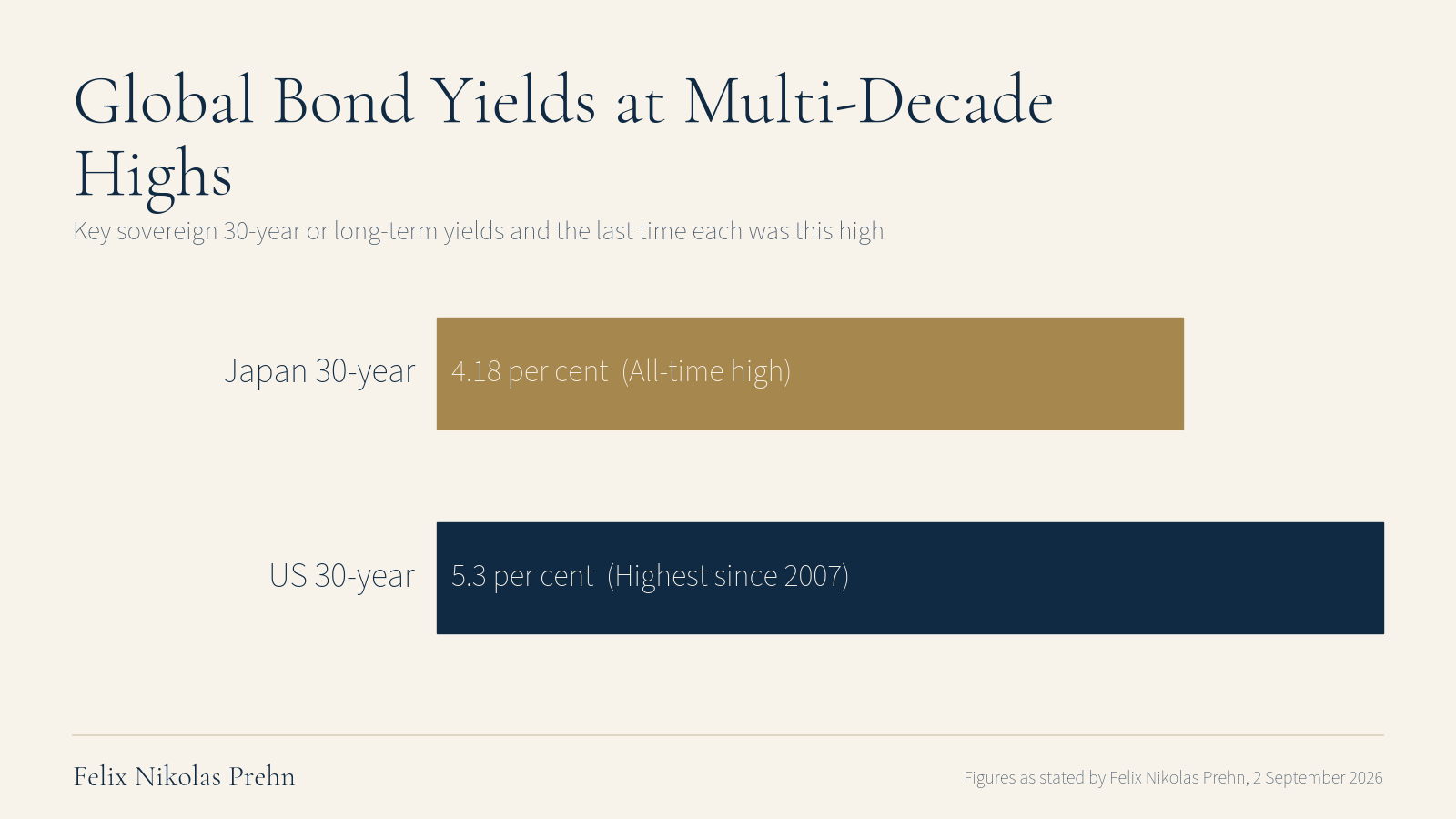
Yesterday, something happened in Japan that almost nobody in America noticed, and it's going to hit your savings before this time next year. Japan's 30-year government bond, and that's just the IOU the government hands out when it borrows money for 30 years, jumped to 4.18 per cent. And I know that sounds incredibly boring, but it's the highest it's ever been, ever. And I truly know you'll feel like Winston had a lie down when I mentioned bond yields in Tokyo. It sounds like the most far away dull thing on earth.
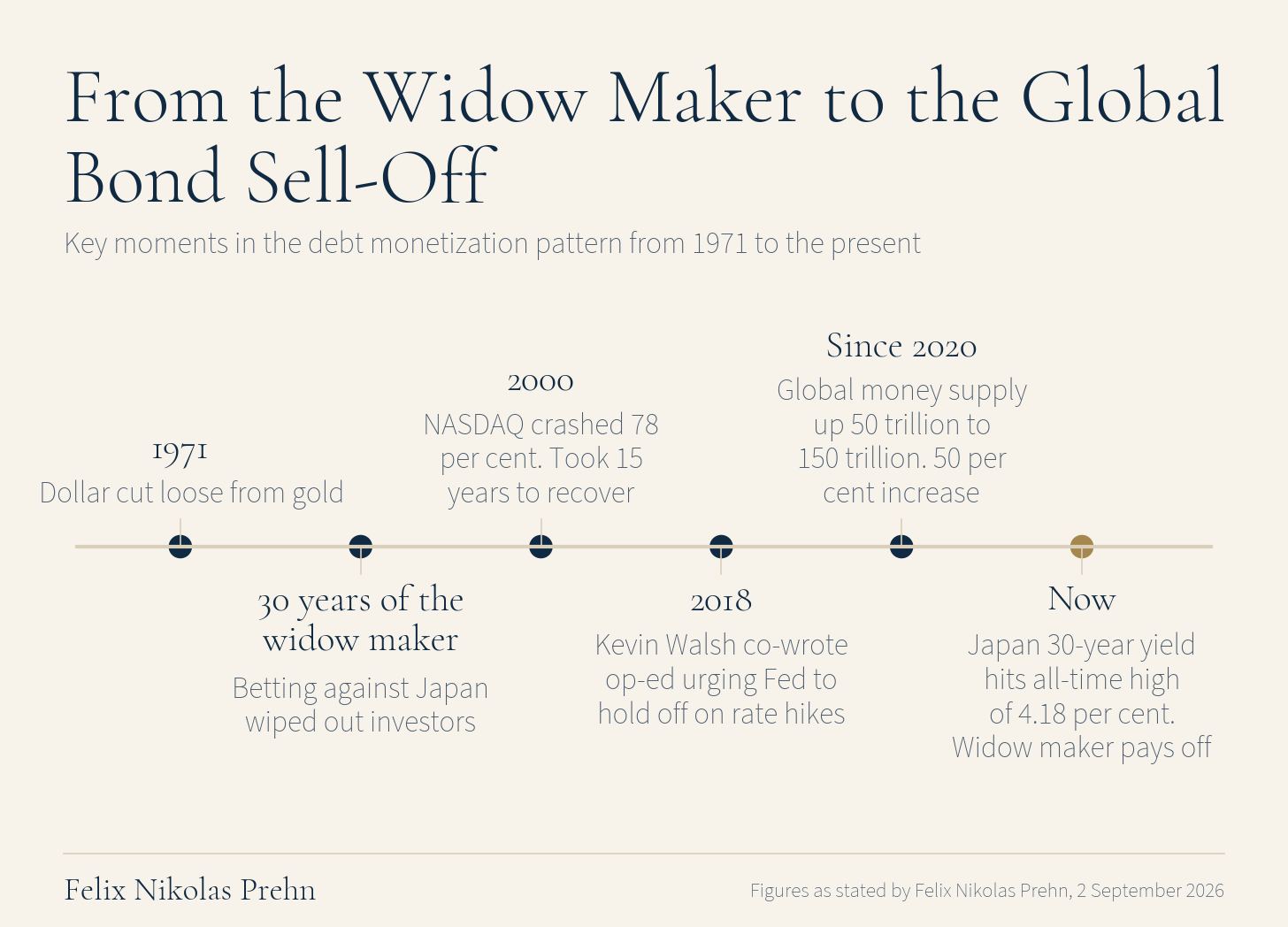
Like it has nothing to do with you. But give me two minutes because it's probably the most important number for your retirement right now. And I'll show you exactly why. So the first thing you should know is that for the last 30 years, there was one trade on Wall Street so dangerous that they literally nicknamed it the widow maker. It was betting that Japan's borrowing costs would finally blow up.
And for 30 years, it wiped out every single person who tried it.
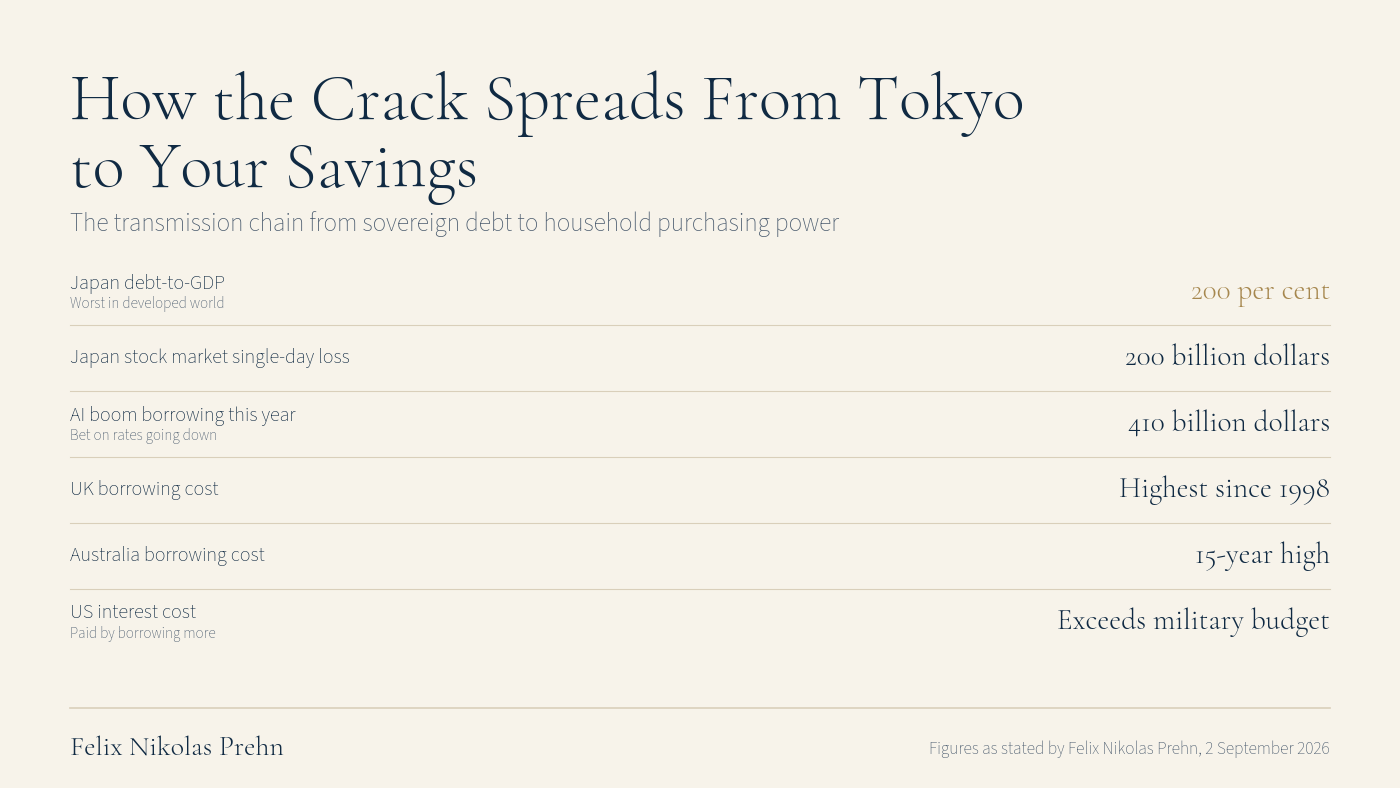
Yesterday, the widowmaker woke up. And overnight, Japan's own stock market lost more than 200 billion in a single day, led exactly by what? Yes, the tech names that everybody thought were bulletproof. Here is the heat map of the Japanese stock market. Not very pretty, right?
And the part that should matter to you is that this isn't some tiny country you've never heard of. This is Japan, the third biggest economy on the planet, the careful one, the one where the trains run on time and everything just works wonderfully. And in my humble opinion, Japan is about 10 years ahead of America on the exact same road or even railway. Too much debt. A central bank that printed money for years to hold it all together.
And now the bill is coming due. What cracked in Tokyo yesterday is a dress rehearsal. Well, what's coming to Washington or rather New York really and to your portfolio. My name is Felix Breen. That's Winston back there with all the hard research.
I used to be an investment banker before I got out and I started teaching regular people the stuff Wall Street likes to make complicated about seven years ago. and we've taught well over 25,000 people these last seven years. And if there's only one thing I want you to know about me is that I never take sponsors. I was never an affiliate link anywhere or, you know, a stock that's pumped because you're getting paid for it. And I I don't judge people to do it. It's, you know, each to their own, but I don't need to.
And therefore, I can just tell you exactly what I think. Doesn't mean it's right. I'm not a financial adviser. I'm not certified in anything other than sort of mild form of lunacy. Uh but what made me want to sit down today and record this for you is that everybody assumes that gold is the escape hatch for all of this. the thing that saves you when the money breaks.
And gold's been on a pretty decent run. But when I actually sat down and asked whether gold is ready, I mean, ready for what happens if Japan and then the dollar go the way these numbers say they're going, the answer, well, it sort of unsettled me because gold isn't ready, not the way you think it is. And most of the people who believe they own gold actually don't own any gold at all either. So for the next 20 minutes, only one question really matters. When the same crack that just opened under Tokyo opens up under the dollar and the New York Stock Exchange, I'll show you the charts saying it already is by the way.
Are you actually protected or do you just think that you are? And before we go deep into this, let me do the useful thing first. Everything I'm about to walk you through, what's breaking in Japan, why the dollar is on the same road, the whole is your gold real thing. I've written the whole thing out in plain English for you, what happened, why it matters, and and and the simple twominut check you can you can apply to see whether your metal is real. And it's completely free.
There's no catch. You just download it. You go to felixfriends.org/japan because that's what I'm worried about, what happens after Japan. And the links are down in the description, obviously. So, so grab it and then come straight back to this and then we're going to have some fun.
Well, some slightly unsettling fun. But I really mean it when I say this. The fact that you're even here sitting with something like this instead of like, you know, doom scrolling, it actually puts you ahead of 99 per cent of people because most people will never spend 20 minutes trying to understand what's happening to their own money until well, it's too late. So, you're doing the thing that they won't. So, give yourself a little bit of credit for that and and let let's keep going.
So let me explain the widow maker properly because this is really important. For 30 years, smart people looked at Japan and said the same thing. This can't go wrong. Japan owes about 200 per cent of its entire economy in debt, right? Almost doubled in the US.
It's the worst in the entire developed world, you know, excluding sort of tinput, you know, African countries or something. And no offence to tinput African countries, but yeah, you know, your basket case of a government is a bit of a joke.
So investors kept betting that Japan's bonds would blow up and that their interest rates would shoot up and they kept losing money again and again and again and it was so reliable that the trade was named after you know the widow maker. So why did they keep losing money? Because Japan did the smart thing, the thing Bessend is doing right now. their version of the Federal Reserve stepped in and became the buyer when nobody else wanted the government's debt. So, it created money out of thin air and it bought the debt itself. And it kind of worked well until it doesn't because the price you pay for that is your currency.
The Japanese yen has been getting weaker and weaker and weaker, and ordinary Japanese savers have watched their spending power bleed away for years. I'm actually planning a Japan trip right now. It's marvelous. It's far far cheaper now than when I first went there. But obviously for the people it isn't great.
So what's just changed?
Well, the Japanese 30-year interest rate went to the highest level in history. So the widow maker finally paid off. The dam they build started to leak and the stock market got the message. Two and a billion dollars of money just vanish. So to me, Japan is the very beautiful canary and the perfectly run and immaculate coal mine.
Um and and it shows a very heavily indebted country, including America, exactly how this plays out. First, the debt piles up, then the interest rate becomes unpayable. Then the central bank steps in and buys the debt with printed money, and then the currency pays the price. So keep your eye on Japan because whatever happens there is coming to your economy. Europe is the same, by the way.
The UK is the same. And the thing that genuinely worries me for everybody out there is this. Everything I've just shown you, everything I'm about to show you, the government drowning in debt, the interest cost exploding, it is happening at the exact moment the biggest speculative bubble since 2000. The AI bubble is here.
And I want to be careful here because I'm not an AI hater. AI is real. It's glorious. It's changing the world. But the internet did it too, didn't it?
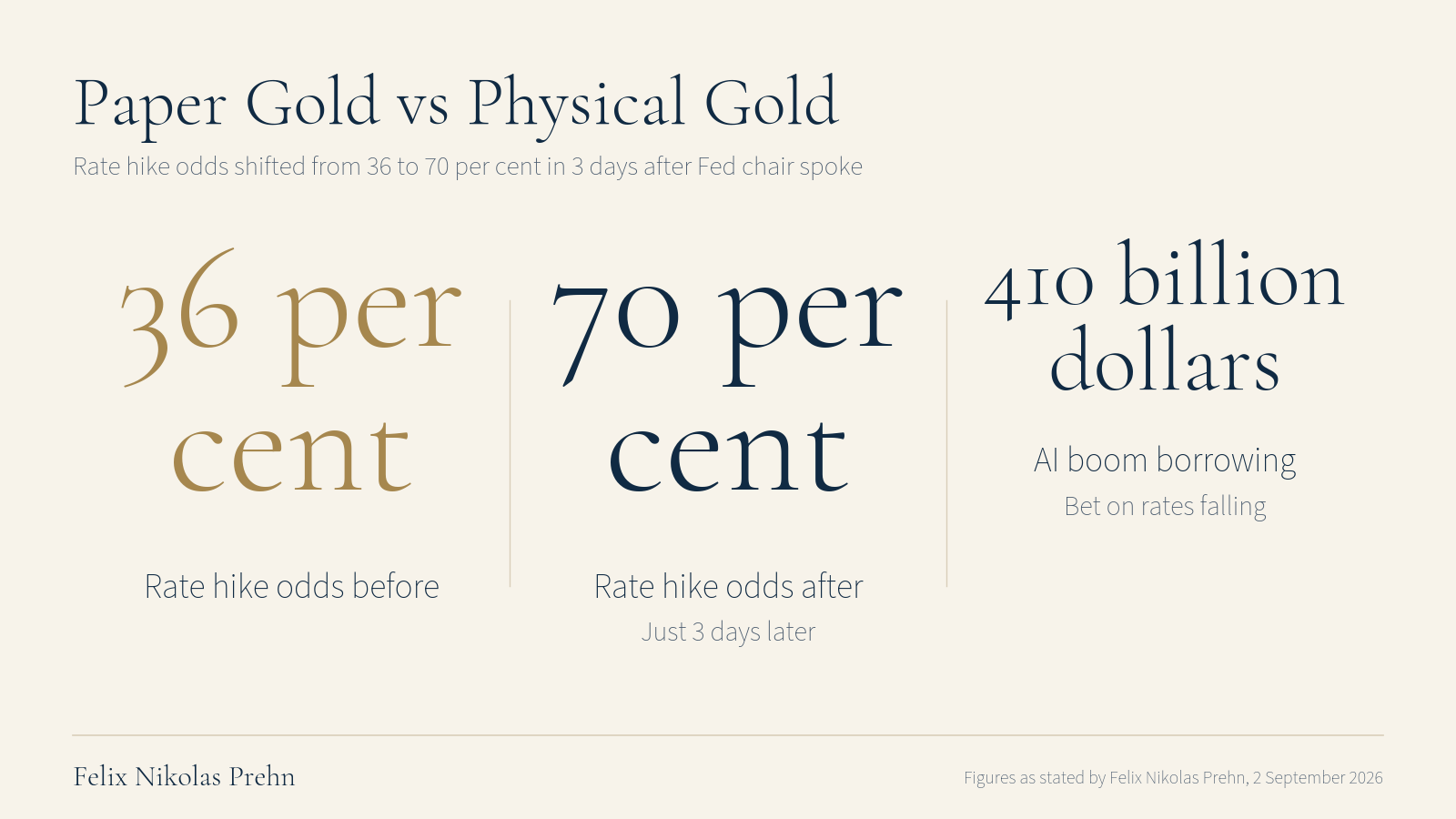
You're watching this through the internet. And that's the point because the companies that borrowed to build this AI boom just borrowed 410 billion this year so far. A lot more spending planned. And they did it that betting that interest rates would go down. Now rates at the moment are going up.
Look at the chart on the screen here. Global yields, which is a fancy word for interest rates, are the highest they've been since 2000. And these things, yes, they do tend to rhyme. And then one of Warren Buffett's henchmen just said this, and I haven't been able to stop thinking about it since he said it. And he said, if you wanted to own the obvious winners of the internet, you know, in 2000, the can't lose kings.
They were Cisco, Yahoo, and AOL. Two of them disappeared.
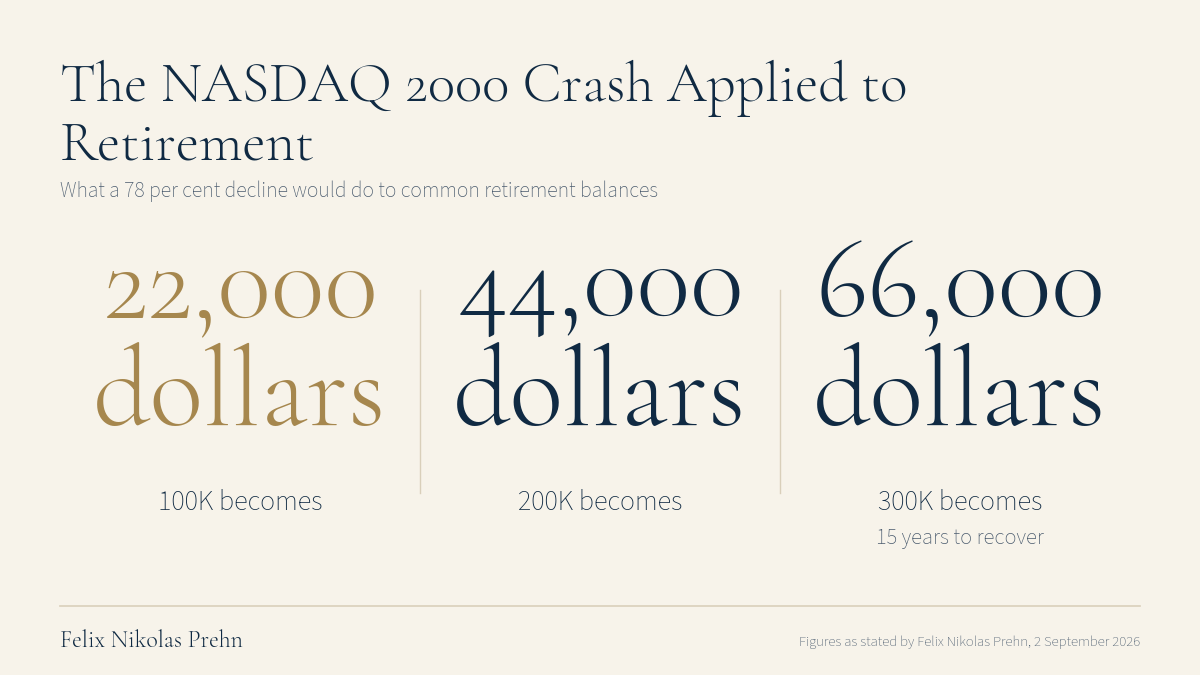
The third never recovered, which is Cisco. And the technology was real the whole time. So imagine you're 55 years old. You're planning to retire at 65. You've got 100K in your retirement account, which is average.
Maybe you've got a bit more. Well done. Now imagine the AI names that everybody owns. Do the thing that happened to these internet darings. The NASDAQ crashed 78 per cent in 2000.
It took 15 years to come back to where it started. So you $100,000 becomes $22,000. And say you have $200,000. Well, it becomes $44,000. you've got $300,000, it becomes $66,000. And it goes back only to where you started when you were saved.
And I'm not trying to scare you. I'm just saying this happened to millions of people and the valuations today are worse than they were back then. So, what do you actually do about it? Well, yes, gold might be part of the answer, and we're going to get to that. But how do you really protect your pension, your retirement, your 401k, your index funds, all that stuff?
Because the kind of crash that history keeps us, keeps telling us is coming is something you need to be prepared for. And my goal is to teach you properly what to do about it. It's going to take me about two hours and I want you to be able to ask me questions in real time. So, I'm going to do it live and I'm going to do it this Thursday evening because we've done something similar last Saturday. More than 7,000 of you showed up, but a couple of thousand of you emailed me and said, "I can't do Saturday because I don't know why, but you could." So, we're running it one more time.
This is part two. If you missed part one, you're going to benefit from part two. If you were a part one, come and join us for part two and you'll learn a bit more. And you can join us there completely for free at survivethebubble.com. And that's kind of at my in my view at the moment the most important thing we're doing here in this community is teaching people how to survive the bubble, right?
So, if you're going to shop for yourself, let's have some fun. Write the word thrive in the comments so I know you're in because thriving is what we want to do.
We're not not a panic channel here. So, links in the description. Write thrive in the comments if you're going to be there. Let everyone else know that you're going to be there. And let's get into act number two.
The dollar is on the exact same road as the yen because this isn't a Japan story. Global yields, fancy word for interest rates, hit the highest level since 2008 and since 2000, right? Let's put that up for you. US 30-year yields just touched 5.3 per cent. We hadn't seen this since 2007.
What happened up to 2008? Well, the UK's borrowing cost hit the highest since 1998. Australia hit a 15-year high. Every major economy at once, and the Financial Times called it a global bond sell-off. This isn't one country having a bad week.
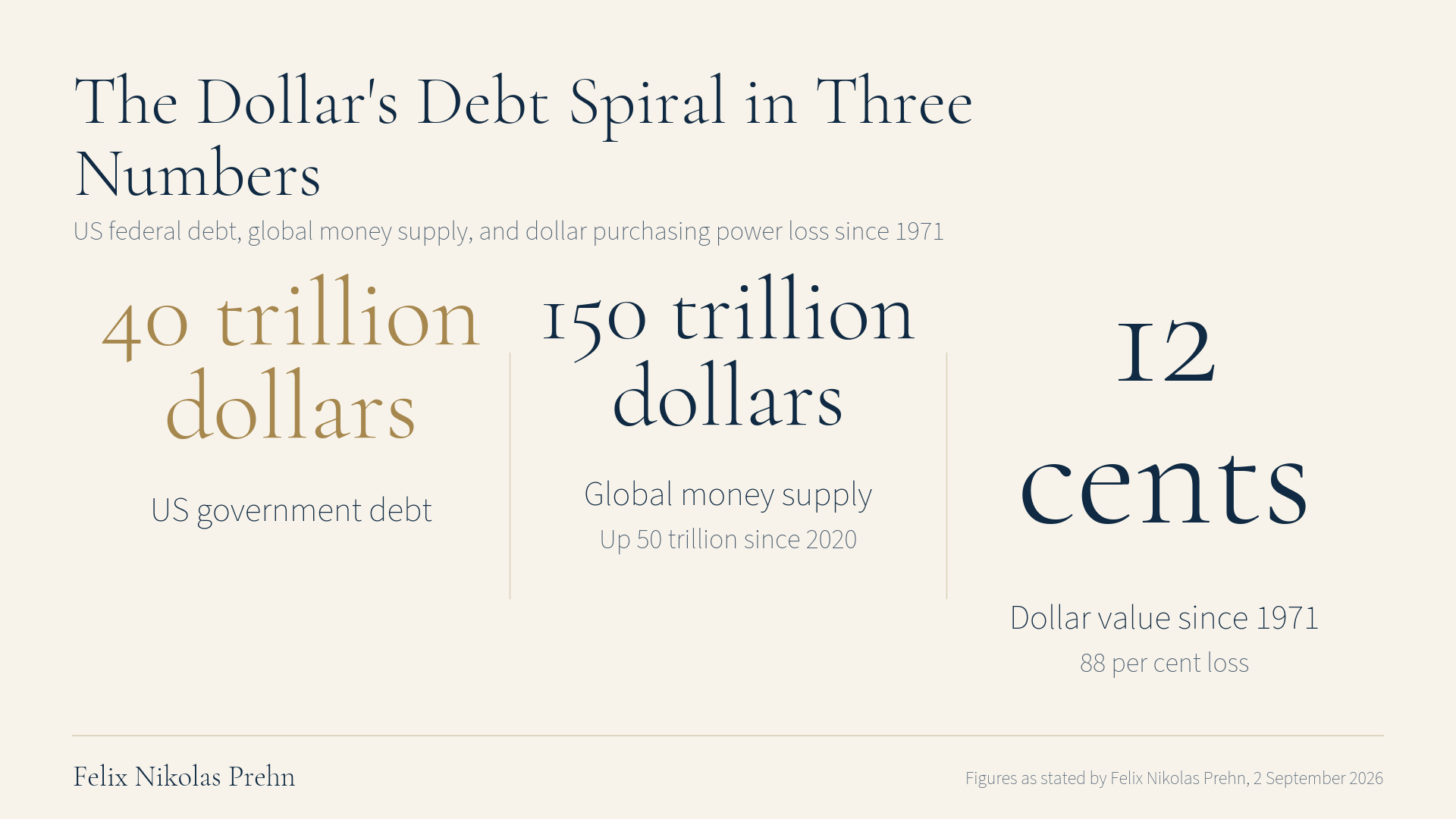
It is the whole system repricing at the whole time. And the numbers are pretty bad in the US. You already know this. 40 trillion debt and so on, yada yada yada. What does it matter?
The total isn't the scary part. The scary part is that the interest is at insane levels and the interest is so high that it's more than the US military, which is kind of absurd, isn't it? So, how do they pay for it?
Well, to pay for the interest, they borrow more. More borrowing means more debt. More debt means more interest, which means borrow more to pay for the interest. And that, my friends, is a Ponzi scheme. But maybe you're thinking, well, look, it's the government's problem, right?
Well, three ways out of this. You can grow your way out of it. That's never going to happen. Door two is just you stop paying for the debt. Well, the world collapses and we all live on, you know, sadines or something.
That isn't going to happen. So, they're all going to go for door number three, which means inflation, quiet inflation, money printing. Let the dollar lose value like the yen has lost value. And here's the proof. The proof that's hitting your bank account, your salary, your portfolio.
Because shrinking the value of the dollar means shrinking the value of your dollars. Your savings are part of the bill.
Your paycheck is part of the bill. And if you live in the UK, same problem. If you live in the, you know, Soviet states of Europe, you got the same problem. Same story, just a different currency. The world's money supply just hit 150 trillion.
It's up 50 trillion just since 2020. So it's all the money all the money in the world has gone up by 50 per cent since 2020. Not because the economies grew. No, just money being printed to keep the Ponzi scheme alive. And here's what it does.
We can go back in history. They started this in 1971. Well, a 1971 dollar, you know, when it was cut loose from gold, the dollar is now worth 12 cents in purchasing power. So, you have a $100 bill, you know, from your grandfather or something from 1971. Maybe you're that old. Offend most of the audience.
You know, that's always a good strategy, isn't it? Um, well, that $100 bills will buy you $12 off today's stuff. So, nobody stole the money. It just got diluted, inflated away. So gold, this is the bit that people get wrong and it's the reason for the title.
Everybody assumes gold's lifeboat. And historically, they're not wrong. When the money breaks, gold is what holds value, right? Currencies come and go, but gold sticks around. So you just think, "Oh, I own some gold.
I'd be covered." But when I actually dug a little deeper into this, I found two problems. Problem number one is the market isn't ready.
There's something most people never think about. There is far far more gold being traded than there's actual metal metal sitting in vaults. And for every real bar, there are many many many paper claims floating around, futures, you know, contracts, promises, you know, fugazi. So, as long as everyone stays calm and hardly anybody asks for the metal, it works fine. But if Japan and the dollar go the way these numbers point and everyone reaches for the real gold at the same time, there isn't enough physical metal.
And that's what I mean when I say gold isn't ready. The demand that's potentially coming is far bigger than the metal that's actually available to deliver. Problem number two is this. A lot of the gold people think they own isn't really ready either. Because people say they own gold, but a lot of what they own is paper.
They bought a fund with gold in the name and assume it meant somewhere there is a bar with their name on it. Often there isn't. A lot of these products are just tracking the price. future swaps and IOU with no real metal behind them or metal you could never actually claim.
So in the exact scenario where you want to get gold the most when the paper promises are breaking, you'd be holding a promise, right, from an institution that's going to be in trouble. And if you want to check if the gold funds you own are really gold, um I'll put a link down below to this. It's a tool that I built for myself and then I I make it available to you guys. Um, and you can go into funds here and click on the gold filter. Show you basically all the funds in the world.
And it'll show you whether they hold gold bars, right? And some of these do, some of these don't. And it works for everywhere in the world. But even the ones that do, you can click into those, and it'll tell you what it actually owns. It'll tell you whether you can actually redeem it for real physical gold and and all that kind of stuff.
So very very important you understand what you own here. So there's a link down below. Um I can't remember what the link is but it's something to do with Winston which is what the app's called. So you can check that out. The other part that I absolutely love about this I stopped reading the news completely.
Um I just get um news here. This is a example portfolio but um it'll show you only news on the stocks you own and why they moved. It does that live for you which is very very cool. And then you know the market in a minute you get that every day. in that way you can turn up all the other noise out there that's um trying to get your money. Now, let me show you something about what the smart money is.
And smart money is the wrong term because you know smart money implies that they're smarter than you and they're not. They're skilled. They learned a skill.
It's like someone who's better at golf than you. Well, they had a better coach. They practiced for longer, right? Very little of that is actually some god-given, you know, skill. It is just a skill that's learned, right?
You learn to ride a bike and swim and drive a car and do all the other things you do in life. It's a skill. So, money managing is a skill. But back in 2018, two men wrote an oped telling the Federal Reserve to hold off on raising rates. One of them was called Kevin Walsh, and he's now the guy running the Fed.
And and in just 3 days, the market's bet on a rate hike this month jumped from 36 per cent likelihood of a rate hike to 70 per cent because Kevin the Walsh was talking tough uh Jackson Hole. Now the read that a lot of skilled people I know are having is this and I want you to see this. Um the tough guy act buys the Fed some credibility, right? But at the same time, a deal gets done with Iran. Oil gets crushed and lower oil means lower inflation, which means we can now cut interest rates.
And it lets the market rip to new highs, what everyone declares a golden age. Now, I can't tell you whether that's the exact script because, you know, I'm not running the show. But the point is this. The people at the very top are playing a chess game with with your money and they're not playing it to your benefit. The bond market is breaking everywhere and it's the one player out the table that can't really be be spun and manipulated.
It's telling you what the money is doing and I always follow the money and it's telling you there is more fear in the air. So the question from the top of this video that comes back around is this. They can see the crack forming. The skilled money can see it. The only question is whether you are positioned for it or just assuming that you are.
So, I'm not the guy in a bunker telling you the world's ending and load up on ammo and sardines or the Winston would enjoy the sadines. People have made money through every one of these episodes. The ones who got hurt were the ones who didn't see it coming.
They read about it afterwards because nobody explained it to them, at least not in plain English. So, my whole purpose and mission here is to make sure that that isn't you. So, let me leave you with the whole picture in one breath because it's quite a lot. Japan's borrowing cost hit the highest in history. Bond yields around the world are breaking out across the world to 2007 to 1999 levels and the global money supply which money is being printed is at 150 trillion which is a 50 per cent increase since 2020.
So, they're being printing money. The dollar lost 877 per cent of its value since 1971. I actually think it's a lot more but that's the official number. And that's all happening while we're in the biggest bubble since 2000. And everyone thinks that the gold stuff will save them.
But actually, most of you don't own any real gold, right? So the gold is insurance if you own the physical stuff, but it isn't actually the thing that makes you wealthy. I always say gold doesn't go up, the dollar goes down. It's a bit harsh, but it's kind of true. So what's happening to your money right now?
Whether or not you have a plan, well, it's happening. And I know most people have no plan. So join me this Thursday night. I think it's 8:00 PM New York time. It's completely free.
I'll teach you for about two hours. I'll walk you through exactly what the skilled money is doing, what they've taught the other people who are now skilled money and how it impacts you, your pension, your portfolio, the decisions you can make right now. It's free. It's live. Bring your questions and let me know if you're going to show up. and by writing thrive in the comments because I don't want you just to survive this.
I mean, most people survived 2000, but it wasn't very much fun. I'd like for you to come out of this better than you went in. So, you already watched an entire video like this that puts your ahead off almost everybody out there. So, going to do the small thing that really makes it counts and I'll see you on Thursday night. All the best.
Ask a hundred people what really moves the stock market and you'll hear the same handful of answers. the Fed earnings, Elon, Trump, the jobs report, Winston and almost nobody.