Transcript
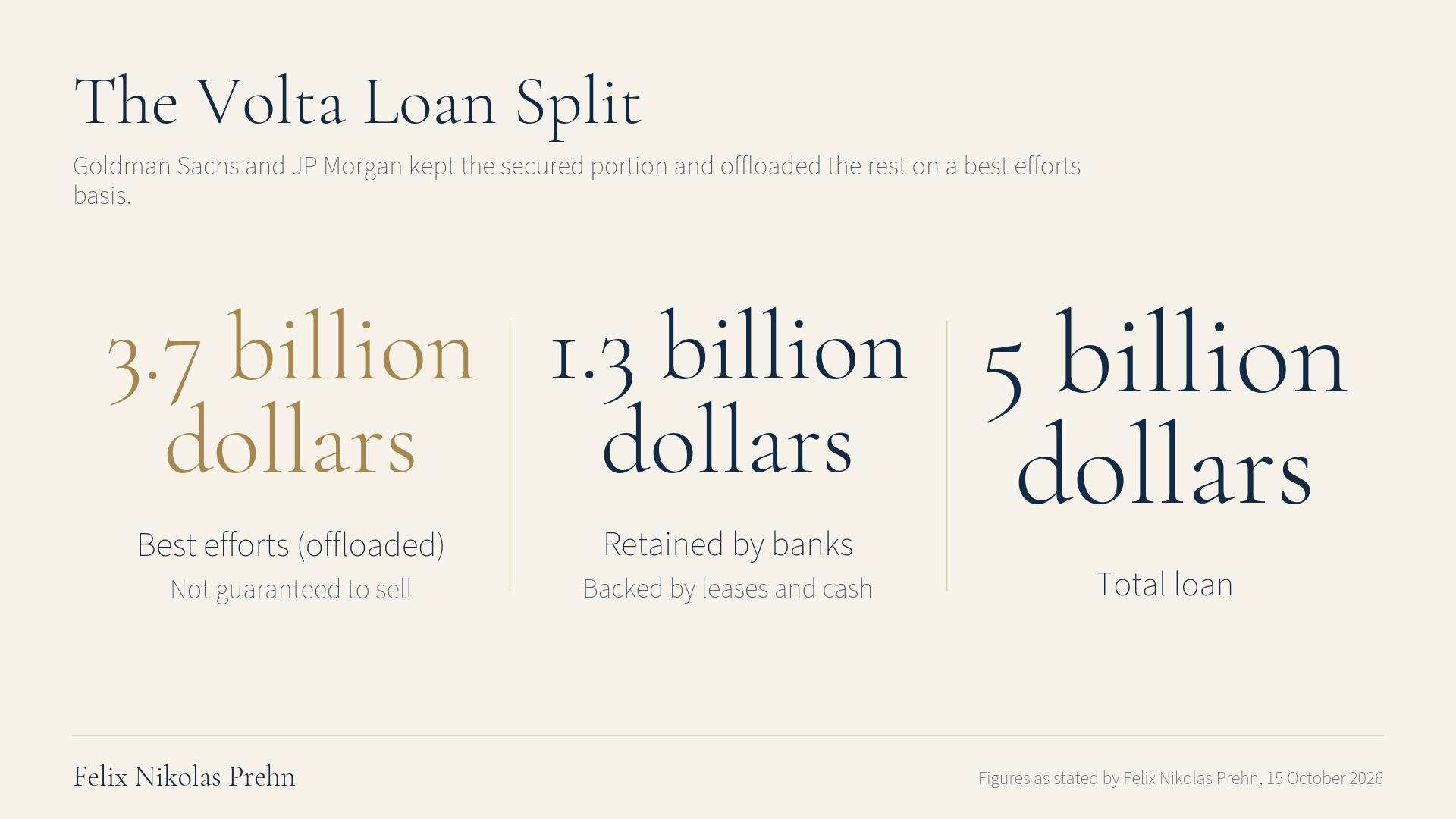
The two most powerful banks on Wall Street just agreed to arrange a $5 billion loan and then they refused to hold any of it. So they banked the fees and they passed the risk onto somebody else. Now that loan wouldn't be that unusual, but it is for AI chips, 36,000 Nvidia chips. It's basically the thing that the entire world has decided is the future of everything. And the banks arranging this deal, Goldman Sachs and JP Morgan, apparently are not willing to bet their own money that this particular future pays off.
The thing I want you to understand, the thing nobody on financial news is connecting clearly right now, is that this is not really an AI story. It's a money story. And the people who move trillions for a living are doing something very quietly that you need to know about. So this video is not about whether AI is good technology or not. It probably is. But this is about who's paying for it, who's taking the risk, and who quietly gets to walk away with just a fee and no risk.
Because those three groups of people are very, very different. And it matters enormously for your money to understand the difference. My name is Felix Nikolas Prehn. I used to be an investment banker. I'm also the founder of the Prehn Institute where we do financial market research and we also provide instructions to people willing to learn. And from everything I've read in the last 24 hours about these deals happening right now, I think they know something you don't.
So by the end of this video, my promise is that you will know what they know. Just give me a few minutes and I'll make it very, very clear for you. But I will also, because a lot of data in here, a lot of information in here, I'm going to put all of this together for you into a free report and you can download and learn what's happening inside the AI market. Who's holding the risk and what it might mean for your portfolio and your savings. And it's completely free and it's waiting for you just at the link below this video. Just click it, read it, share it with anybody who wants to see it.
The reason I'm recording this for you is very straightforward. Most people will see a headline saying Goldman's bullish on AI and they'll act on it and they will not hear about the best efforts clause. They will not read the interest rate comparison. They will not see the trading desk note that says something very different from what the analyst published. And they're not meant to see it.
But you're here. And the fact that you're here genuinely trying to understand what is underneath these headlines already puts you ahead of 99% of people and I really, really mean that. The vast majority of retail investors never ask why a bank is recommending something. They just act on the recommendation and the machine is designed well to basically make it work like that. But you're not most people, you're watching something that's a little bit more in depth here. So brilliant, let's jump straight into it.
Now, first we need to understand the business model. Not just Wall Street jargon here, but the actual mechanics in plain English because this one key unlocks everything else that I'm going to explain to you next. So when a bank arranges a loan, they earn a fee. When they publish a price target and tell you to buy a stock, they earn fees from the trading activity that follows. So whether you win or lose on that trade doesn't really matter to them. Their business model is the transaction. Your outcome is your outcome, not theirs.
Think of it like a car salesman. Not that we would ever of course compare the mighty investment bankers to car salesmen. No, no, no. They are glorious, upstanding, incredibly intelligent, wonderful, handsome, 6'9 giants of humanity. I think we've sucked up enough, haven't we? So anyway, a car salesman does what? Well, he earns a commission. Whether you love the car for a decade or if it falls apart in 6 months, the sale is the product. What happens to you after the sale is nothing to do with them.
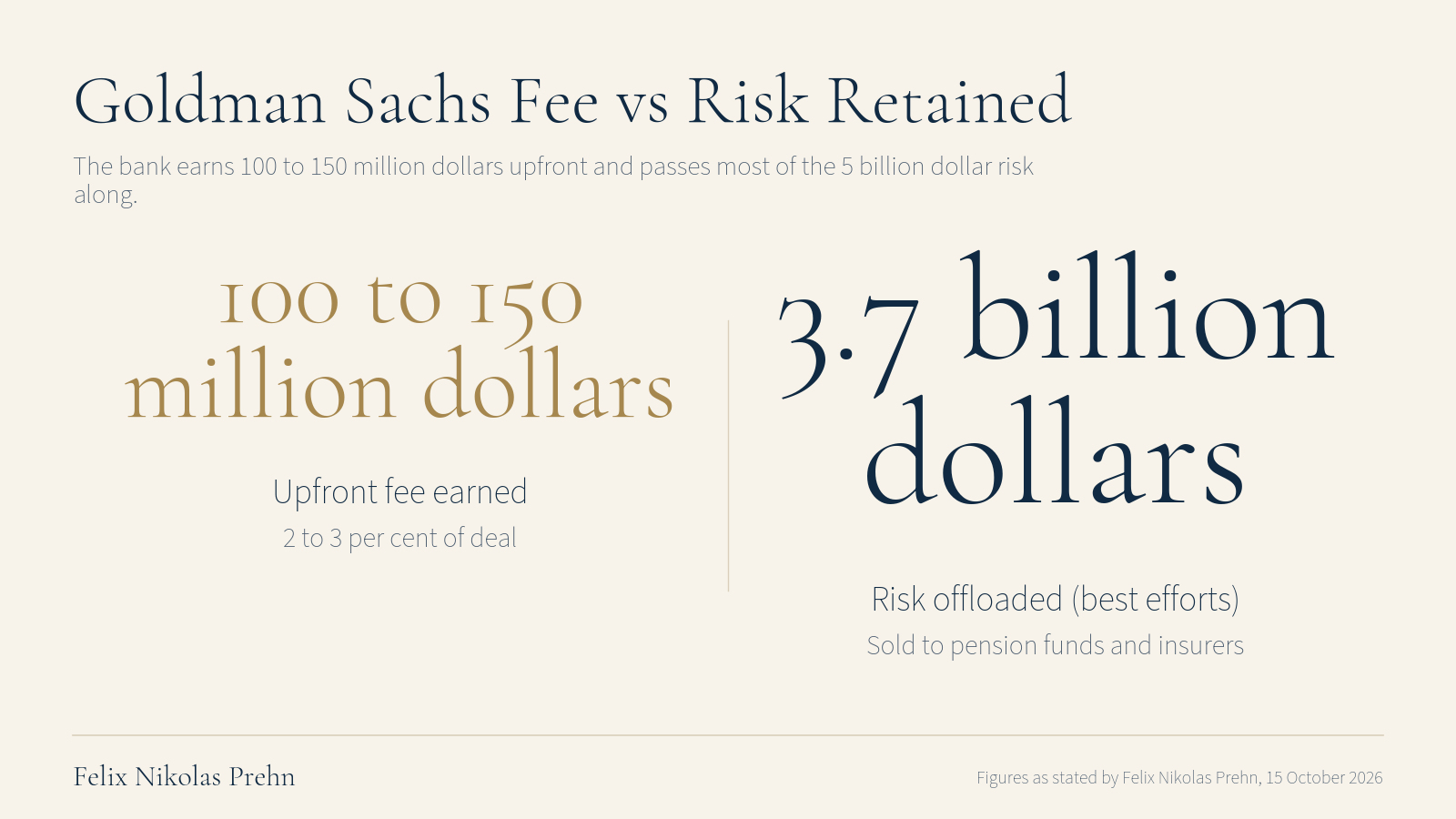
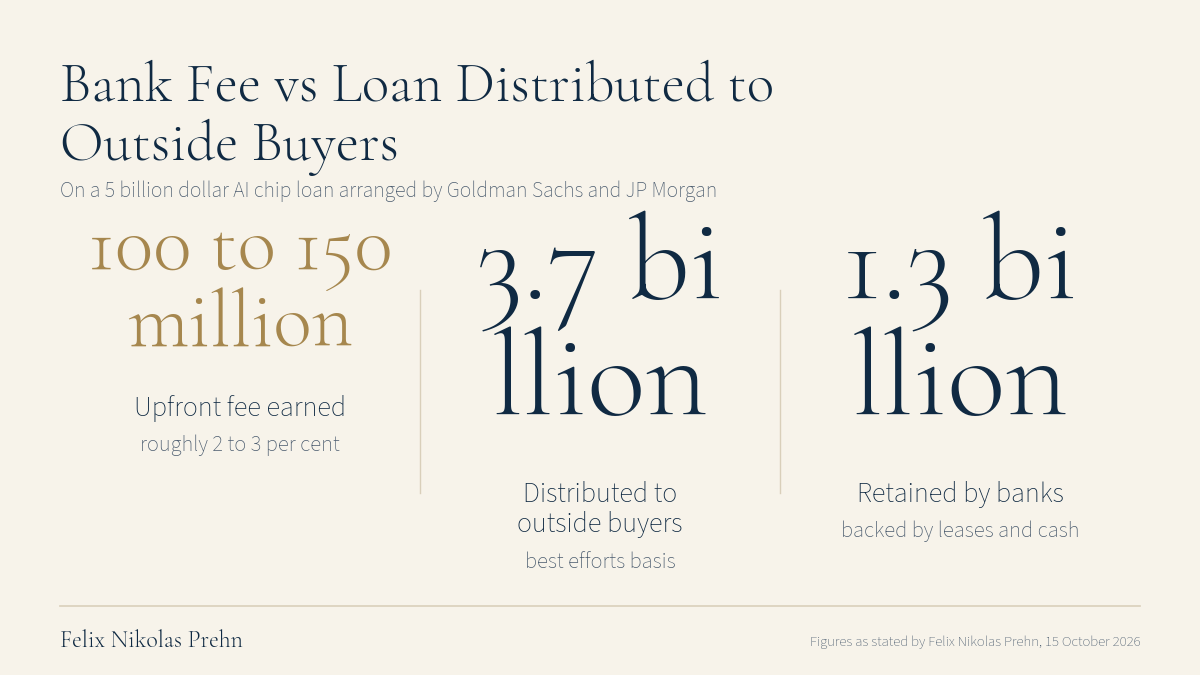
Now let's apply that to the wonderfully amazing, intelligent, generous people at Goldman Sachs. Well, when Goldman arranges a $5 billion loan for an AI company, they get 2 or 3% of that deal up front. And that's about $100 to $150 million a deal right now. So they earn it the moment the deal is done. Not over 5 years. They don't care if it gets repaid. They don't care if the borrower stays solvent. The moment the paperwork is signed, the fees are in Goldman Sachs' accounts. Everyone gets their bonus. Everyone goes and buys another Ferrari and a yacht and the trickle down effect to mistresses around financial cities.
So Goldman Sachs has an enormous incentive to close deals and a very, very limited incentive to worry about what happens to you or to the borrower 5 years from now. It is not their job to worry about the kittens. But the mechanism goes even further than that. Goldman does not want to sit on the loan once the deal is done because holding a loan ties up capital money and it means Goldman has to set aside money in case the borrower defaults and that's expensive and it limits what they can do with their balance sheet in the next loan they're going to arrange.
So they sell the loan. Who do they sell it to? Pension funds, insurance companies, private credit funds. So it's the institutional investors who manage your retirement savings and the loan goes out, the fee stays with Goldman Sachs and the risk is now somebody else's problem on somebody else's balance sheet. Now this is not illegal. This is not even unusual. It's the exact architecture that's run investment banking for decades. And of course nothing ever went wrong. 2008, no, nothing ever went wrong. So it's how this works. It's how the mortgage backed securities market worked in 2005 and 2006. It's exactly how the AI chip loan market is working today.
Now think about what this structure does to the information environment around you. Goldman's research analysts publish a note telling you to buy Meta stock. AI is going to drive earnings much higher, they say. Are they wrong? Possibly not. Maybe they're completely right about Meta. But they're also generating trading fees from every investor who acts on the recommendation. They're maintaining Goldman's relationship with Meta's management for the next deal. And they're supporting the conditions that make it easier for Goldman to arrange Meta's next bond offering or share placement.
So the analyst covering Meta works of course in a different part of the building from the banker arranging the AI chip loans. They're legally separate. There is a wall in between them. The two will never speak. But they both work for the same institution. And that institution earns money from your transactions, not from your returns or your outcomes. So when you hear a strong buy recommendation from a major bank on an AI company, you're getting information, yes. But it is real information produced inside a machine that earns money when you act on it.
And once you understand that machine, the whole thing falls into place. So keeping that understanding in your head is probably the most important thing you can do right now to protect yourself. Let's dive a little bit deeper. So that's the machine. Fee upfront, risk transfer to someone's pension. No consequences if it goes wrong, at least not for the bank or for the banker.
And that machine is running at full speed right now in AI, in energy, in oil, and the petrodollar, the whole thing. Because what they're not telling you, while they're really busy collecting fees and moving risks to somebody else, is that the AI story and the oil story are actually not two separate things, they're the same story. When the money financing AI starts pulling back, we're going to show you exactly why it already is. The energy projects that depend on that computing power, they start to stall. And when those projects start to stall, the oil price does something very specific, something the people who trade oil for a living are watching very carefully right now.
Now that is a skill that you were never taught, which isn't your fault at all. But you now know it's a skill. You also know that you can learn skills. You've learned many a skill, walking, swimming, cycling, hitting a ball, that sort of thing. And if you want to protect what you've built so far with all that hard work, I believe it's your responsibility to now learn that skill. So I'm going to teach it to you for free. I'm going to teach it to you for free this Saturday for about 2 hours and I will teach you how it affects your portfolio and your pension and how the smart money is positioning right now before any of this lands on the evening news or whatever. So if you want to join us, get your free seat at petrodollarshock.com. The link is down below in the comments and let us know you're coming in the comments.
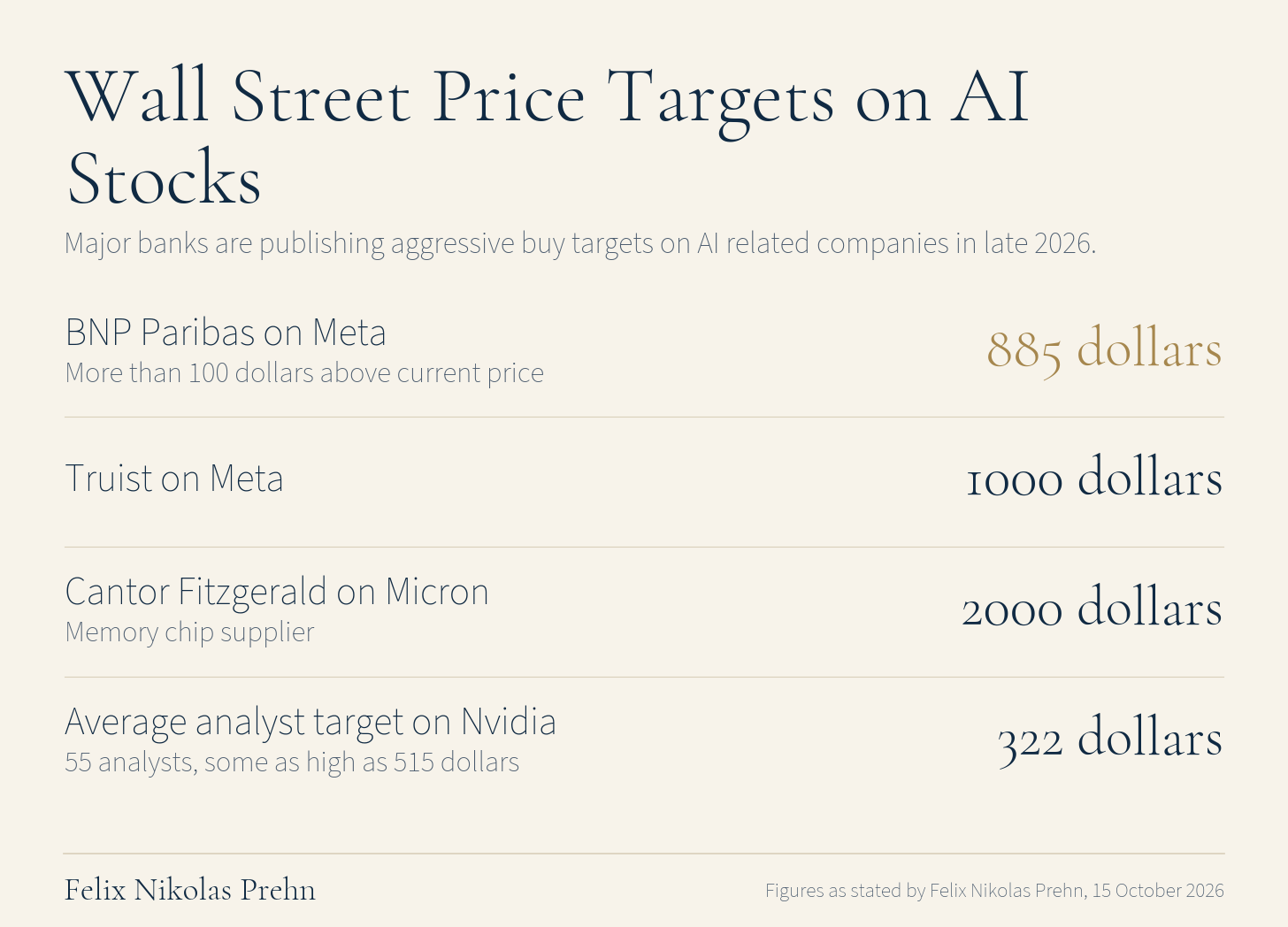
Now let's look at what these same banks, the ones who are offloading the AI risk, are telling you to do with your money. So there is a French bank. It is called BNP Paribas. It is one of the biggest banks in Europe, at least that's what they say, and it has a price target on Meta just out today of $885. Now Meta is currently trading more than $100 below that. So BNP is telling the world buy Meta, there is 16% upside here.
There's another bank called Truist. They say Meta is worth $1,000 per share. So if you own Meta now they're saying it's still cheap. Then we have another Wall Street titan, Cantor Fitzgerald. They have a price target on Micron. It's a memory chip company that supplies the entire AI chip company of $2,000 a share. $2,000. So if you're holding Micron right now, the analyst wants you to think you're sitting on an
Enormous gain that hasn't happened yet. And then Nvidia, the average price target of 55 analysts on Wall Street is about $322, some as high as $515. And their consensus is the single word buy. And they're saying that to you. They're telling that to the media.
Now hold those numbers in your head. Remember the business model. Every time you buy Meta shares because BNB Bara says it's going to the moon, trades generated. Somebody owns a fee. Every time you act on one of these recommendations and move money into these stocks, the banks earn. Every time the AI boom creates enough confidence that these companies want to raise fresh debt or issue new shares, a bank's going to arrange them and they earn a fee for doing so.
So the price targets don't just inform you. They actually create the conditions for the transaction machine, for the fee machine to keep running. And I want to be very precise here. I'm not saying the analysts are lying. I'm not saying Meta is not going to $885. It might. Some of these targets might turn out to be exactly right.
What I'm saying is that the function of a strong buy note from a major investment bank is not purely there to help you. It is a commercial signal inside a fee generating machine. And those two things coexist in every piece of research that comes out of a major bank.
And there's something else worth understanding about how these numbers work. When a bank publishes a target, that number gets picked up by the financial media. It gets quoted in headlines. You see the newsletters and on financial YouTubes and podcasts and all of the attention keeps the sentiment environment warm. And a warm sentiment environment is the precondition for new deals, new share offerings, new loan syndications, new fee opportunities for the bank so they can buy more yachts and finance more mistresses.
So the price target isn't just this opinion, it's the infrastructure. The infrastructure for the transaction machine to keep running. Yet there's one other piece of information coming out of the banks. Goldman Sachs has a share trading division, not the research analyst who published the price tag. No, actual traders, the ones who manage real money and watch real money flow every day.
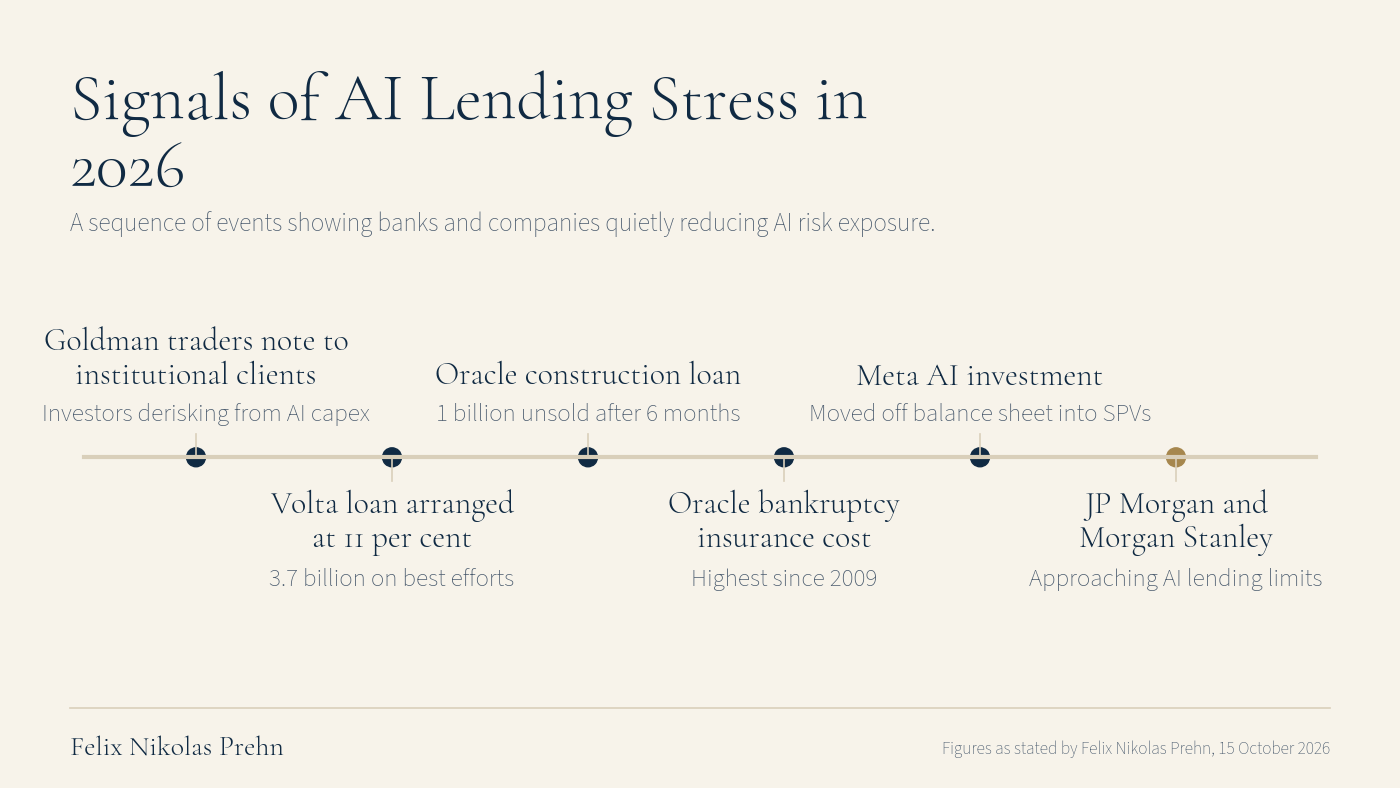
And this week, those traders sent a note to the institutional clients, not to you, not to the financial media, the ones who actually have a lot of money. And the note said that investors had continued to derisk from AI capex. That's capital expenditure and AI financing exposure. It's a direct quote from Goldman's own traders. Derisk from AI spending and AI financing.
So one bank, one week. The research analyst says buy. The trader says derisk, as in sell. And the bankers are arranging loans and selling those into the market on AI. So you get three signals from one institution and only one of those signals is for you.
So the moment, the exact moment where Goldman Sachs analysts are saying buy AI stocks, Goldman Sachs bankers are arranging a $5 billion loan for a company called Volta Infrastructure. Now Volta was founded in 2026. Its origins are in Bitcoin mining, which always makes me feel very confident about a business model. And it's backed by a company called Bitdeer. It's always nice when there's an animal name in the title.
Now, it is of course pivoting to AI, and it has signed a 6-year computing contract with Anthropic, and it's buying 36,000 Nvidia GPUs. It's a serious bet on AI infrastructure just like they were serious about mining Bitcoin.
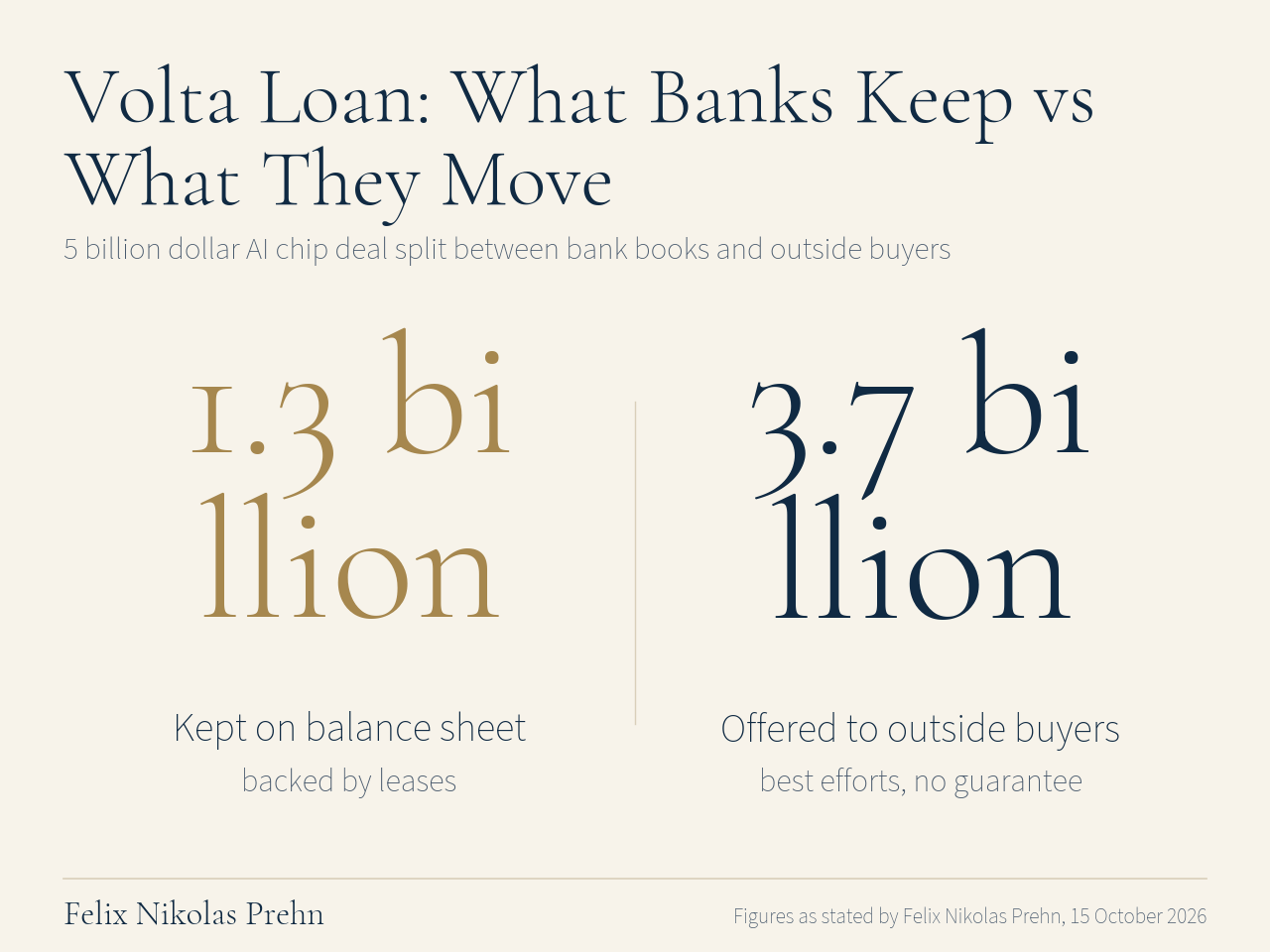
Now Goldman Sachs took their fee. JP Morgan took their fee and then they choose not to hold most of that loan. They put $3.7 billion of that loan out on a best efforts basis. And that little phrase is something you need to understand. Best efforts means the bank will try to find buyers for the loan. It does not mean they found them. It does not mean they're guaranteeing the results. What it means is we will try and if we cannot sell it, we're not on the hook.
So the risk isn't sitting on Goldman's books. It's on whoever ends up buying it, which is probably going to be your pension fund. Now, if you paid attention, you will realise the bank kept some of the loan, $1.3 billion of that. Yes. But that is backed essentially with a mortgage on leases in cash. That's the part the bank is willing to underwrite. They were not willing to underwrite anything that was backed by the chips themselves.
So what backs the chip portion? Nvidia GPUs. 36,000 of them. They're worth a great deal of money today because everybody apparently wants them.
Now, I appreciate this is all very detailed and intricate, but it is like watching a video on the 2008 global financial crisis in 2007 and going, "It's all a bit technical. It's a bit boring. I shall go and watch a video of a kitten," which is a reasonable thing to do.
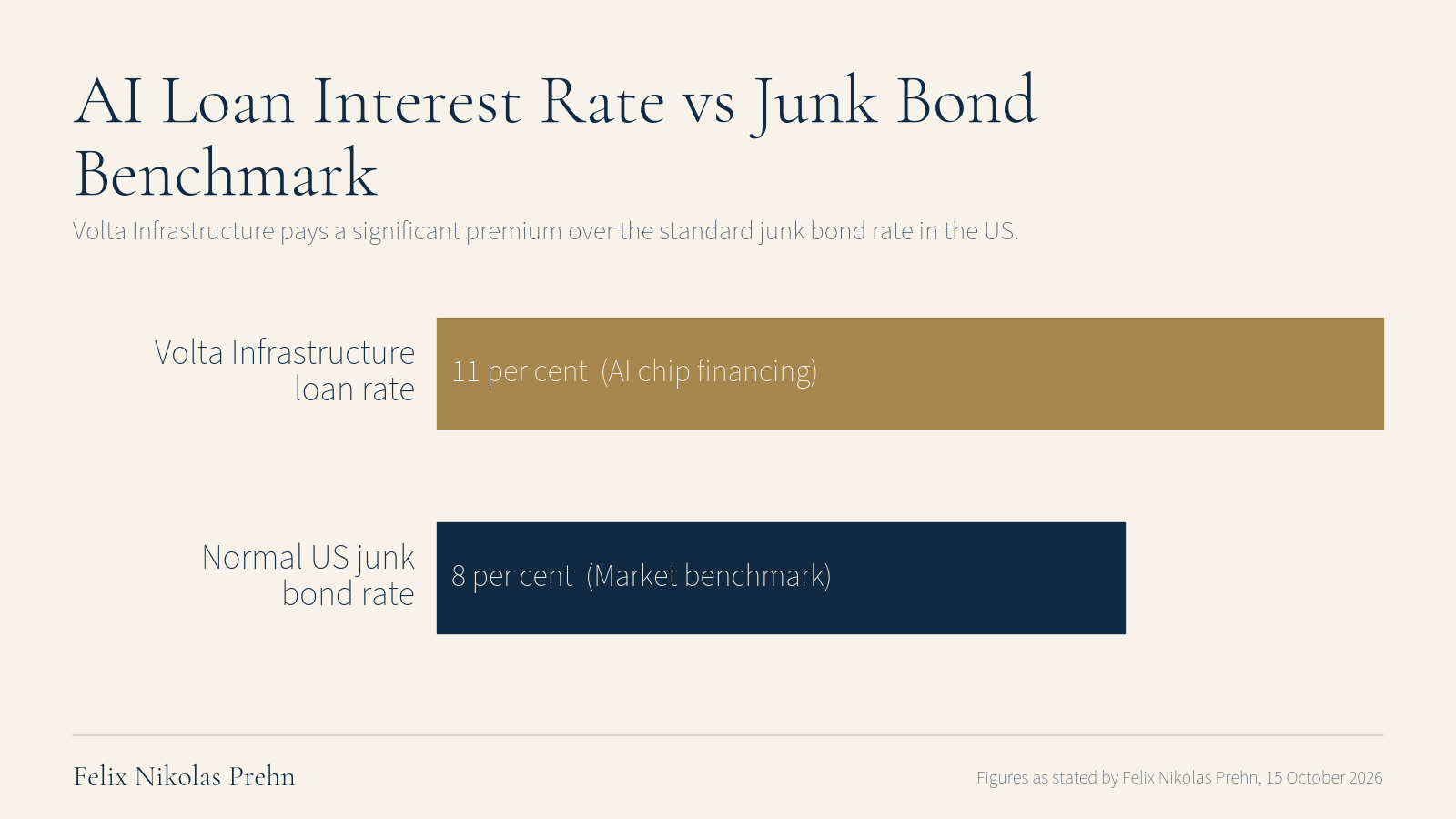
But give me another minute. The interest rate on this loan tells you what the market thinks about the risk. The interest rate on that loan is 11%. Now, a normal junk bond in America, which means you have a pretty crummy business and you're borrowing, is 8%. So Volta is paying 3% more than the going rate for junk. And that's the market telling you this thing is, I was going to say dog, right?
And Goldman Sachs and JP Morgan, they're saying, "Well, we'll arrange it for you. We'll take a great big fat fee and we're going to offload on some sucker." And then there is this. Nvidia is an investor in Volta. The chip maker is a part owner of the company that's borrowing money at 11% to buy its chips. So the company on the hook for this loan is partly owned by the company that sold them the equipment the loan is buying. That is not a normal arrangement. And I think you should understand it exists.
Now look at what else is happening around this deal. Oracle, one of the biggest names in American tech, has been building data centres at this incredible rate, funded by debt. Now that debt is now trading below face value. The market is pricing them at less than what they were worth on paper. And the cost of insuring bankruptcy risk for Oracle is at the highest level since 2009. Now 2009 was when the global financial system was in a pretty significant crisis.
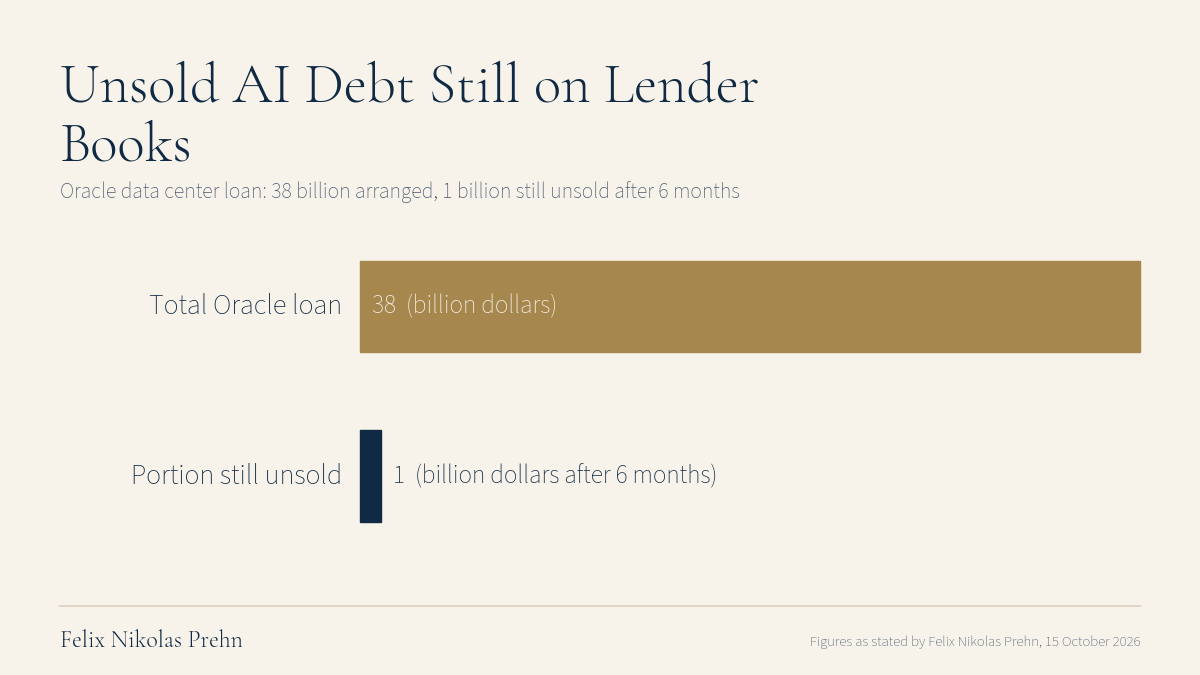
But it gets worse. Oracle took out a $38 billion construction loan for data centres in Texas and Wisconsin. Now, 6 months into this project, there is still a billion dollars of that that is unsold. And the original lenders, the ones who took the loan on their books, that took the risk when the deal launched, they're now selling that portion of the debt at a discount. They're taking a loss to get out. They don't want any of their money in on this. Not even one out of $36 billion.
And JP Morgan and Morgan Stanley have been moving AI related loans off their balance sheets faster than you can say Maserati for bonus, faster than you can say 100-foot yacht. Both banks are approaching the limits of how much AI financing they're willing to hold.
And it's the same with the tech companies. Meta, the company that BNB Bara just told us is worth $885, just moved billions of dollars of its own AI investment off its main balance sheet entirely. They set up a new company. They call them special purpose vehicles. It's like a shelf company. And then they stuff the debt into that company. And that way people apparently don't see it.
So the banks are selling the risk. The companies are moving the risks and hiding it. And the research notes still say buy AI.
So this is not one deal. It's a system. It has a direction. This Volta alone is the most recent very visible example. But it's sitting in a market where the signals all pointing in the same direction. Interest rates on AI lending are moving up. In fact, we're borrowing so much for AI, it's driving your interest rates up on your mortgage and everything else in the country.
And the people who are being asked to buy all this debt, they're getting less and less sophisticated. So it's now life insurance companies. Yet the traders in these big banks continue to derisk from the whole AI exposure.
So what does it mean for you? What does it mean when the same institution's left hand says derisk and sell and the right hand says buy, buy, buy, buy, buy? Well, at least tell people to buy. It means they're serving different clients. The traders serve institutional clients who have large AI exposure and they're getting a little nervous. The research analysts serve the broader market and create the weather if you wish.
And then at some point the music will slow. It'll not stop but it'll slow. And it slows, institutions that got in earliest, the ones who took the fees and distributed all the risks to everybody else, well, they're pretty comfortable. They're going to go off on holiday and enjoy themselves. The ones who bought late and bought these loans late in the cycle, well, they're the ones sitting on losses when it turns.
And that later group, unfortunately, tends to be the pension funds and the insurance companies because they're managed by, well, slightly, how do I put this politely, less aggressive people perhaps, which is a positive way of putting that.
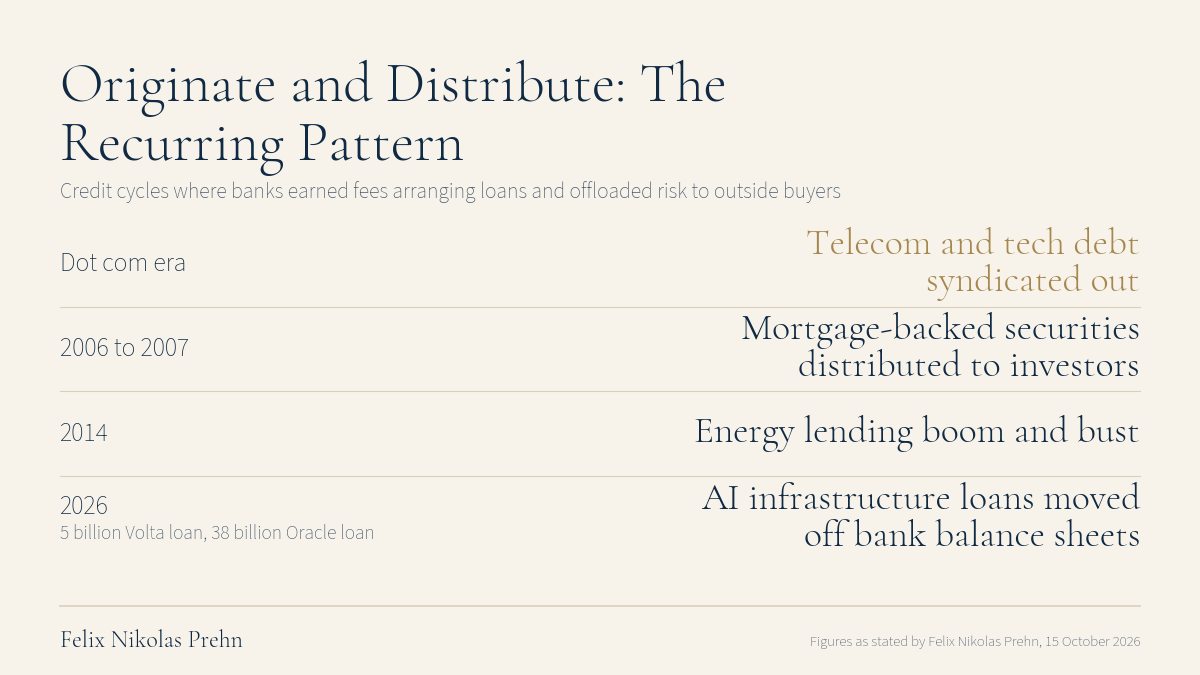
And this pattern again isn't new. It runs through every major credit cycle in modern financial history. 2006 and 7, dot com, the energy lending boom of the 2014s. Every time is a different asset. The mechanism is always the same. The bankers make a lot of money. And right now in late 2026, you're watching the early stages of the mechanism running again.
Goldman Sachs and JP Morgan are near the limit of what they can lend. Morgan Stanley is moving AI loans. Oracle's debt is priced at levels we haven't seen since the last financial crisis. So this isn't stopping immediately and suddenly, but it's slowing. And as it slows, the risk migrates from one clever person to one slightly less clever person. And clever is actually the wrong word, from one
Skilled and trained person to an untrained person. So what happens when this hiccups, the machine seizes up? Well, the effect ripples outwards and you feel it. The data centres stop being built at the current pace. The energy contracts that power those data centres become uncertain. The grid projects planned to serve them slow down.
The companies supplying those energy systems see their order books thin out. And ultimately, we see a big impact in energy costs because a data centre is not just a tech product. It's an energy product with computing hardware inside. It's construction. It consumes extraordinary amounts of electricity. It's cooling, power, infrastructure, connections to the grid and all that stuff.
It's a tremendous part of economic growth in the US right now. The signals are there. You just need to know what to watch for and how to watch them. I'm not giving you opinions. I'm not saying the market's going to crash tomorrow. These are just facts.
You can check the public filings and the financial press and everything else. The facts are out there. It's just people are not reading them together and understanding how this all connects. You just see a $2,000 price target on some chip maker. The information is public, but you do need to know what you're looking for. And that's the gap.
It's not intelligence. It's not actually access to secret information. It's just vocabulary. It's knowing what a best efforts clause is. Knowing what a credit default swap is, knowing what it means when traders and the research analysts at the same firm have opposing opinions at the same time. Once you have those words, the news looks very, very different to you.
Wall Street is actually not out to get you. They're not against you, but they're not there for you either. They're there for the fee. And when the fee stops being worth it or when it comes with too much risk attached, they move on. And the risk stays in the system and it migrates towards the people who are least prepared for what's coming.
Your job is simply to understand the system well enough to know when the music has slowed. Not when it's stopped, but when it's slowed. Because by the time it's stopped, well, the smart money is out. They told you in their way. It's just you didn't know what the language was. So you have to speak the language.
And the free training I'm hosting this weekend is for people who want to understand what comes after. What happens when the AI lending machine slows, what it means for your stocks, your portfolio, and what the smart money is already positioned for right now before any of this shows up in the news. It's going to be one live session on Saturday, about 2 hours, completely free, completely live. Go grab your seat down below in the comments and I look forward to seeing you there.
Right now, I think we're going through some weird phase transition. And normally when you get bad economic news or you get bad jobs data that people are going to fly to safety into the bond