Transcript
Gold keeps falling. It dropped more than 3% in a single day last week. It is down to its lowest level over seven weeks. But here is what did not happen. The people with the best information in the world did not sell. In fact, it's the opposite.
I've been digging into this for some weeks now. I've read Goldman's key report on this and UBS, who are really the gold people's report on this, and Bank of America's report on this. And there is another one from Goldman Sachs. And guess what? They actually have information and data that I didn't have and that we didn't have and you probably don't have. So I decided to make this video to walk you through this so you are as well informed as the professional institutional clients of these banksters.
My name is Felix Nikolas Prehn. I'm an economist and former investing banker. That little head down there was Winston, who's our golden retriever and of course chief gold analyst. And I always say follow the money. And what the money is doing right now, it's buying gold hand over fist while the price on your screen is telling you to panic because it keeps dropping.
So the question that's going to run through this whole video is why are the world central banks buying gold at not 4 times what they were buying but now 5 times the pace? And what do they know that we haven't been told yet? And what have Goldman Sachs and Bank of America just told their institutional clients so we can make better decisions going forward?
Now, there's a lot of data on this, a lot of charts in this and I've put all the important ones together for you completely for free. You can download them down below. There is a link there. It is literally the government numbers, the central bank numbers, the UBS numbers, the Bank of America numbers, all that stuff. It's completely free. Felix.org/goldfloor. And honestly, if you watch this and you read that, you'll be ahead of 99% of people.
And one more thing, I take no sponsorships. There is no endorsement here. I'm never affiliated with any gold company or whatever out there or any company for that matter. And I've done also one more thing for you, a bonus which is also in the report, but it'll also be the end of this video. How do you actually buy physical gold? Who are the best dealers to go to? Who are the biggest storage places and all that stuff? What are the premiums you need to pay? I'm going to walk you through that at the end of this video.
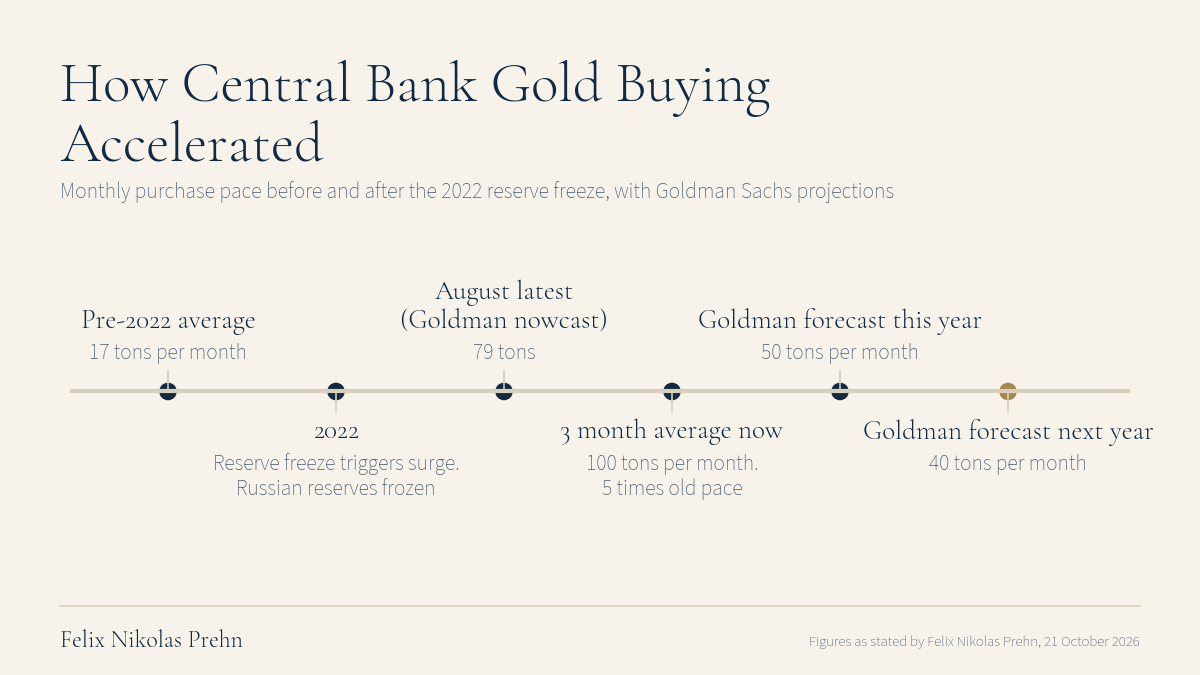
But first, I want to dig into what's really important right now. So, Goldman Sachs, these guys here, they run what they call a nowcast. And it's because official numbers on what the central banks do, and we track that in the Winston app, who's buying gold, you can see it, but the numbers are a little bit late and they're incomplete. Why? Because not every government will report it. So they built their own estimates from trade and from customs data in real time.
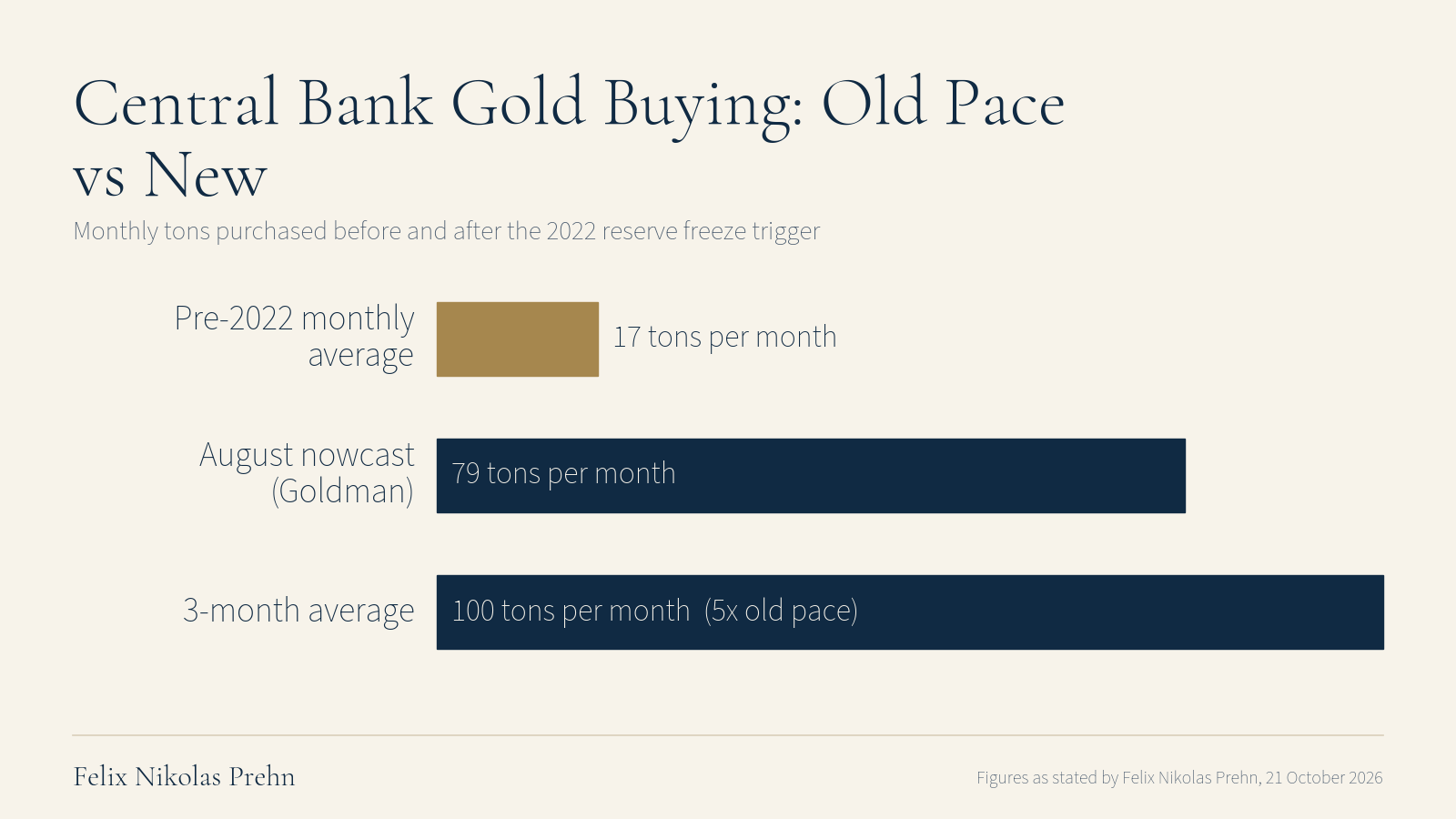
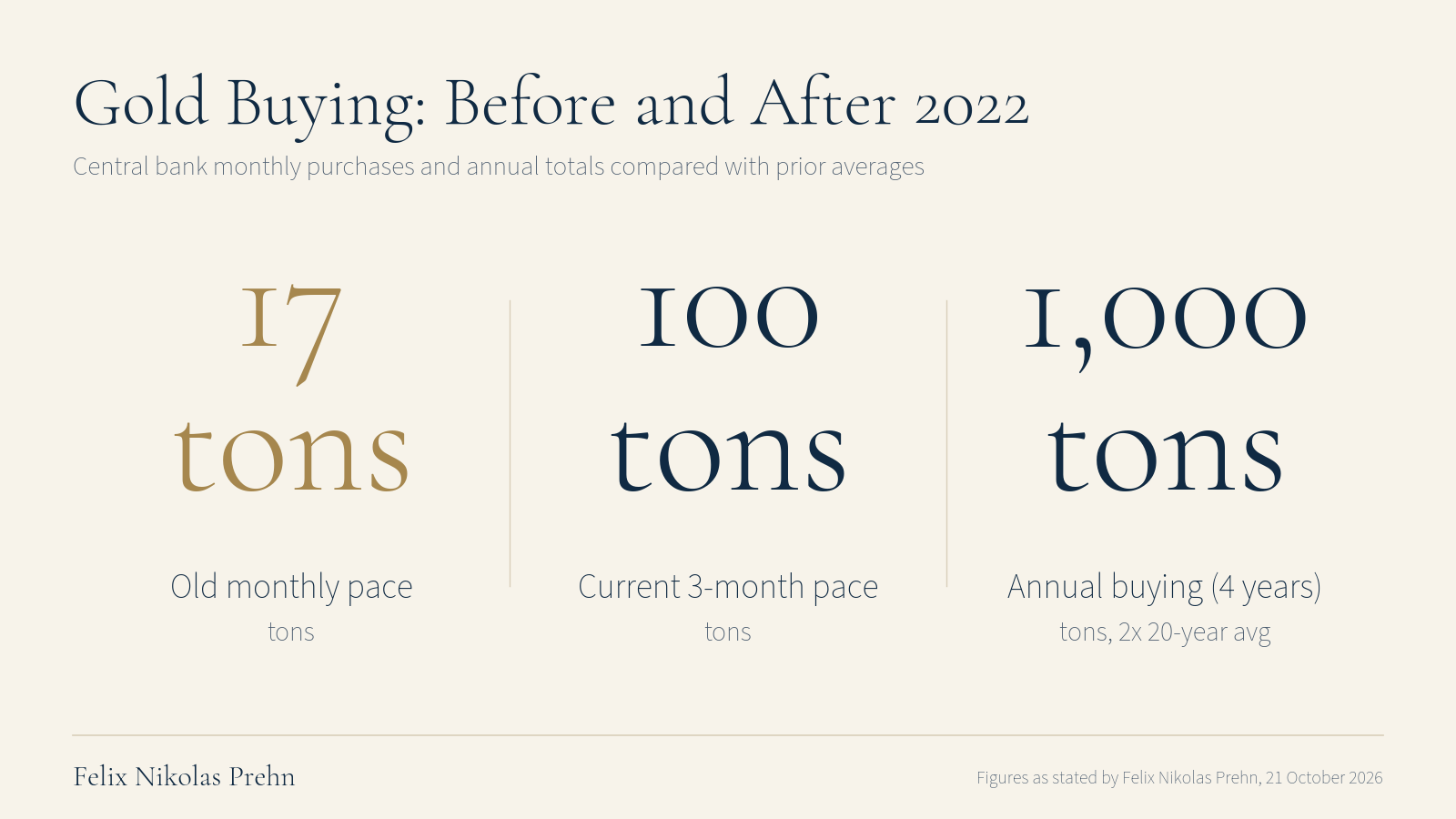
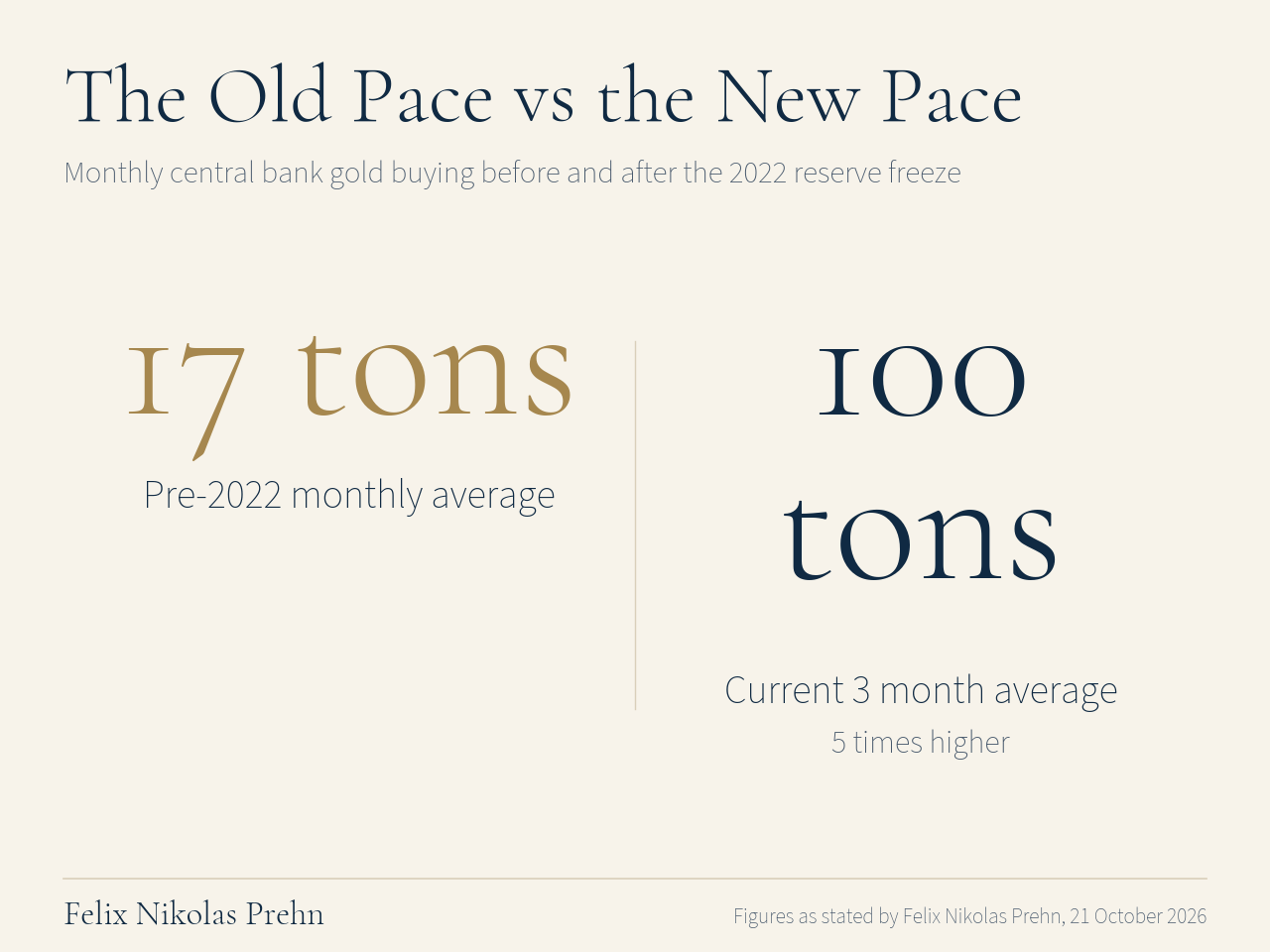
And for August that estimate came in at 79 tons. And that means very little, so let's compare it. Well, before 2022 the average month was 17 tons of buying. So August was 4 times more buying than usual. But they go one further. If you take the last 3 months average, you're looking at almost 100 tons a month, which is 5 times the old pace.
And our Swissy friends here at UBS again confirm once again that over 1,000 tons a year of gold has been bought for 4 years running, which is twice the average of the last 20 years. And I've walked you through before what happened in 2022. And again, Goldman agrees with me on that. And they're saying freezing of Russia's reserves that year was the trigger. Every central bank on earth woke up and was like, "We better do something about our risk here."
And governments expect the buying to continue. They're assuming 50 tons a month this year, 40 tons a month next year. And those are the low ball numbers, I think, but still more than double the old normal.
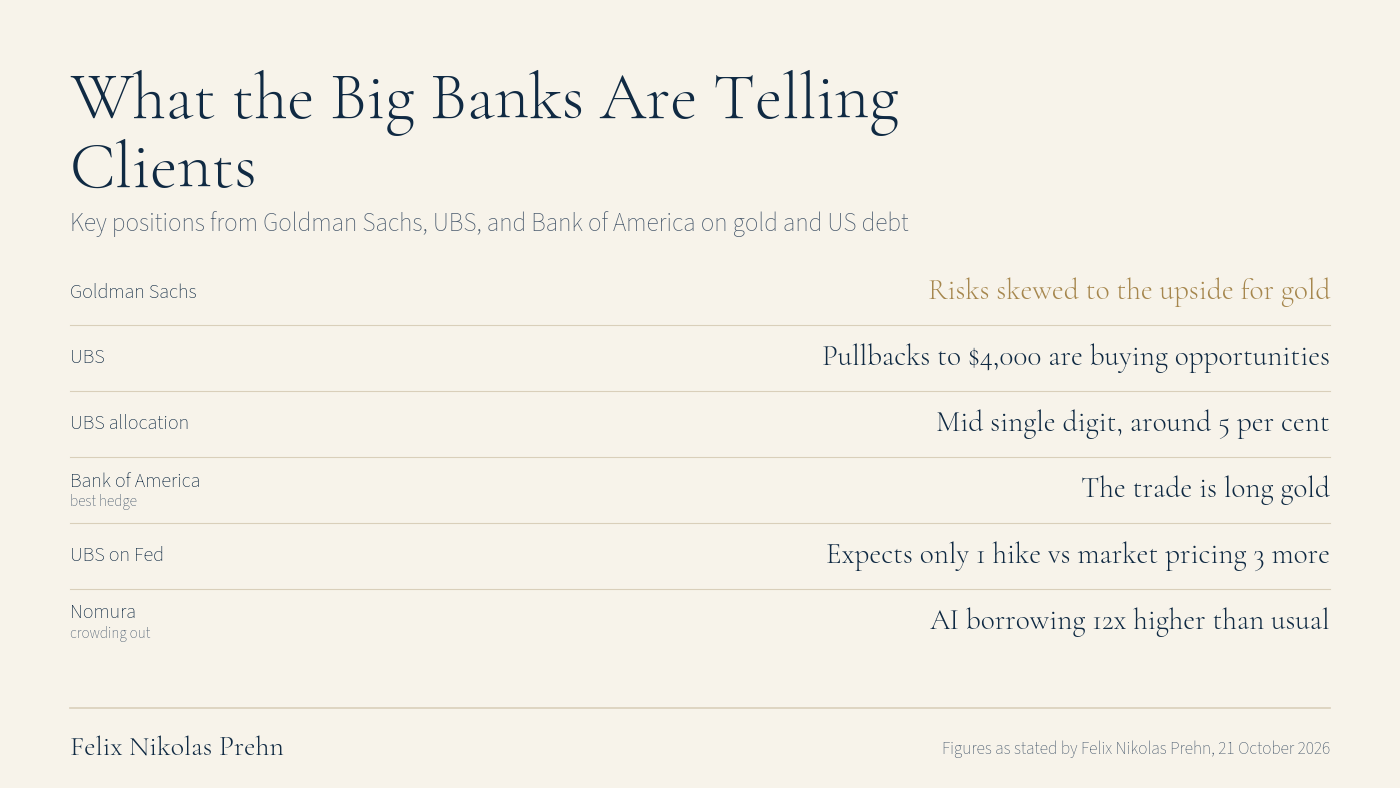
And then you have Bank of America. Their chief investment strategist puts a weekly note out to bank professional clients, the guys who actually manage a lot of money. And he sets out his rules for investing now. And one of the rules is anything but the dollar. And under that rule, he wrote just 5 words. The trade is long gold. How long is banker speak for buy it, own it. Again, I'm not telling you to do that. Not financial advice. Just reporting what Bank of America says. You have to come to your own conclusions. You're not an institutional investor.
But he calls gold the best hedge against what he sees coming. The dollar losing value, a collapse in bonds and prices inflating away your wages. So the central banks are buying at 5 times the old pace and top Wall Street guys are telling their clients to own it, which makes last week confusing, right? Because gold didn't go up, did it? No, it fell. So let me explain why.
The fall is real. Now, according to UBS, it dropped more than 3% in a single day, which I think is accurate. And their explanation is simple, and I fully agree with it. I actually put a video out on that. And when I was speaking on Kitco, I said exactly this. Oil prices went up. When energy prices get dearer, markets bet inflation will stick around. So they expect America's central bank, the Fed, to raise interest rates again.
And UBS says markets are pricing in about a 70% chance of a rate hike this month. And that lifted the dollar. It lifted the interest rates on US government bonds. So why the heck does that matter to us gold bunks? Because gold doesn't pay you anything. No interest, no dividend. In fact, you have to pay to store it. So when a government bond pays more than inflation, the cost of sitting on gold goes up. And some money walked out into the bond world.
And Goldman Sachs makes the same point. When markets expect rate rises, it weighs on the exchange funds that buy gold for ordinary investors. And the market is also expecting 3 more Fed hikes by the end of next year. Now, UBS, our lovely Swiss friends, are saying it's only going to be one. So if they're right, guess what? There could be tremendous upside for gold if they're right.
But what I found most illuminating about UBS's note is that, and I'm quoting him, they say a weakness is an opportunity to add exposure. And they put a number on it. They say pullbacks towards $4,000 an ounce, they said, can be seen as opportunities for investors to add. So one of the biggest wealth managers in the world watched gold fall and told clients where it would happily buy more. Well, most people who watched gold fall went, "This hurts."
Right now, seeing what the biggest buyers are doing while the price on your screen is telling you to panic is what? It's a skill. A skill you were never taught, which is not your fault at all. But I think it's our responsibility to learn it if we want to keep what we spent our whole working life building. And you can learn it. It is actually not difficult. You've picked up way harder things than this because no one's born knowing how to drive or read a mortgage statement or something complex like that.
So I'm going to teach it to you completely for free in a live training. And I'll show you how America's debt problem is reaching your portfolio and your savings and your retirement plans and how the skilled money is positioning for it right now before any of this lands in the mainstream media. And unfortunately, most people try to prepare for this once the damage is already done and by then things have already moved, which is not what we want to do.
So it's completely free. It's completely live. You can ask me your questions. There's no replay. So you actually need to be there. If you want to do that, grab your seat at survivethebubble.com. And my hope is that you will come thriving out of this crazy world that we currently live in of debt and money printing and everything else. And if you want to do that thriving, grab yourself a seat. It's down below in the link and write thrive in the chat.
So let's get back to the central bank buying motivation. It's important to understand this and to just hammer this home one more time and then I want to look at how you can actually buy gold with you. So why are they buying at 5 times the usual pace while the prices keep dropping?
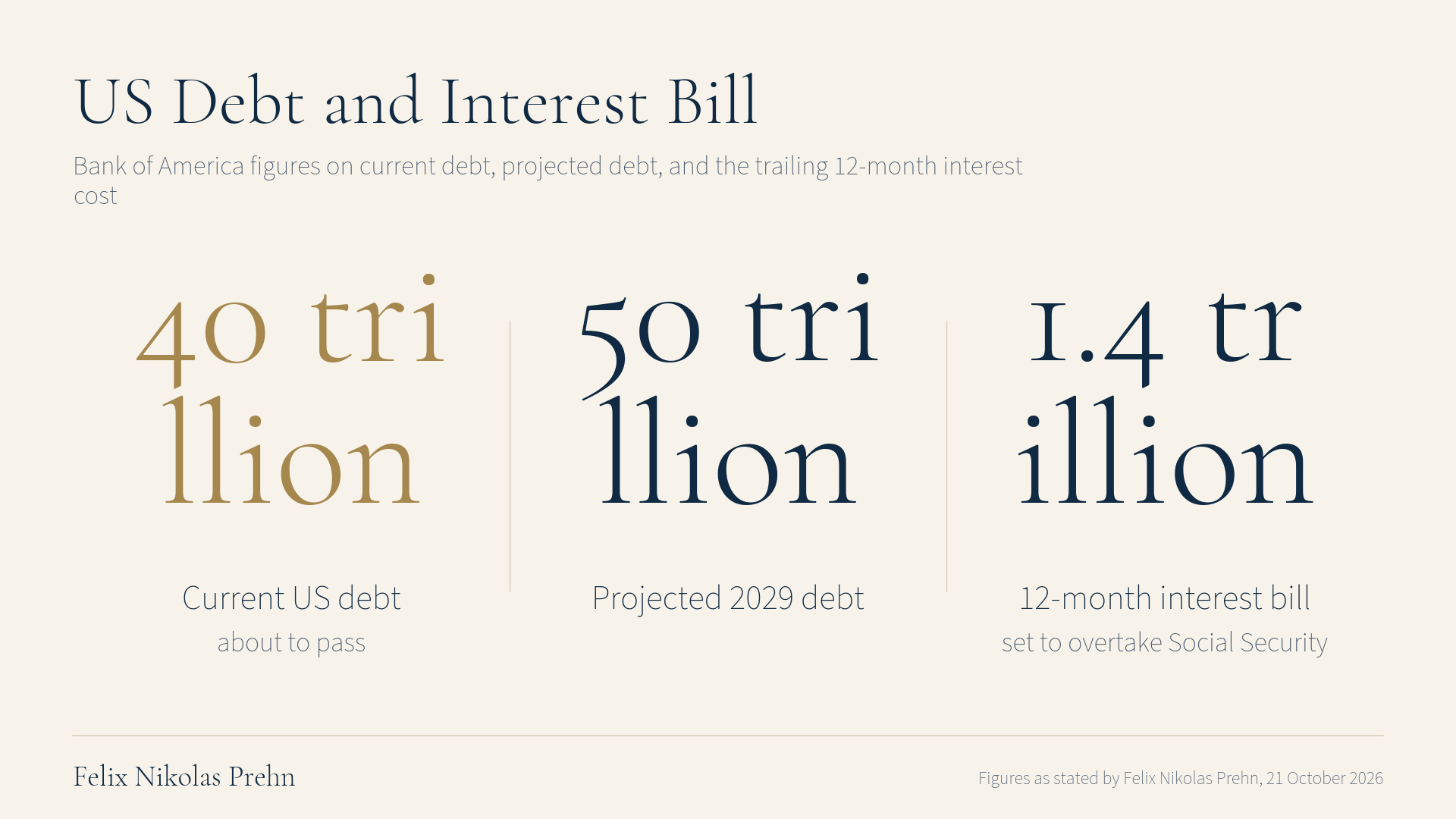
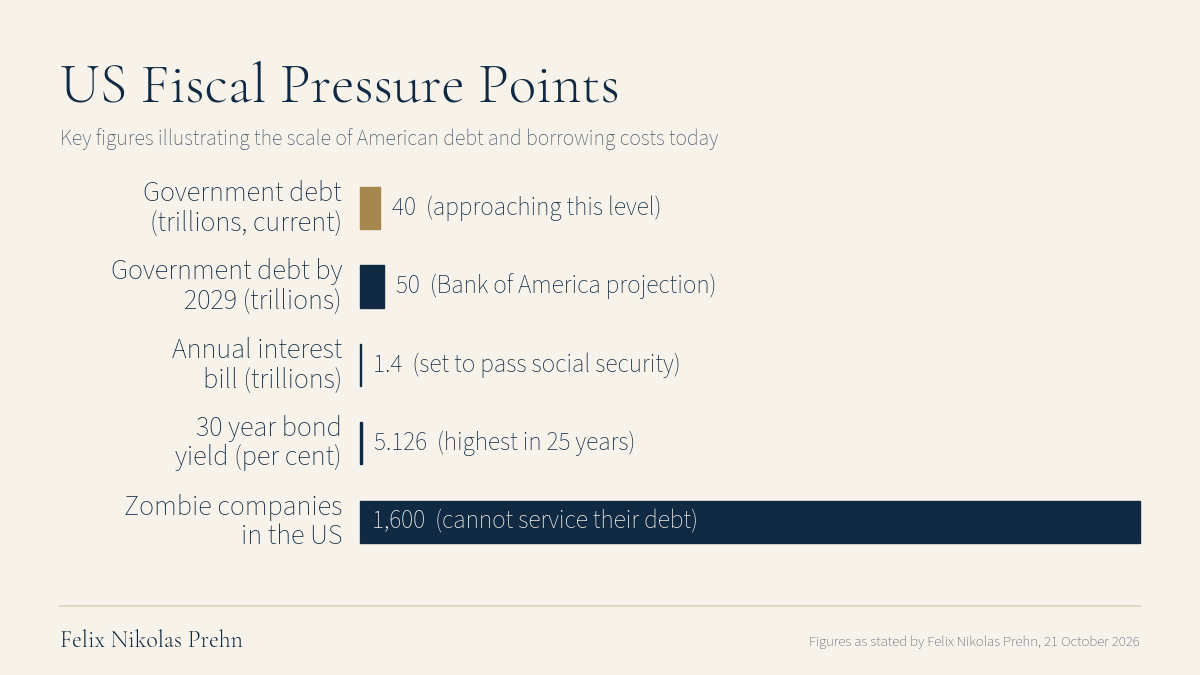
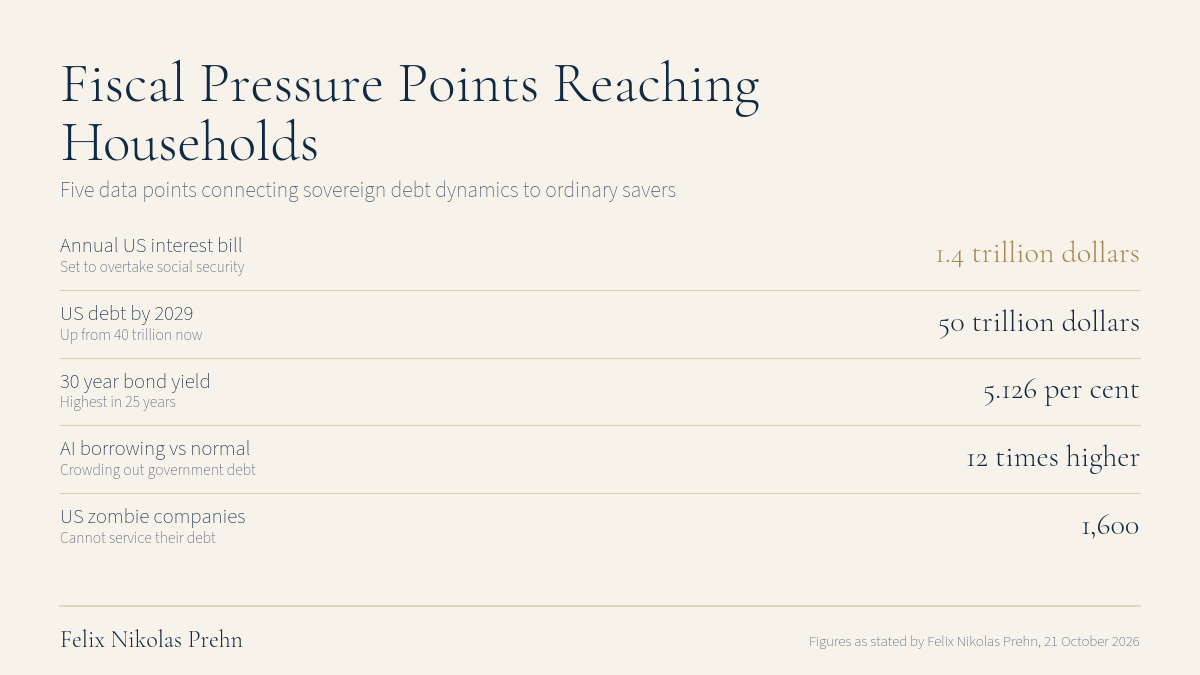
Well, the answer is the USA. We've all heard about America's debt before. I'm not going to dwell on it. Bank of America says it's about to pass $40 trillion, $50 trillion by 2029. And these numbers are so large they are meaningless now. But what is new is that the interest bill, so the cost of servicing that debt, is now according to Bank of America $1.4 trillion over the last 12 months.
And that means it's going to overtake social security, which is the single biggest thing the US government spends money on, more than the pensions for the entire country. And it's going to keep rising until the 5-year government interest rate drops below 3 and a bit per cent.
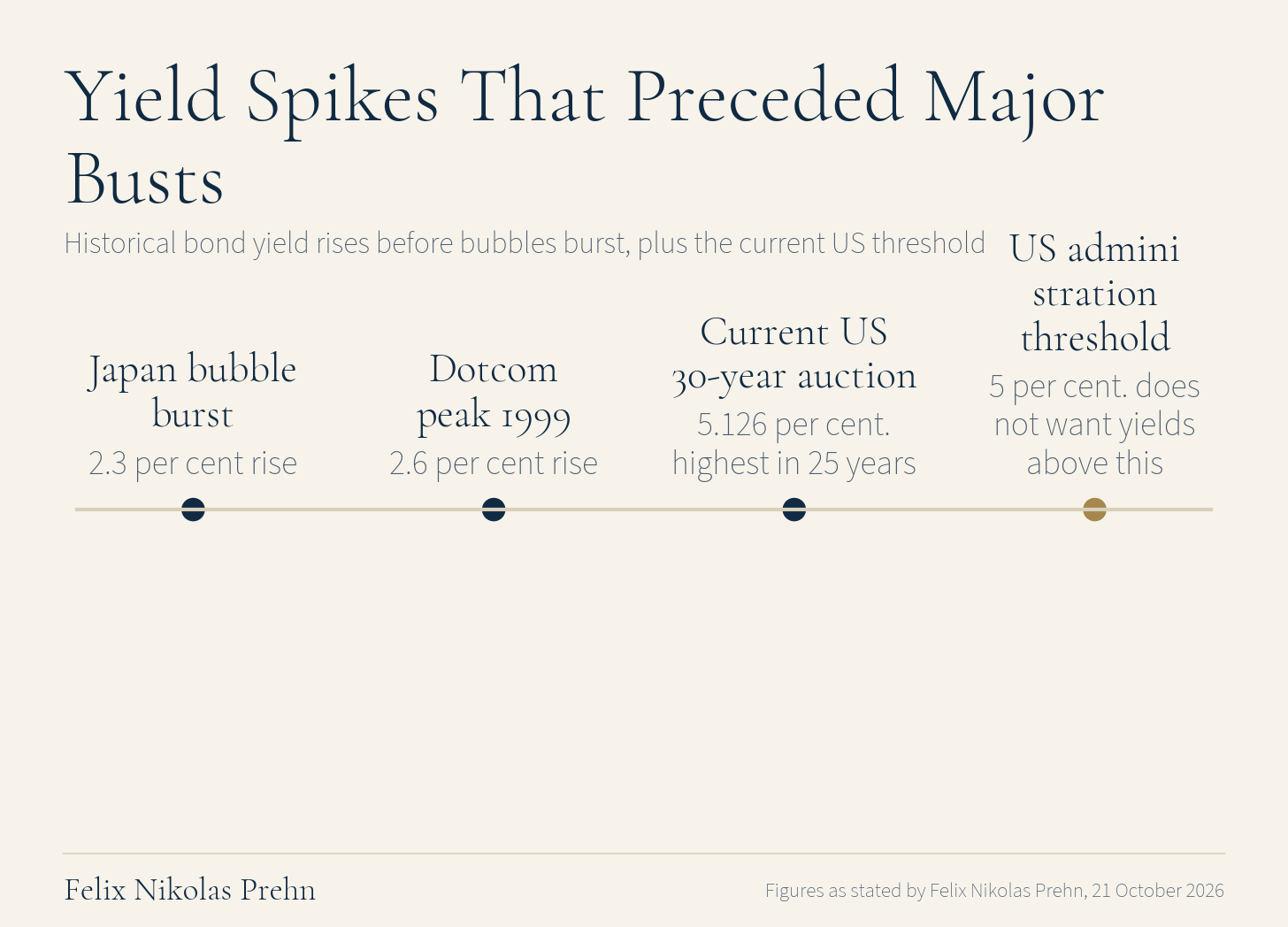
And then there's what happens in the bond market. On the same day American stocks hit new highs, the US government sold a bond for 30 years at 5.126%. It's the highest interest rate the US government has had to pay in 25 years. So in plain English, Washington had to promise more than 5% a year for 3 decades to get people to lend it money. Now stocks loved it. Lenders were demanding danger money and the government has new competition for that.
Money. There is a Nomura strategist out there who points out that borrowing by AI companies and data centres is 12 times higher than it usually is. And there's competition for money now. Every dollar that a pension fund lends to a data centre is a dollar it doesn't lend to the government. And that's why it's called crowding out. So when the biggest borrower on earth has to compete for cash, it's going to pay more.
And UBS says they're worried about the value of money and what it will buy in future and it's going to keep people reaching for real hard assets. It also talks about the longer-term desire among central banks to reduce their dependence on the dollar. So Goldman actually goes even further than this. They say recent geopolitical events, Iran and so on, are going to push private investors to diversify too, partly by weighing on how people see the finances of western governments.
And this is quite something. The Bank of America chap, the chief strategist, he says investors are convinced that policymakers see nominal GDP boom as a solution to the indebtedness. Now nominal GDP is the size of the economy before you take out inflation. So if prices rise by 4% a year and the debt stays put, the debt gets smaller by 4% compared with everything else. You don't have to default. You don't have to have spending cuts. You don't have to raise taxes. The debt just shrinks on its own year after year.
And economists have a name for that and it's called financial repression. And I would actually call it financial oppression. And it's what we've seen from 1945 to basically the 80s. I'm not going to take into the details because I've done that before. But who pays for that? Well, you do. Anybody who earns dollars, anybody who has savings, anybody's in the wrong asset.
What worries me the most though is that Bank of America's data says that sharp rises in bond yields, which is the cost to the government of the bond essentially, or it's the interest you get on the bond essentially. It's when they jump, booms usually end. Japanese yields rose 2.3% before Japan's bubble burst. American yields rose 2.6% before the dotcom peak in 1999. And Bank of America says the US administration does not want yields above 5%.
So the government has a choice. Let yields run and risk breaking the boom or hold them down and let inflation do the work on the debt. Now, gold tends to do well in the second case. And it's the case the governments have picked before. In my humble opinion, they're going to pick it again. But if you're worried about the first one and that the boom is going to burst, well, have a look at what companies would struggle the most if borrowing is going to stay expensive.
And one thing we do in the Wid Nap and I think it's a good scan to do on your portfolio is click on the danger zone filter here. And you can do that for any industry. You can do that for any major region out there. But say for the United States, there are 1,600 zombie companies. Now what's a zombie company? A zombie company is a company that can't service their debt. So they haven't got enough cash flow and they're burning cash. So those stocks are very, very risky if that situation pans out and it's good to know whether you own one of those.
So what do we do about it? Well, quick recap. Interest bill record, right? Government does not want yields to rise above this 5% threshold and central banks are basically swapping paper stuff for metal at 5 times the old pace. So trust is getting tested because gold's leaving the US. And what are the big banks saying? Well, UBS says central bank buying, reserve diversification, long word, and high government debt and geopolitics are going to provide structural support as they say for gold.
So they're essentially saying there's a flow of bias underneath the gold price. Again, I'm not promising you that. That's what they're saying. So they're positive on gold over the next 12 months and they suggest if you like gold, consider, and this is their data, a mid single-digit allocation. In other words, a modest slice of your portfolio, 5%, not 50. Goldman Sachs says gold shares of private investors' portfolio is still low and the risk to their forecast are essentially skewed to the upside. So they're saying, it's banker speak for if we're wrong, it's going to go up a lot more.
But most importantly, what are we going to do is we're not going to panic. We're going to have a plan. First, separate the two stories. The short-term fall was about rates, the dollar, and the selling that comes with a dip. The long-term story is central banks buying at 5 times the old price. So in my humble opinion, don't let just one side of that story dominate, right?
And then second is decide how much before you decide when. If you own no gold at all, ask yourself why given what the central banks are doing. If you've got a huge pile, UBS actually suggests rebalancing some of that into other commodities. Position sizing is always key.
And then third, decide your level of calm. Now, UBS says $4,000 an ounce is the area where they see opportunity. You don't have to use that number, but you have to have one if you want to buy somewhere because if you decide in the moment, well, you usually end up buying at the top and you end up selling at the bottom, right?
And then fourth, check what your cash and your pension are actually earning after inflation. And if it's less than nothing, which it probably is, you are already paying for the debt. You're basically voluntarily donating to the slush fund the government has. Now, none of this is advice for your personal situation. I don't know who you are. My goal is always to give you information and then skills so that you are a better informed and this is a good place to start doing some of your own research.
And come and join us and take the next step in the live training. I'll take you through all of this in much more detail, like the actual breakdown structure that I use that I've been taught that I apply every week and that doesn't just work for gold. It actually works for everything, like every stock, every commodity, every bond. It's all the same ultimately once you really understand the basics and you don't need a finance degree for it. You just need to be willing to learn a skill that nobody's ever taught you. It's completely free. It's completely live. Grab yourself a seat at survivethebubble.com and let us know you're joining us in the comments down below.
Now, I promised you a bonus and that's how to buy gold. It's the question I get asked most often. Now, first, very important. I have no affiliation with any company I'm about to name. I take no payment, no commission, no sponsorship from any of them or anybody else ever. So it's my own research, nothing more. And it's not a recommendation. You shouldn't therefore do it. You got to do your own homework. But some people just don't know the names to start with. So it's hard to do the research.
So there are three ways you can own gold. Physical, the metal you hold. There is metal stored for you in a professional vault or there's a fund that holds the gold while you own a share of the fund. So let's look at them one at a time. Number one, start with the physical. If you want to own coins and bars in your hand, you want to buy them from a long-established dealer, not a website that appeared last month.
Now in the United States, the two most widely recognised online dealers are JM Bullion and APMEX. Both have traded for years. They publish their prices openly. In Britain, the names people seem to trust the most is the Royal Mint itself, which is the government. There's also Atkinson, Bullion by Post, and a couple of others. I list them on the screen here. In Europe, the best known one is Degussa, which is based in Frankfurt. They have branches across the continent. There's also Pro Aurum and Philoro and a few others.
But what makes a dealer serious? Well, typically they have membership of the London bullion market. That's actually quite important. Live transparent pricing and also a published buyback price so you know what they will pay to take the metal back from you.
Now, let's talk about cost because this is where people get caught. You never pay just for the gold price. You pay the gold price plus a premium which is the cost of the minting and the dealer's margin. And the rule to hold in your head is that the premium falls as the bar gets bigger because the cost of making it, well it's spread across more gold essentially.
So if you buy a 1 ounce sovereign coin, a Krugerrand, a Maple, an Eagle, whatever it is, you're going to pay somewhere between 3 and 6% above the official gold price. If you want to get those small little biscuit bars, they go from a gram up to about 10 grams, the premium is higher, often 8 to 15% or more because you're paying to manufacture a lot of tiny pieces. And for a larger bar, your 100 gram or your even your 1 kilo London bar, the premium is going to be the lowest, often just about a percentage point. And by the way, you can negotiate those rates if you buy more frequently or slightly larger amounts and you can shop around from dealer to dealer and I would certainly do that. You will also occasionally find dealers who have inventory that somebody really wants to sell right now for whatever reason and
You might be able to get that a little bit cheaper. But if anybody tries to charge you more than, I don't know, 8% or something on an ounce of a bullion coin, well ranked right now.
Next there is storage. A few coins can live in a home safe or something like that. But once you're in a meaningful amount, you want a professional vault. And here you need one word, allocated. Allocated gold means specific numbered bars that are legally yours, held in your name, kept off the vault company's balance sheet. If that company goes under, your gold is still yours.
Unallocated gold is only a promise on paper where you are an unsecured creditor standing in line with everybody else. So always, always, always choose allocated. Write that word down.
Now the 3 largest independent vault operators in the world are Brinks, Loomis and Malca-Amit. And you've probably seen their trucks driving around because they also pick up cash and other high value things and move artwork around the world and that sort of stuff. Now the jurisdictions that are generally most trusted for this are London, Zurich, Geneva and Singapore.
Proper vaults insure the metal at full value and they do that typically through Lloyd's of London which is the insurance place. And if you would rather not arrange all this yourself, there are services like BullionVault and the Royal Mint and so on and they have their own vaults and they let you buy allocated gold and store it from the very first ounce and you don't have to do anything else.
Now if all that sounds too complicated, the simplest route of all is a fund. If you don't want metal in a vault at all, a gold-backed fund holds gold for you and you buy and sell it like a share. In the US, these are called ETFs, index funds. In Britain and Europe, they're called UCITs because it's a stupid name and their governments are ridiculous.
You can also check in the Winston app, go into funds, and then click where you are in the world, US, Europe, UK, Switzerland, Canada, Australia, wherever you are, and then select gold. And that will tell you all the gold funds and what their fees are. And you obviously want the lowest. And then it'll tell you whether they actually hold gold bars because not every fund necessarily does. Some simply own some sort of future promise option or something or other which is probably not what you want.
So that's an important place to start digging. But the largest, the most liquid fund in the US is the ticker GLD. They have a fee of 0.4% a year which is pretty significant. So there's a cheaper option which is their GLDM that has just a 0.1% fee. There also is IAUM which is just slightly cheaper and then there's OUNZ which actually lets you redeem it for real metal.
Now in Europe you cannot legally wrap a single commodity like gold inside an ordinary index fund because those rules demand diversification and Europe is a particular basket case of lunatics running it. So the European gold products are not funds. They're exchange traded commodities backed 1 for 1 by physical metal sitting in a vault. In practice, they actually do the same job, but the legal wrapper is a little bit different and it's actually worth understanding what you own.
The main ones listed in London are iShares Physical Gold, Invesco Physical Gold, and WisdomTree's Core Physical Gold. They're all around 0.12% of fees. In Germany, there is Xetra Gold which can be delivered to you as physical metal. And if you want a British-made option, the Royal Mint also has a responsibly sourced physical gold product. I don't even know what that means, but apparently it's a thing.
So there it is. Coins and small bars from long established dealers, allocated storage in a vault you trust, or a low-cost gold-backed fund if you'd rather keep the whole thing very simple. There are 3 routes. Again, I have no affiliations, no commissions, just my research. The details are also in the document you can download below, but just pick the one that fits you. And if you want to play around the Winston app, there's a link down below to that as well so you can check that out.
But honestly, come and join us on Saturday. And we're not going to talk purely gold, but I will just give you a financial education in about 2 hours that you haven't had before. And it'll show you how money flows, can show you what the skilled money is doing with their money and I think it's a pretty important thing to understand. In fact, I think it's probably the most important thing to understand for anybody managing any amount of money. I wish you all the best.
Right now, I think we're going through some sort of weird phase transition. And normally when you get bad economic news or you get bad jobs data, people are going to fly to safety into the bond