Gold falls but the biggest buyers keep buying
Gold dropped more than 3 per cent in a single day last week, according to UBS. The metal fell to its lowest level in 7 weeks. A move of that speed tends to dominate screens and crowd out everything else.
Yet the largest and best-informed buyers on earth did not step back.
Bank of America's chief investment strategist told professional clients the trade is long gold. He called gold the best hedge against dollar devaluation, a collapse in bonds, and inflation eroding wages.
Central bank buying at five times the old pace
Goldman Sachs runs what it calls a nowcast model. Goldman's model uses trade and customs data. It estimates purchases in close to real time.
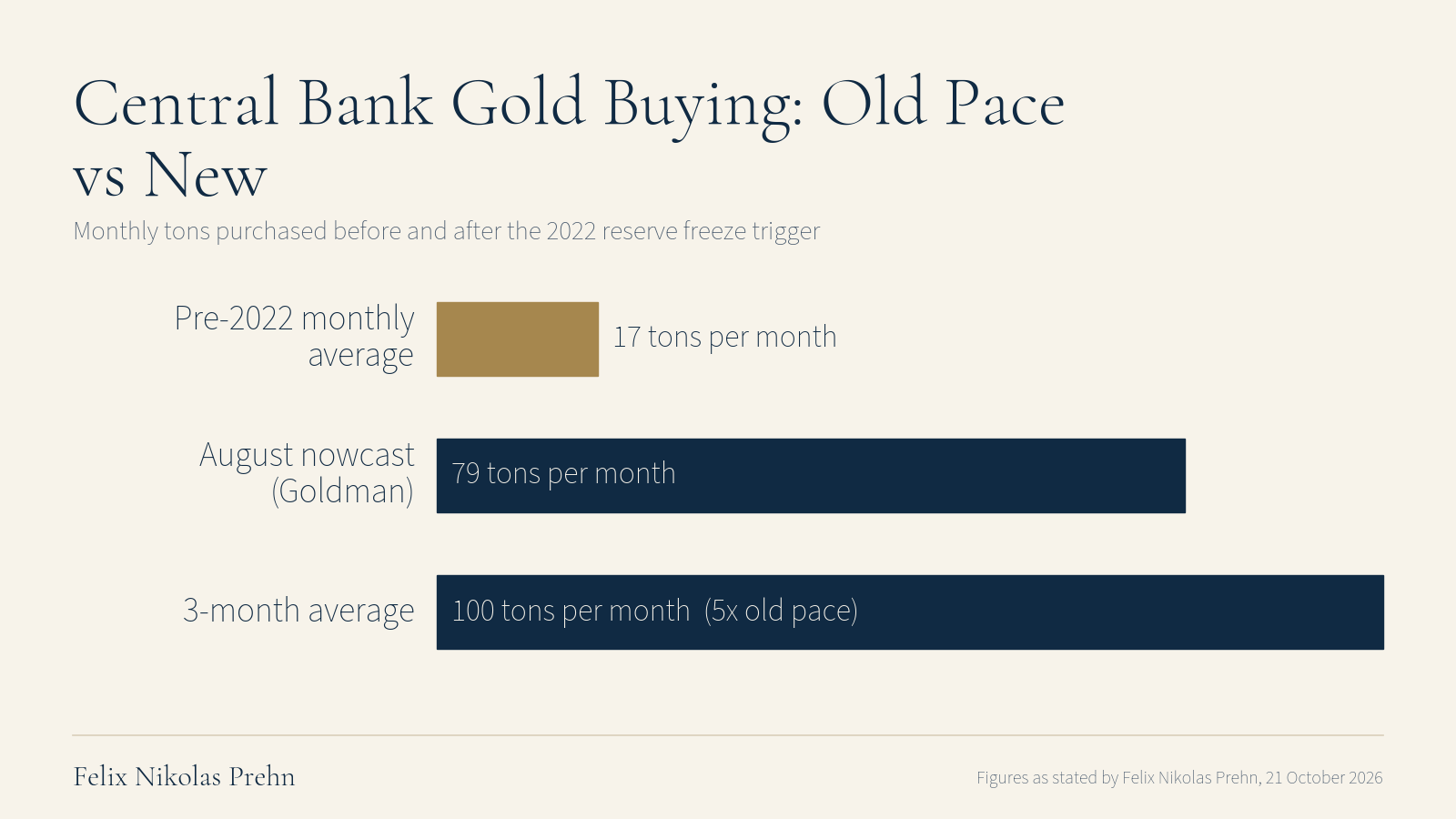
Official figures arrive late. For August, the figure came in at 79 tons.
Before 2022, the average month of central bank gold buying was 17 tons. August was roughly 4 times that figure.
The 3-month average is close to 100 tons. Gold buying is running at 5 times the old pace.
UBS confirms the broader trend. Central banks have bought over 1,000 tons a year for 4 years running.
The pace is twice the average of the last 20 years.
Goldman Sachs and the data point to the same trigger.
In 2022, Western governments froze Russia's foreign reserves. Every central bank reassessed its exposure to assets that could be immobilised by a political decision.
The buying surge began there and has not stopped.
Goldman assumes central bank purchases of 50 tons a month this year, falling to 40 next year. Goldman's projections are more than double the pre-2022 norm.
Why gold dropped: rates, oil, and the dollar
The short-term fall has a clear mechanism.
Oil prices rose. When energy costs increase, markets bet that inflation will persist.
Higher inflation expectations feed directly into rate pricing.
UBS says markets are pricing in about a 70 per cent chance of a Federal Reserve rate hike this month. The prospect of higher rates lifted the dollar and pushed up yields (the interest a bond pays) on US government debt.
Gold pays no interest and no dividend.
Storage costs money. So when a government bond pays more than inflation, the cost of holding gold increases.
Some capital moves into bonds. Rate-rise expectations weigh on exchange-traded funds that buy gold.
The market is expecting 3 more Fed hikes by the end of next year. UBS expects only 1.
If UBS is correct, gold has room to recover. If so, the market has overpriced the tightening ahead.
Where UBS sees opportunity
UBS told clients that pullbacks towards 4,000 dollars an ounce can be seen as opportunities to add exposure.
UBS suggests a mid-single-digit allocation to gold, around 5 per cent of a portfolio.
The US debt engine behind the gold rush
Bank of America says US government debt is about to pass 40 trillion dollars. Felix Nikolas Prehn argues the figure will reach 50 thousand billion dollars by 2029.
The US government interest bill over the last 12 months is 1.4 trillion dollars, according to Bank of America.
In Felix Nikolas Prehn's analysis, the interest bill is set to overtake social security as the single biggest government expenditure. The programme covers pensions for the entire country.
The bill will keep rising until the 5-year government bond rate drops below 3 and a bit per cent.
On the same day American stocks hit new highs, the US government sold a 30-year bond at 5.126 per cent. The rate is the highest the US government has paid in 25 years. The Treasury offered more than 5 per cent a year for 3 decades to attract buyers.
The government faces competition for capital. A Nomura strategist points out that borrowing by AI companies and data centres is 12 times higher than usual.
Every dollar a pension fund lends to a data centre is a dollar it does not lend to the government. The largest borrower on earth must pay more when it competes for cash.
Crowding out and financial repression
Nomura describes a textbook case of crowding out. Private-sector demand for capital displaces government borrowing and forces up the rate the Treasury must offer.
Bank of America says the US administration does not want yields above 5 per cent. The 30-year auction at 5.126 per cent suggests the market is already testing that threshold.
Bank of America's chief strategist reports that investors believe policymakers see a nominal GDP boom as a solution to indebtedness.
GDP measured in current prices includes inflation. If prices rise by 4 per cent a year and the borrowing stays constant in dollar terms, it shrinks by 4 per cent relative to everything else.
The government need not default or raise taxes. The debt erodes on its own over time.
Economists call the process financial repression. Governments hold interest rates below inflation.
The real burden of debt declines as a result. Savers and wage earners lose purchasing power.
Sharp rises in bond yields have preceded the end of previous booms.
Japanese yields rose 2.3 per cent before Japan's bubble burst. American yields rose 2.6 per cent before the dotcom peak in 1999.
The alternative is to cap yields and let inflation erode the debt over time. In Felix Nikolas Prehn's view, gold tends to perform well when governments cap yields, and sovereign borrowers have taken that path before.
Zombie companies and the risk beneath the surface
The United States contains 1,600 zombie companies, a figure Felix Nikolas Prehn highlights. A zombie company is one that cannot service its debt from its cash flow. If the Fed delivers 3 more hikes rather than 1, the pressure on these firms intensifies.
Record stock prices coexist with 1,600 firms that cannot service their debt from cash flow.
Rate expectations weigh on gold in the short term. Central banks are accumulating gold on a schedule that has lasted 4 years.
The freezing of Russia's reserves in 2022 showed that paper assets carry political risk. US government interest costs have reached 1.4 trillion dollars.
Private demand for capital is crowding out government borrowing. Policymakers may resort to financial repression to manage this debt, eroding the value of dollar-denominated assets.
Central banks have bought over 1,000 tons of gold a year for 4 consecutive years. Sustained buying above 1,000 tons a year for 4 years points to a structural shift in reserve management. A speculative position lasting 4 years would be unusual.