Transcript
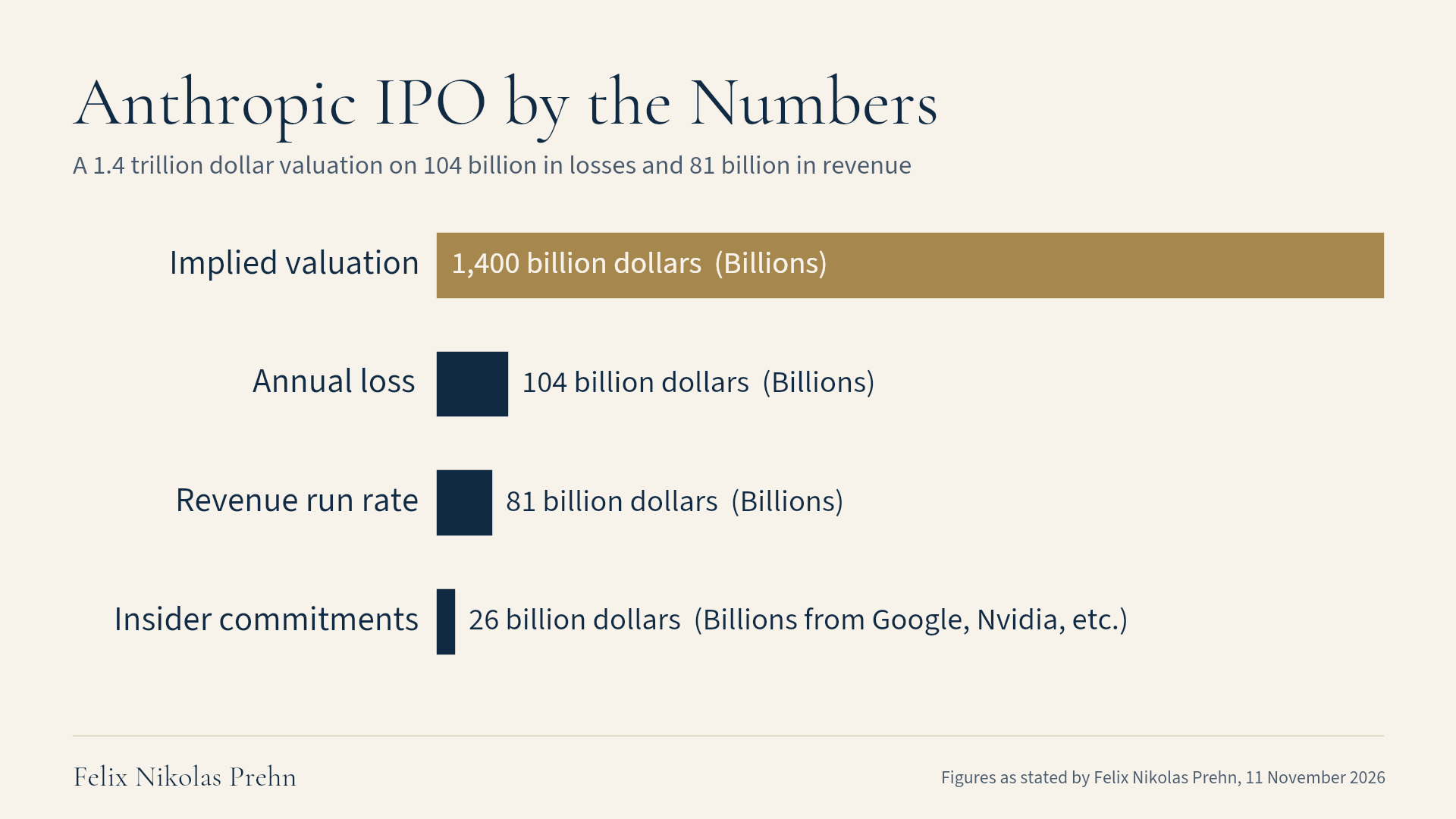
There's a company that has lost a hundred billion dollars last year and they've just put a price tag on itself and the price tag is $1.4 trillion and the biggest names in the world, your Google, your Nvidia, the chip makers, Microsoft and so on, they're not laughing at the number. No, they're actually buying it. They're putting billions of their own hard cash into it just to get a seat at the table before you and I are even allowed in the room. And everyone's looking at that and is going, well, is this therefore the top of the market? This is of course the anthropic IPO.
Is this 1999 again? Is this 2008? And I think that's the wrong question. I think honestly it's a complete distraction from something much much bigger that is happening to your money and your portfolio. Why are you sitting there thinking about this great big IPO?
Because as Winston here just told me, who's rather fond of um celery, which of course he deserves, is that America's money has just hit an all-time high.
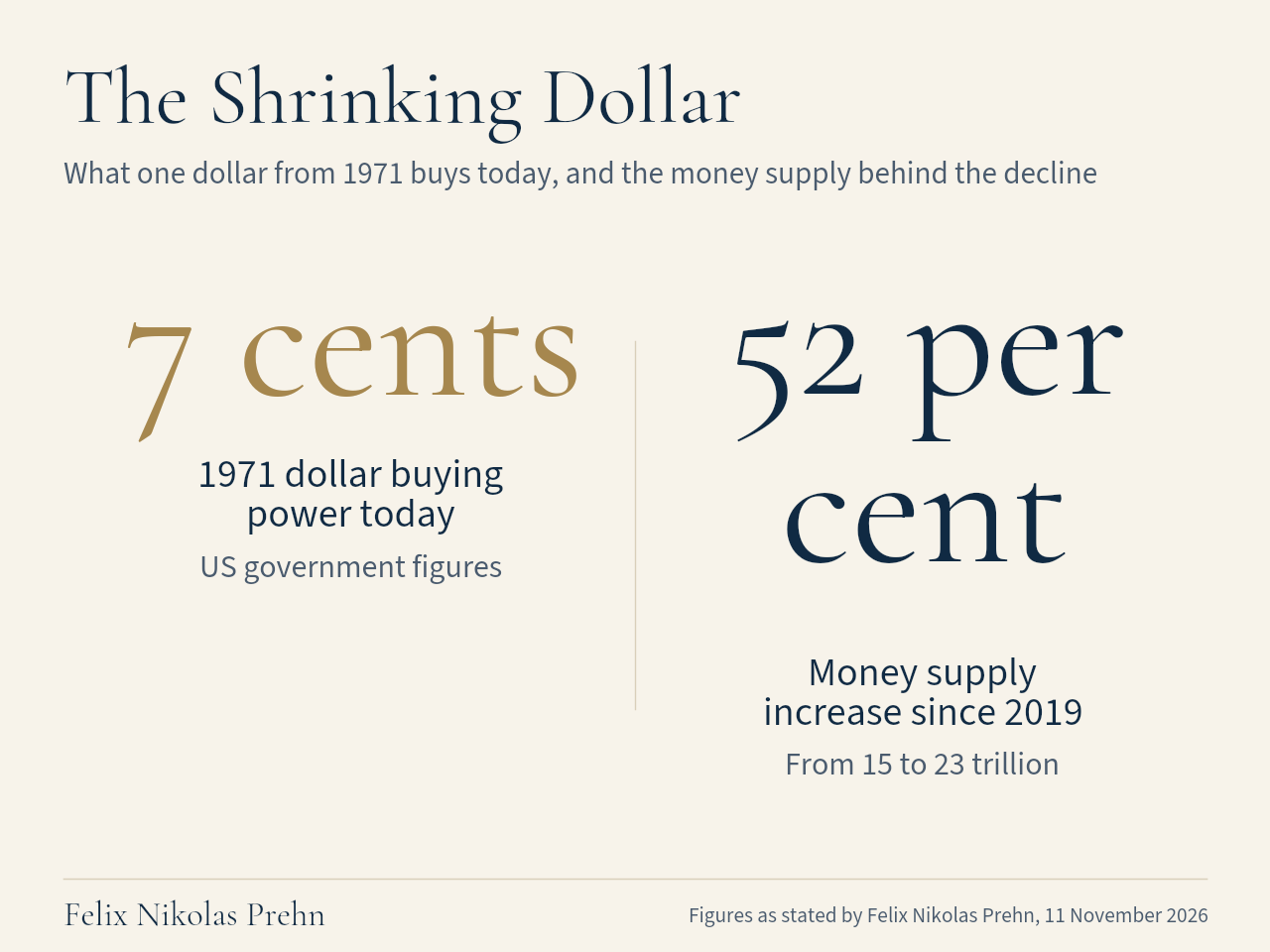
It is up 52 per cent from where it sat before the pandemic, and it is speeding back up. I've got the chart on the screen here, and that little line there is how much money they're printing. And when that much new money gets made, asset prices don't fall. No, they can't. It's just sort of basic arithmetic.
Now, some assets can fall, but not all of them. So, you might be thinking, "Brilliant, everything's going to go up." But guess what? Someone pays for that. And again, it's not the people buying in the 1.4 trillion insane IPO, it's everybody else. And then I watched a little clip from Bill Gates, the Glorious, and what he just said on camera kind of changes how all of this sinks in and reads.
So stick with me and I'll explain the whole thing for you in the next few minutes. If you're wondering who I am, my name is Felix Nicholas Pin. I'm an economist, former investment banker, founder of the Pin Institute. That down there was of course Winston who's uh keen to David gets treats. Very rarely gets treats.
You want another one? Winston. Winston. There we go, young boy. Sit down.
Well done. Um he does all the hard thinking, did all the research for this, so he deserves a reward, right? And he's also put together for you all of this data because I'm going to throw a ton of data at you in a free report. You can download it down below. It's in the description below.
But let's start with Anthropic for a second here. The filing came out this week. They're going to sell 800 million shares priced at somewhere between 70 to $78 here. And at that range, you're looking at about $1.4 trillion, which is pretty extraordinary. Now on paper they have made a loss of 104 billion but I have to be fair about them actually they do actually have revenue real revenue and it's growing very fast about 81 billion or so at present is the run rate and the clever money is not going this is insanity run no Google you know the chip makers they've committed 26 billion between them to buy a bit of this IPO slice before it goes life.
So, they're not uh they're not nervous. So, yeah, everyone's going bubble top mania, it's all going to collapse and all that. And I sort of understand the instinct. I do. I've been warning about the AI valuations for many months.
But ask yourself a different question. Where did the money to pay the $1.4 trillion for this stuff actually come from? Because this is what really matters, and it's the part people skip over because it's a little tedious.
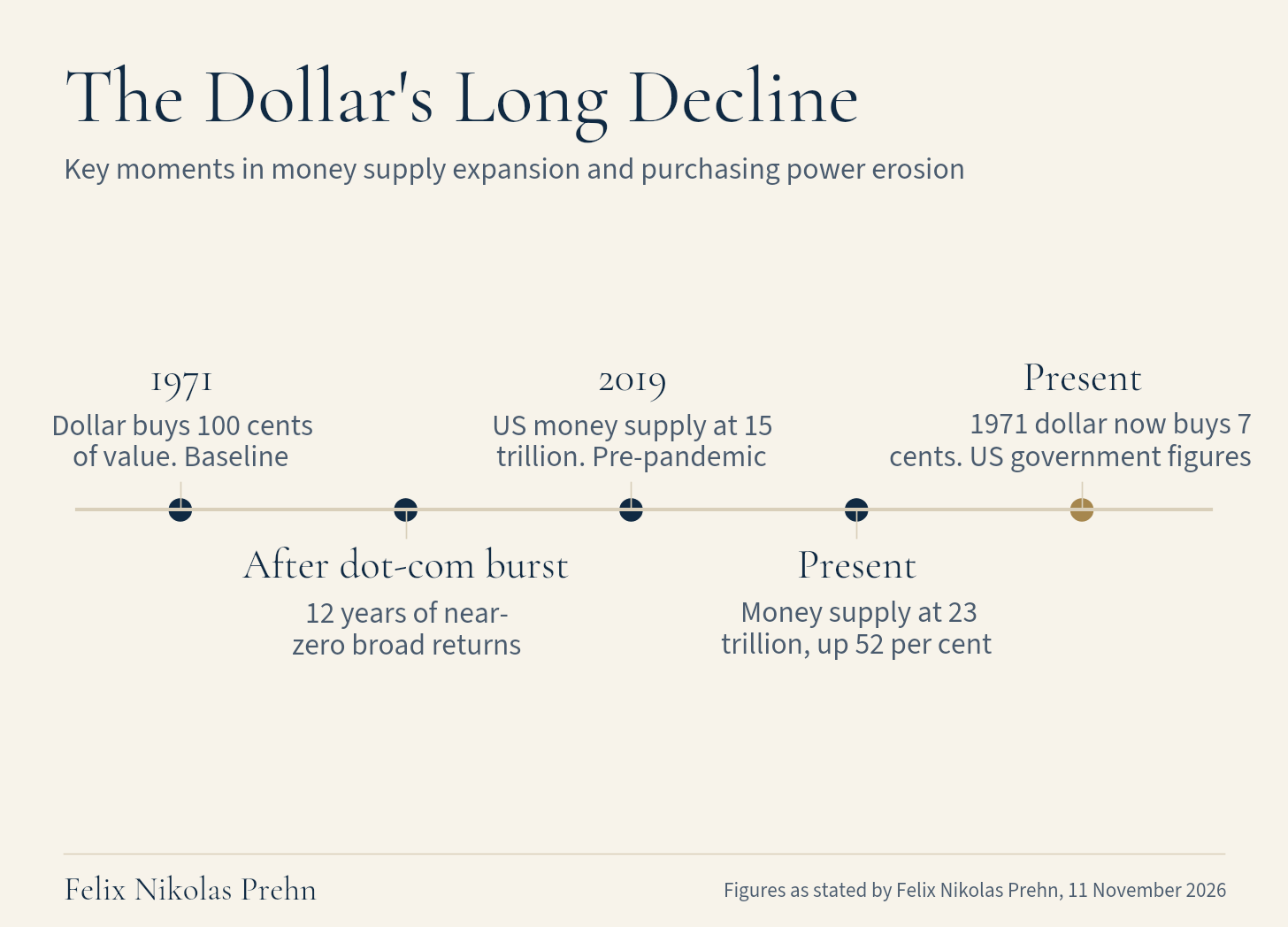
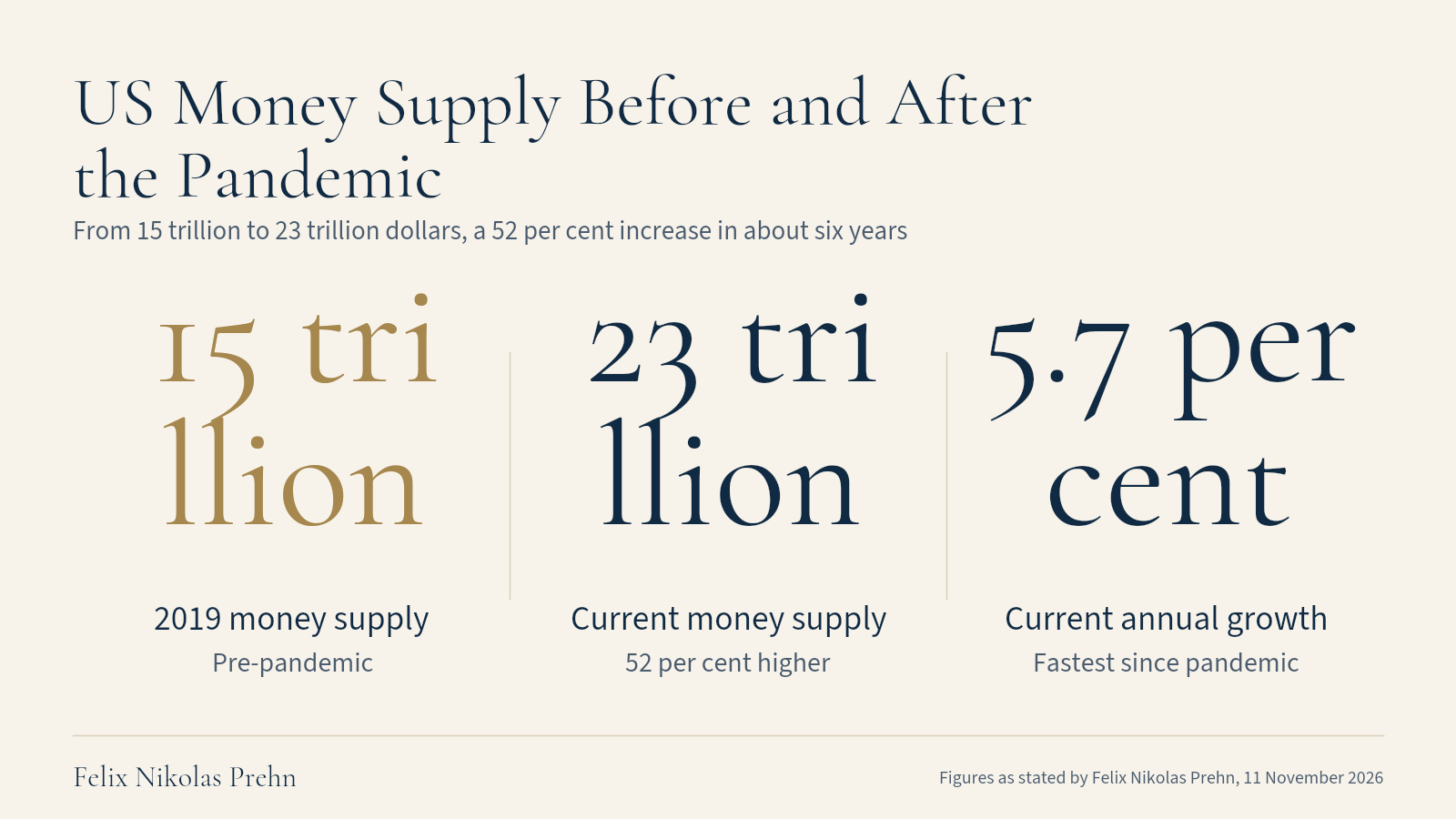
Look at the money supply. In 2019, before we really heard of, you know, lockdowns, America had about $15 trillion sort of generally gushing around the system. And today, that figure is $23 trillion, which is 50 per cent more than it was in just six years. And right now, the growth is insane. 5 per cent or 5.7 per cent to be precise this year.
It's the fastest we've seen since the pandemic. So, you're getting a tidal wave of new money on one side and then a company allegedly worth 1.4 trillion on the other side that loses billions of other people's money. People look at that and go, "Yeah, doesn't really have anything to do with the sh." But it's actually the same thing. It's completely linked. When you create that much new money, it does what?
Well, it goes hunting for returns, for shares, for property, for private companies that we're not allowed in or and the price of those things goes up because not because they got better or more profitable or more exciting.
No, it's just there more dollars chasing the same thing. So, think about like the street you live on, the same house, the same bricks, the same, you know, dodgy roof. It sells for double what it did a decade ago. The house didn't improve. No, the value of the money shrank.
That's the trick. So, everyone feels wealthier, but actually the value of money shrank. So, this insane anthropic valuation isn't actually the problem or the disease. It's sort of like the thermometer that tells you how much fresh money is being printed. And therefore the question stops being is this overvalued to am I about to get taught am I about to get caught even at the top and it becomes something a lot more personal to you because whose money is being made worth less?
Well, is it yours or is it somebody else's? I'm fairly certain the answer is yours. And I want to show you why and far more importantly what you can actually do about it.
Say your portfolio is up 10 per cent this year. Let's just pretend. Feels good, right? The number on the screen is bigger than it was. But if the money supply grew 52 per cent over a few years and your portfolio grew less than that, well, you didn't get any richer.
You slid backwards in terms of what your money can actually buy, you lost ground. And people don't really explain that to you because the whole industry is sort of run on this. Let's make all the numbers green. Everyone's excited. Everyone will trade more.
Everyone will make more money. Well, at least the guys running the exchange school. So why do we not get taught this? I we could go down, you know, the tinfoil hatut sort of route, but once you realise this, you realise that there is a skill here that separates those who genuinely do well in these money printing scenarios that we're living in right now. And those who feel like they're doing well, but they actually secretly hiddenly, if that's a word, get a little poorer every year.
And my goal is for more and more people to join the happy side of that column because life's a lot better on that side of the column. So what I want to do with you live on Saturday is exactly this. At how to prepare.org, you can sign up for a completely free seminar with me. It would be about two hours long. We sit down together and we build the actual plan step by step for protecting and for growing what you've got in a world where they will not stop making more money.
I'm not just going to give you a PDF or something. No, we're going to do it live. We're going to do it together. There's no replay. So, if you want to join, come and join us live.
And by the end of it, you'll have a plan and you'll have clarity on what's actually happening and how the professional money, the skilled money is actually managing their money in this strange new world that we live in. So go to herpair.org. There's a link down below in the description. Click on that, register, come back here, write clarity in the comments because that's what we're going to leave with on Saturday. That's the goal.
And in the meantime, I'll walk you through this and then the lovely thing that Bill the Gates just said. So we established that money is being made printed at a pace we've basically never seen outside of, you know, a pandemic or a big war. So, the obvious question is how how do you bring $8 trillion of fresh money into existence without some dramatic headline that everyone's arguing about? You do it with plumbing, dull plumbing that nobody really talks about.
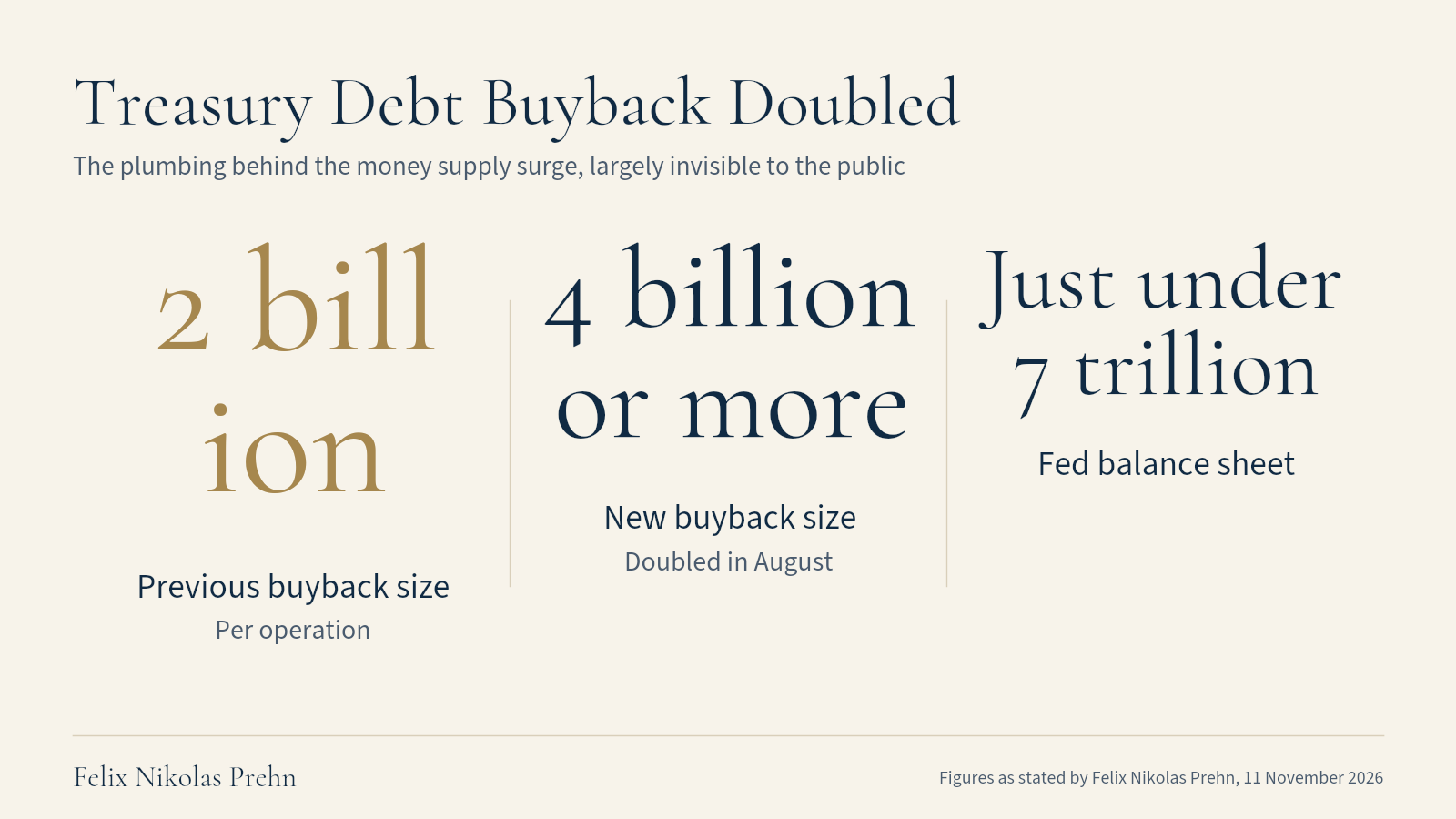
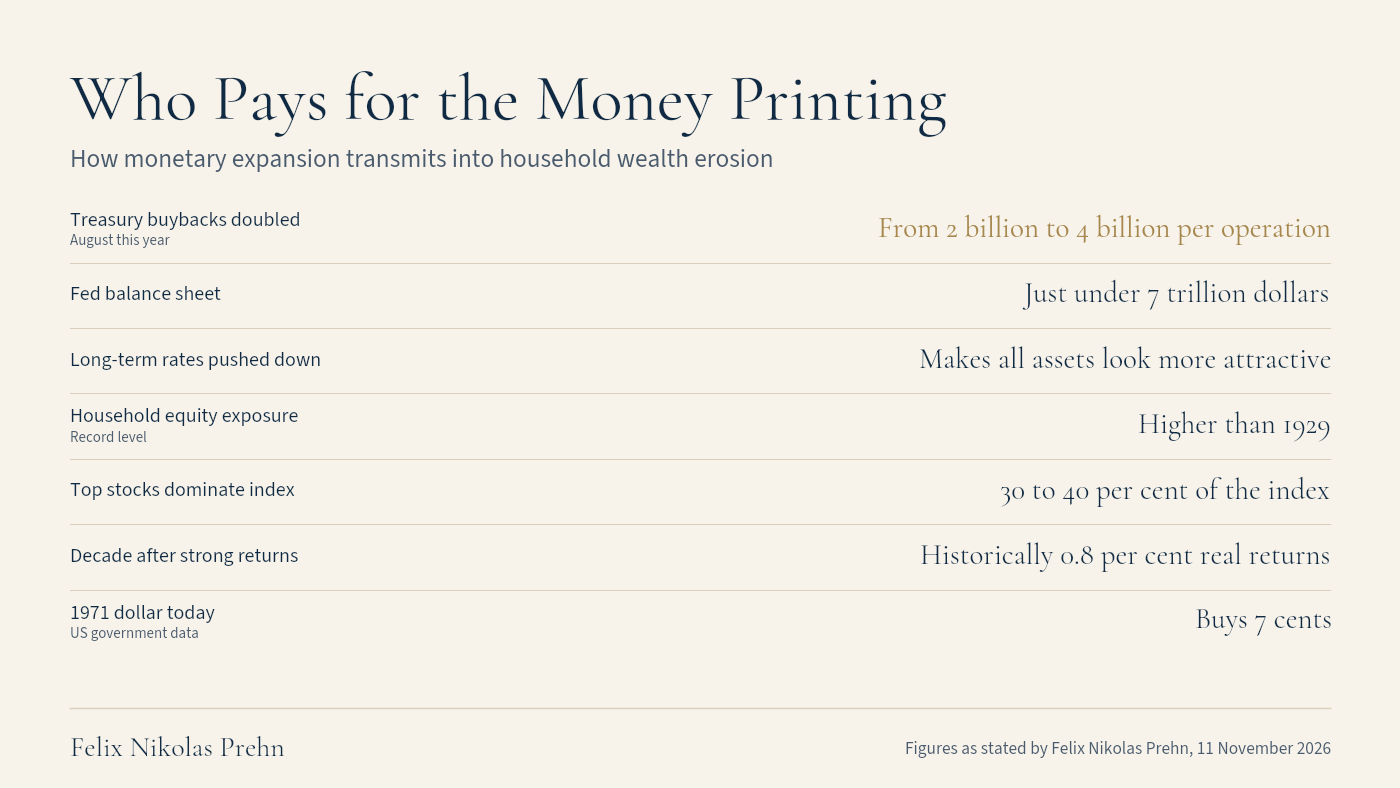
Um, and I'm going to keep this as simple as possible. Back in August of this year, the Treasury doubled the size of something it called the debt buyback. They went from $2 billion at a time up to four billion or more at a time. Now, what's a buyback? A buyback means the government's going into the market into the the bond market and it buys back its own debt.
Sounds a bit weird, but sort of fine. But trace the cash. Where does the money to do that ultimately come from? It comes from the central bank, the Federal Reserve. The Federal Reserve has a balance sheet that is sitting at just under$7 trillion right now.
And and I think the best explanation of this is sort of me going hey could you could you lend me $1,000 and you saying of course Felix and then you printing $1,000 fresh off your inkjet and giving it to me. That's more or less the whole thing the government runs. The state is lending to itself with money that did not exist a single moment before.
Now, the part that they'd rather you didn't think about too much is this. When the government hoovers up, so buys back its own long-term bond like that, it pushes long-term interest rates down. And bear with me for a second. I know it's painful in Dal, but it's really important. So, long-term rates are basically the price of everything.
Your mortgage, um, what it costs a company to borrow and build. And very importantly, when rates are forced down, every asset in existence suddenly looks more attractive by comparison. So money floods in, shares go up, houses go up, and that 1.4 trillion company goes to $1.4 trillion. So it's all this connected circuit, but most people only ever look at the stock price, the share price, but they don't really think about the wiring underneath all of that. And maybe you think this can't go on forever.
Well, there's a country that's done this for more than 20 years.
They just kept buying their own debt again and again and again. So, we kind of don't have to wonder how this ends. We just have to look at the particular country. But who suffers? Salary man, saver man, ordinary working man, right?
And woman and everybody in between. They get hollowed out, but they don't really notice it. Their standard of living just gently grinds downhill. But at the same time, anybody who owns decent assets, and that's very important, not just any old assets, good assets, well, they get richer and richer and richer. And the United States of America is openly copying that playbook.
They're not doing it slowly or secretly. No. 52 per cent more money in six years. That is insane, right? You might think, "Oh, that was co." No, this year 5.7 per cent more money.
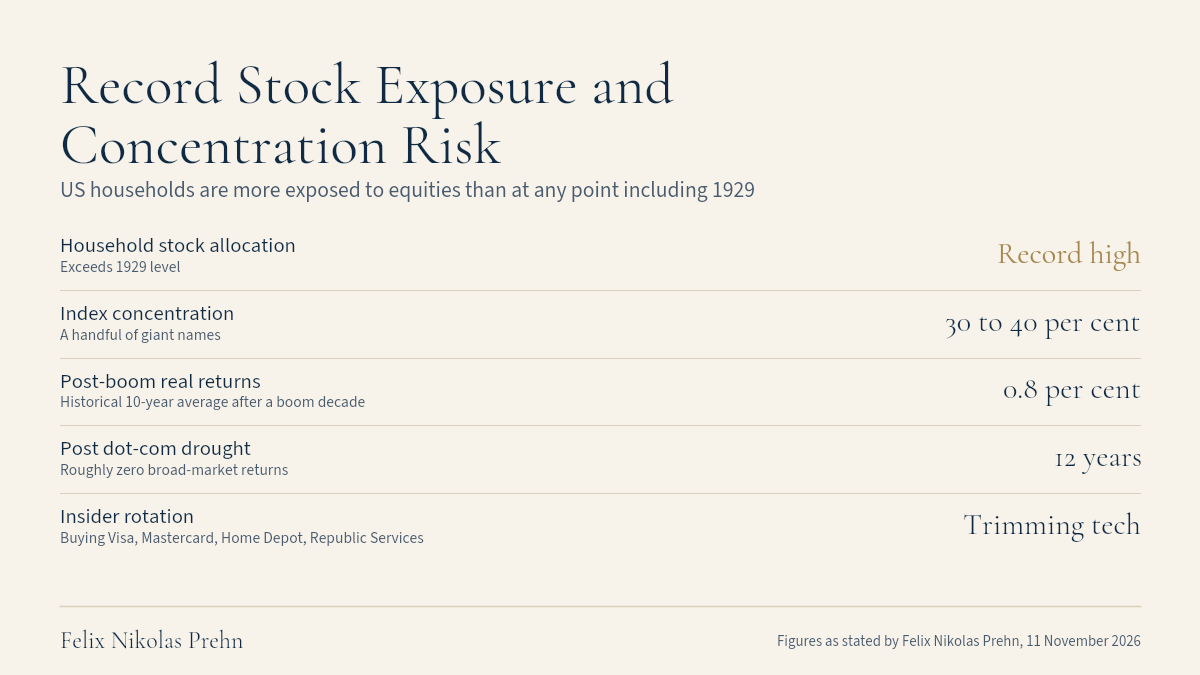
That is insane. Now, you might be thinking, "But Felix, I'm invested. I'm I'm on the good side." Well, yeah, you and everybody else, quite frankly, because households have never had more of their money in the stock market than they do right now. Like, more than 1929.
Just absolutely insane. But everybody owns just a couple of stocks, these giant names that now make up 30 or 40 per cent of the index. So nearly everybody is crowded into one side of the boat leaning on the same thing going this is going to be brilliant. So what we experienced a little bit of in the last few days is like well what if one of those companies wobbles and what happened on Thursday but actually in Friday the big tech companies didn't wobble that much a little bit but not that much right nothing like 20 30 per cent down on the big tech guys we haven't experienced that yet now how do you know how exposed you are well you'd be surprised quite frankly I put something in the Winston up there's a free trial link down below and you can you can just put your stocks in there just put your whatever whatever stock names you own into it and copy and paste it from your broker and it'll show you how exposed each of your stocks is to the AI bubble. So red is very exposed and green is not.
So you're going to want to think where am I on this sort of chess board here and in ideal world I would suggest that you're not just the top end but I believe most of you are going to be at the top end. So look that up and then put your put your exposure to AI in the the comments there and I think most people are probably in the 70 per cent plus range which just if you just think about it is kind of insane right 70 per cent of your retirement your your life's work is just running on this AI train right now and then the next question of course is well if this turns it's all right I've got a stop loss I'll sell who you going to sell to everyone else already owns the tech stocks who's going to want to buy it right so if you want to sell, you're going to have to sell at a great big juicy discount to find some sucker to take it off you.
And that's the problem with these kind of situations. And that's why when these things crash, they crash so harshly because they're no buyers left because everybody owns the same thing. Everyone's trying to offload the same thing at the same time. Right? That's what happened in 2008.
All the banks owned this mortgage junk and they all tried to sell it at the same time. So banks went bankrupt. Another thing I quite like to look at and again this is not you know I don't blindly follow this but we look at insiders and I think it's quite an interesting name thing to obviously look at what insiders are doing but what I also quite like looking at is say what's the Trump buying and selling right and he actually bought a little bit of tech just but if I look at his overall activity over the last six months or so you know these guys are buying Visa card Mastercard, Home Deco, you know, Republic Services, that's a waste management company. Nothing to do with AI. It just picks up rubbish.
Um, and they trimmed their tech exposure. So, always look at the people who are in power and have the most money and look at what they're doing. Don't listen to what they're doing. Look at what they're doing. That's another thing I I quite like to track.
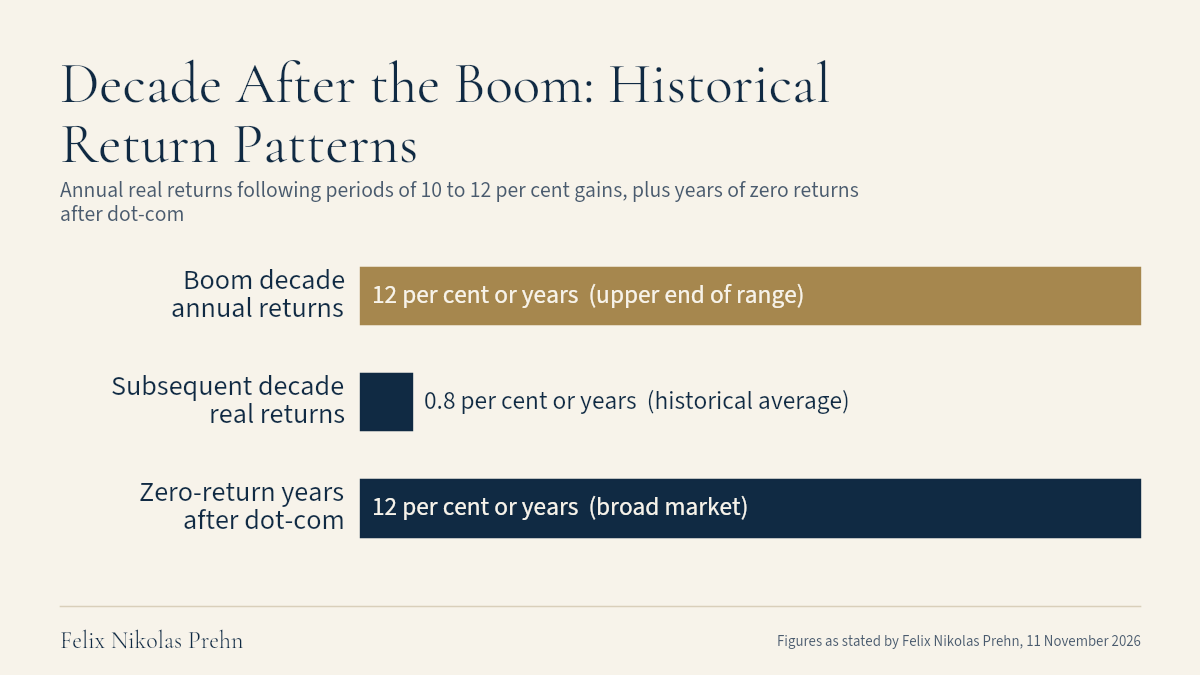
So, another big myth is that people think that it'll be fine in the long run. It'll be fine. Like in I'm going to retire in 10 years. I'm going to get my 10, 12, 15 per cent a year and and and I can live off that.
It' be brilliant, right? And maybe you have $100,000 or a million dollars or whatever and you've figured out what that percentages you can live off. Well, well done. Unfortunately, that isn't quite the story because the way it really works is that we get these periods where get these periods where the market does, you know, 10 per cent or even 12 per cent for 10 years. And everybody's like, "Brilliant.
This is going to happen forever after." You know what happens the next 10 years statistically? Well, the next 10 years the market does 0.8 per cent. Real numbers. Can look it up. And that's then for the next 10 years.
So the problem is that we always assume that the recent past is going to continue the way it has, right? So if we enter one of these periods, say after the com bubble burst, 12 years of basically zero returns, like zero, right? How does that then work with your retirement?
Now the good news is that the market does not act as one. So yes, the media will tell you this nonsense story that let me find some space that you know the the S&P is basically the market 500 right and everything goes up a few per cent a year whatever but underneath that there are lots and lots of sectors and those sectors move very very differently. So you look at yeah tech was like you know disaster but what went up well utilities energy for example they actually did really quite well so the smart money and by smart money I always grin when I say smart because I know a lot of bankers we're not that smart um but we were trained so the trained money knows that you have to move from one sector to the other untrained money just believes this headline story that you would always get your 10 per cent or whatever, which just isn't true. You could have 10 years or more where you get nothing and then you have to ask yourself, how's that going to impact your plans for life and retirement and enjoyment and so on. So what I want to teach you on Saturday is exactly that.
How to follow the trained money into the places that are more likely going to give you happiness than than misery. And then talking of misery, um I watched the Bill Gates interview. Well, only about a few minutes of it. It's all I could stomach. And it put a genuinely um well cold, icy feeling through all of this.
He's sitting there on CBS and the interviewer asks him this and I'll play you a little clip of it in a second. Um, does something terrible actually have to happen before the world takes AI risk seriously? And Gates says, and I want you to hear the exact words, not my sort of paraphrase, >> it may be that we have to suffer a few of the negatives uh before we'll we'll respond as fully as we should. Fortunately though, you know, those aren't civilization ending. They're they're bad. >> I mean, if you hack if you hack Fidelity or Vanguard and much of the world's trillion dollar retirement nest egg, that would be a pretty big event. >> Well, you could create uncertainty in in cases like that.
And so being ready, trying to make sure we do the things and avoid any negative incidents. that assuming we fall short of that, then when some of the negatives start to emerge, you have very concrete ideas in place. So people say, "Okay, you're right. We don't want that to happen again." Now, this is the guy who is one of the largest asset owners on the planet. Somebody who, whatever these negatives turn out to be, is about as insulated from them as a human being. I'm being generous here can possibly arrange to be.
Now, if you put that sentence over everything that we just talked about, the printing money, the buybacks, the decades long hollowing out of the saver, and it doesn't sound so abstract anymore as a random warning. It starts like like a plan. I was going to say confession, but you know, that would be going too far perhaps. Um, he says we will have to suffer. So it concerns me and a lot of people suffered greatly in the pandemic.
Some people, especially people with lots of money and lots of training in advance, came out brilliantly. So I don't want to scare you. I don't want to be a doom and gloomer. I just want to be a realist here. And I'm looking at this and this concerns me.
So I just wanted to share it with you because I think there is something genuinely brutal in the system that we live in. And I'm a full-blown capitalist. I'm an ex-banker, right? I trade, I invest. That's how I live.
And I benefit from the system greatly. But I also appreciate that 99.9 per cent of people do not benefit from the system as greatly as they could or not at all because no one's ever explained the system to them.
So when you have one of the richest men alive on camera saying that and then you just look back at history 1971 I'll leave you with one number in 1971 by the US government's own figures that dollar today buys you seven cents of what it bought back then. So a dollar became seven cents. And I don't believe that figure. I think it's massively inflated. I think it's a fraction of a cent.
So I believe in two years, three years, five years, 10 years, a lot of people are going to wake up and they're going to look at their buying power, their wealth, which went up on paper, but the reality of life feels exactly like this charting. And my hope is that we can change this for as many people as possible. So join me on Saturday. do me a favor, share this with video with as many people as possible or even just screenshots of it or links to the training or whatever you want to do and let's just make the biggest impact we can because this system that they're running again is deeply deeply disturbing and unfair and it's the one thing that gets me out of bed in the morning. It's the one of the biggest reasons I do what I do here and and share this with you. Um, yes, I get a lot of enjoyment out of it and you know, I've got Winston obviously it's great research, but in all seriousness, this is going to hurt really, really unpleasantly a lot of people and it'll be the people who least deserve it.
So, come and join me on Saturday, how to prepare.org and um share this with more people. I wish you all the best. Right now, I think we're going through some sort of weird phase transition. And normally when you get bad economic news or you get bad jobs data that people are going to fly to safety into the bond.