Anthropic lost 104 billion dollars last year. It has priced its IPO at a valuation of about 1.4 trillion dollars.
A monetary system that has expanded by 52 per cent since 2019 produced that gap. The consequences reach far beyond a single listing.
The Anthropic IPO as symptom
Anthropic has set a price range of 70 to 78 dollars per share for 800 million shares. At that range the implied valuation is roughly 1.4 trillion dollars.
The company does have revenue, with a run rate of about 81 billion dollars. Google, Nvidia, Microsoft and other chip makers have committed 26 thousand million between them to acquire a pre-IPO stake.
In Felix's view, the Anthropic valuation functions as a thermometer, registering how much fresh currency is being printed. More dollars chasing the same holdings pushes prices up. The supply of dollars expanded 52 per cent since 2019.
The house that didn't change
A house on the same street sells for double what it did a decade ago. The bricks and the roof stayed the same, yet the price doubled because the value of the money shrank. The same logic, in Felix's view, applies to a company valued at 1.4 trillion dollars despite losing 104 billion in a single year.
The 52 per cent money expansion
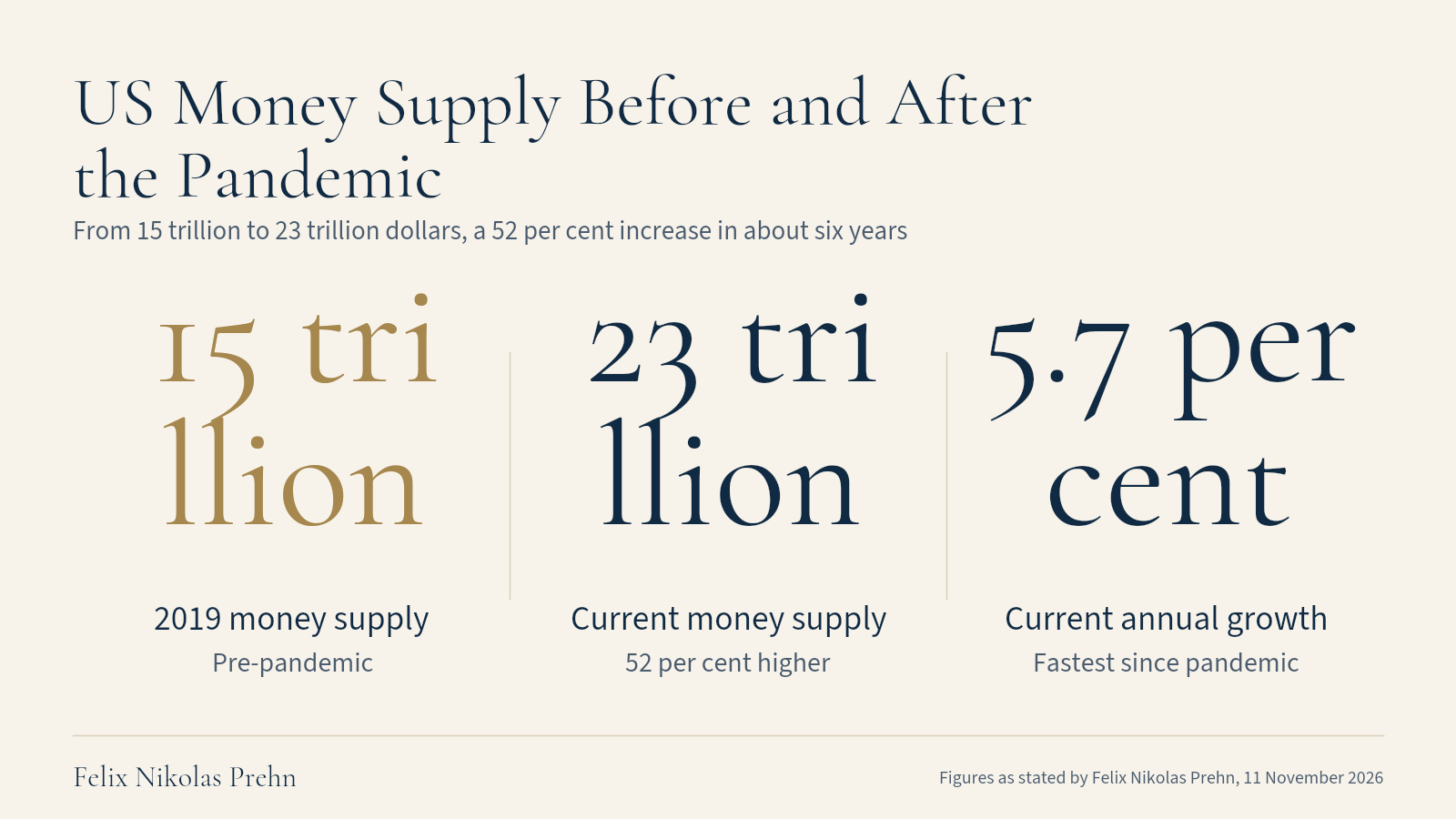
In 2019, before the pandemic, the US money supply was about 15 trillion dollars. Today that figure is 23 thousand billion dollars. The increase is roughly 52 per cent.
Money supply growth this year is 5.7 per cent, the fastest pace since the pandemic.
Felix argues that a 10 per cent portfolio gain sounds impressive. But the dollar supply expanded 52 per cent. Anyone whose portfolio grew less than 52 per cent over the same period lost purchasing power.
The plumbing behind the printing
The US Treasury doubled the size of its debt buyback programme in August of this year. Each operation rose from 2 to 4 billion dollars or more. A buyback means the government enters the bond market and buys back its own debt.
The Federal Reserve balance sheet stands at just under 7 trillion dollars.
In Felix's view, the state is lending to itself with money that did not exist a single moment before. The central bank creates the currency. The Treasury uses it to retire old bonds.
When the government buys back its own bonds of longer maturity, it pushes interest rates on that debt down. Rates at the far end of the curve price mortgages, corporate borrowing and future earnings.
When those rates are forced down, every existing asset looks more attractive by comparison. Capital floods into shares and property. A company valued at 1.4 trillion dollars is one beneficiary.
The playbook already exists
A country has run a policy of repeatedly buying its own debt for more than 20 years. The result hollowed out the standard of living of savers while enriching owners of good assets.
Felix argues that the United States is openly copying that playbook. The money supply has risen 52 per cent since 2019, with 5.7 per cent growth this year.
Debate continues over whether such policies can be sustained. Japan's central bank has faced internal pressure over its bond purchases, and some Asian nations have reduced their holdings of US debt.
Crowded into one side of the boat
US households have never had more of their money in the stock market than they do right now. The current level exceeds what was seen in 1929. A handful of giant names now make up 30 to 40 per cent of the index.
Concentration creates a specific problem on the way down. If a downturn arrives, sellers will look for buyers. But if everyone already owns the same stocks, there is no one left to buy.
Felix argues that selling in such conditions requires offering a large discount to find a counterparty willing to take the position.
The financial crisis illustrated the mechanism. All the banks owned mortgage-linked securities. They all tried to sell at the same time, and banks went bankrupt.
The long-run myth and sector rotation
A common assumption is that the stock market delivers 10 to 12 per cent a year over the long run. After a decade of roughly 10 to 12 per cent annual returns, the following 10 years have historically delivered about 0.8 per cent as a real return. After the dot-com bubble burst, broad indices returned basically nothing for 12 years.
Broad indices and individual sectors can move in opposite directions for years at a time. Utilities and energy have performed well during periods of poor broad-market returns.
Bill Gates and the 7-cent dollar
Bill Gates stated on CBS that society may have to suffer some negatives before responding fully to AI risk. He added that the consequences would not end civilisation. The interviewer raised the scenario of hacking Fidelity or Vanguard and much of the world's trillion-dollar retirement savings.
A 1971 dollar today buys only 7 cents of what it bought then, according to the US government's own figures.
The money supply rose 52 per cent since 2019. When the supply of dollars grows faster than the goods and services priced in those dollars, asset prices rise. It also reduces what each unit of currency can purchase.