Transcript
Right now, there is a crisis brewing in one of the world's most important markets and almost no one's talking about it. And I wasn't going to make this video because I'm on holiday. I was working on some research and I discovered something that I thought is so important that not just the institutional guys who do the research understand it, but that you deserve to understand the same level information too.
And if you agree with me that the fact that Wall Street has an information edge over us and it's a good thing that we level that out, write "unfair" in the comments down below and I'll try to make more of this kind of content. And I will show you an indicator that we've just built that actually really crystallises information here in how it ties in to the oil and Iran panic that we're seeing in markets. Because in the metals market, specifically the silver market, there are 356 ounces of paper silver backed by 1 ounce of real physical silver. And when the music stops, somebody isn't going to get their silver. In fact, most people don't.
And the people who understand what's happening, they're already positioning themselves for what could be a literal once in a generation wealth transfer. So over the next few minutes, I'm going to break down exactly what's happening, why it matters to you as an investor, and most importantly, what you can actually do about it, how you can track it. So let's get into it.
My name is Felix Prehn. I'm an ex-investment banker. My research is usually done by my golden retriever who wasn't travelling with me today, so you're just left with me. Oh dear. And I've learned from people in big Wall Street banks. I've learned from people who are market makers in the big metal exchanges and I use that knowledge and that experience to now help everyday investors to understand what those guys already do.
Because the truth is that the information gap between Wall Street and Main Street, you and me, is one of the biggest reasons regular people miss out on opportunities. And that's why me and my team at the GOAT Academy, my mentors, my Wall Street mentors have been for the last 6 years teaching thousands and thousands of regular investors how the markets really work.
And this isn't some fringe conspiracy theory. This is based on available data from COMEX, the Fed, major financial institutions like JP Morgan and Bank of America. And by the end of this video, you understand exactly what are silver squeezes, why the conditions for one are stronger than they've been in decades, and how you can position yourself and understand what's going on here. Let me just show you our indicator. Literally, it's here. It's at 95 out of 100. But you need to understand why to be able to really do something with this information.
So let's start with the basics and then we'll tie it into Iran and oil and everything else so you have a clear picture of how this actually works. You don't need a PhD for this. So let's start with the basics. What exactly is a silver squeeze? Well, imagine you're running a coat check at a fancy restaurant. You have 100 coats in your closet. That's your physical inventory. But here's the problem. You've handed out 356 claim tickets.
So as long as people don't all come to pick up their coats at once, everything is fine. And assuming everybody's wearing the same coat, some sort of weird Orwellian world. But what happens when 200 people show up, closing time, and they all want their coats? Well, chaos, because some people aren't getting a coat, right? That's essentially what's happening in the silver market right now.
The silver market operates in what's called a fractional reserve principle. So at COMEX, which is the main exchange where silver is traded, there are two types of inventory. There is registered silver. That's silver that's actually available. So think of that as the coats actually hanging on the hanger. And then there is eligible silver. This is silver stored in the vaults, but it isn't available for delivery. It's like coats that belong to someone else, but happen to be in your closet. They're not yours, right? But you're pretending that they are.
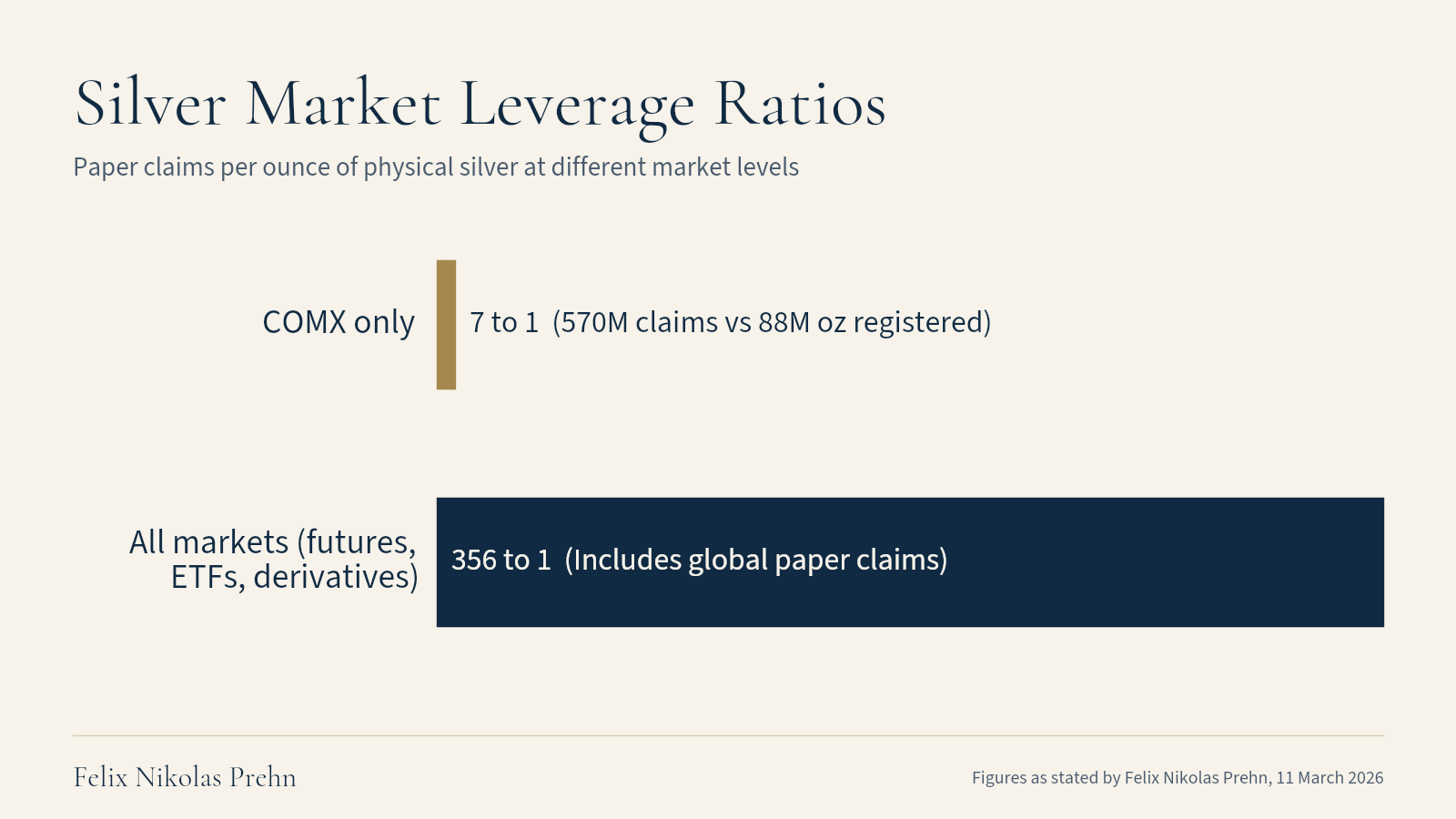
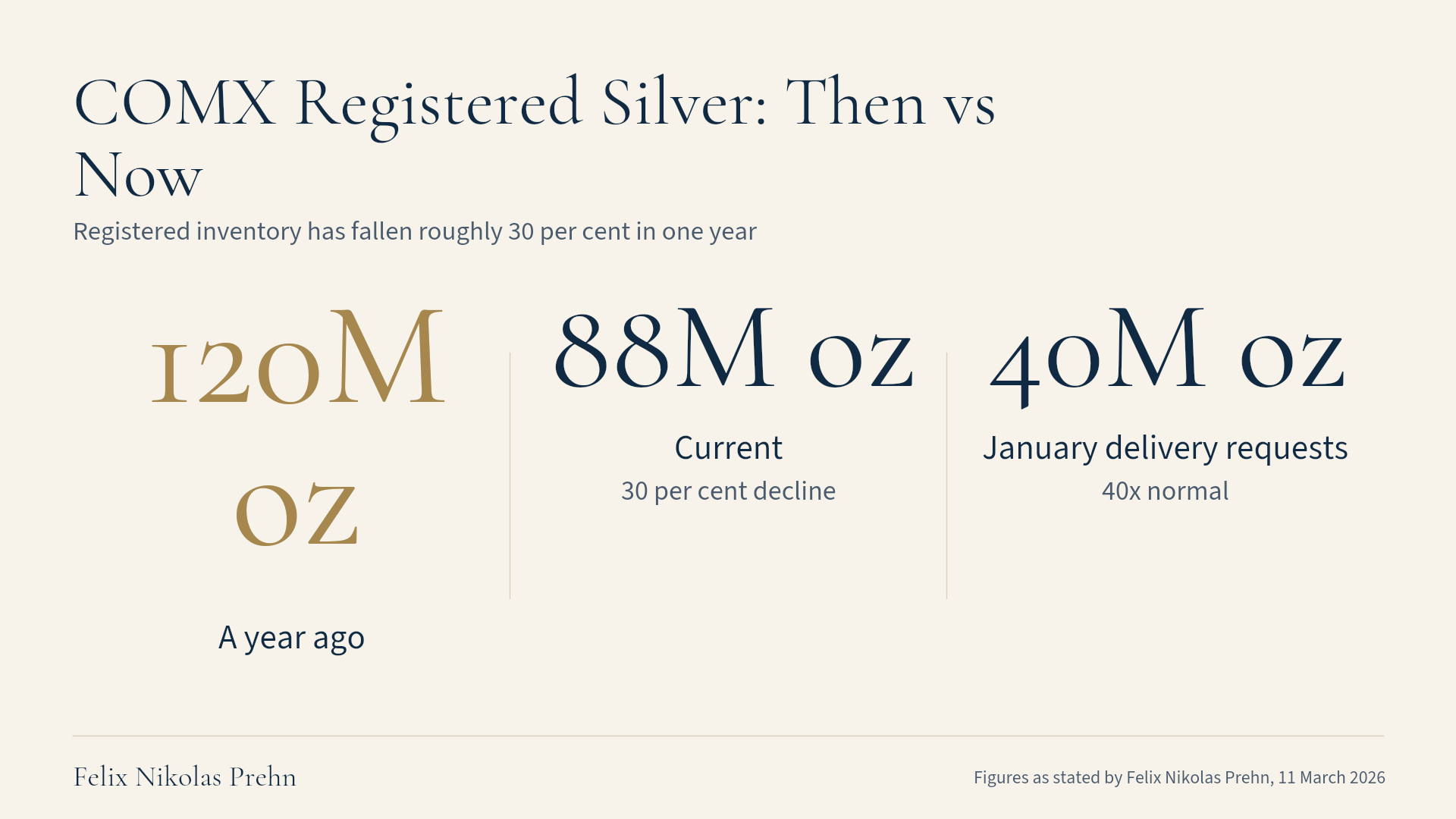
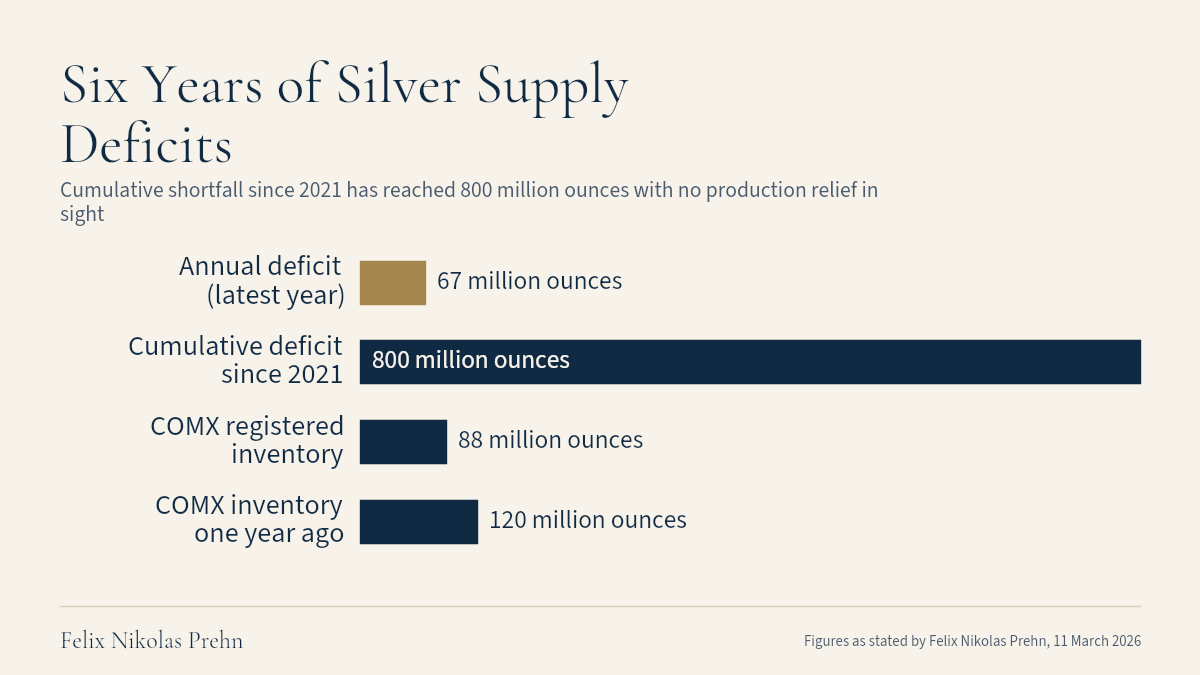
And if you look at the live COMEX data, and again, that's something we track in here. Just chopping on in our metals intel here, and you'll see that registered silver is at about 88 million ounces, right? It was a year ago 120 million. So where did 30% of the inventory go? But that isn't actually the most important part. The most important part is that there are about 570 million paper claims for that silver. So it's a leverage ratio of over 7 to 1 just on the COMEX.
But when you zoom out to the entire silver market, including all the futures, the ETFs and the derivative markets, analysts estimate the ratio may be as high as 356 to 1. So every 1 physical ounce, there are 356 claims. Now, let me ask you, does that sound like a stable system to you? Drop a comment down below and let me know.
And did you know the market, the silver market worked like this before you watched this video? I'd love to understand how many of you already knew about this disconnect. If you knew about it, just write "disconnect." If you're new to this, write "new."
So what's actually happening here on the COMEX side? COMEX, which is the commodity exchange, is where the world's silver price is determined in the paper fugazi world. And every day billions of dollars of silver contracts trade. But most of these contracts are never settled in physical metal. They're rolled over, settled in cash, in paper. And the system works because most people don't ask for delivery.
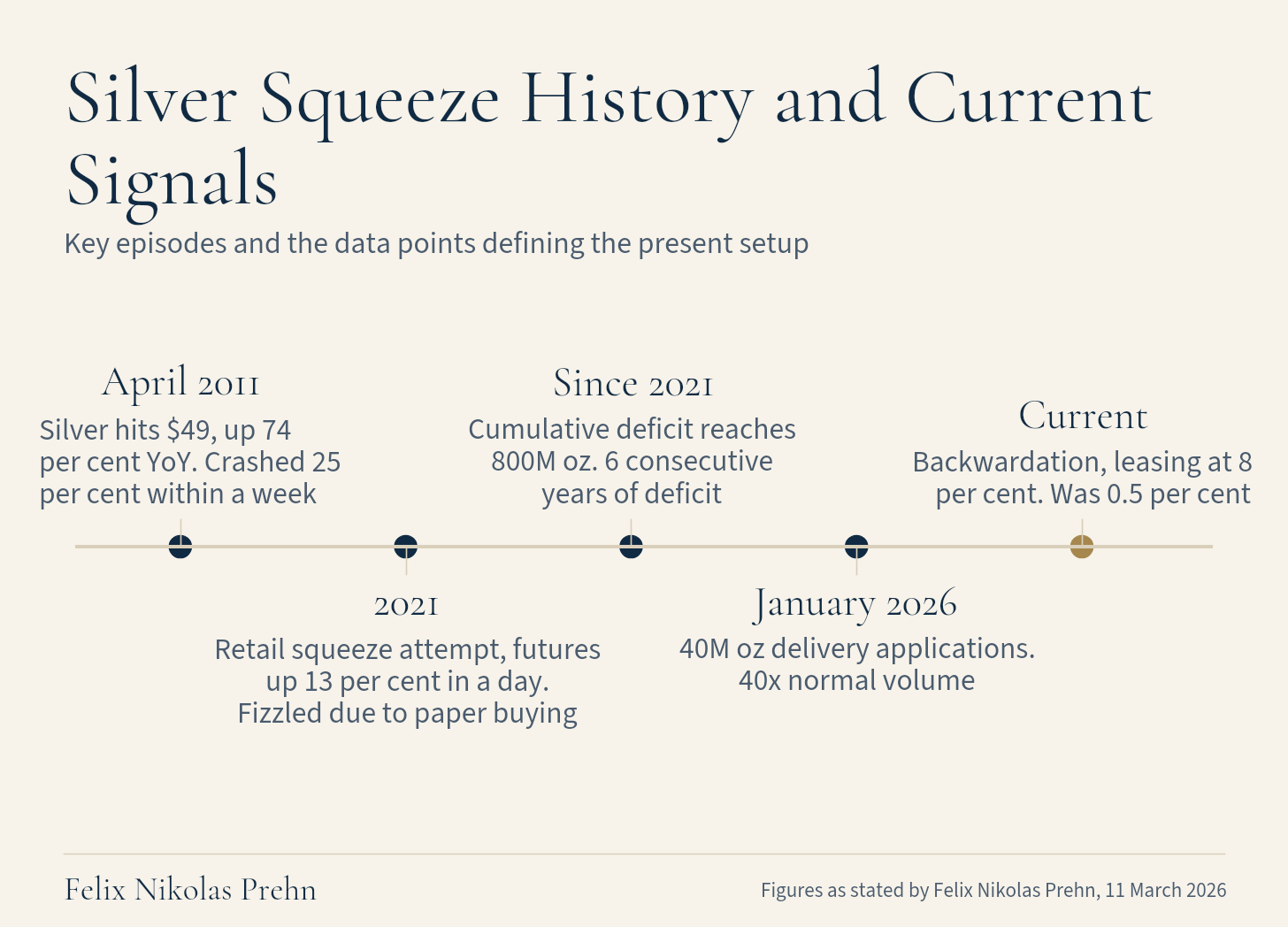
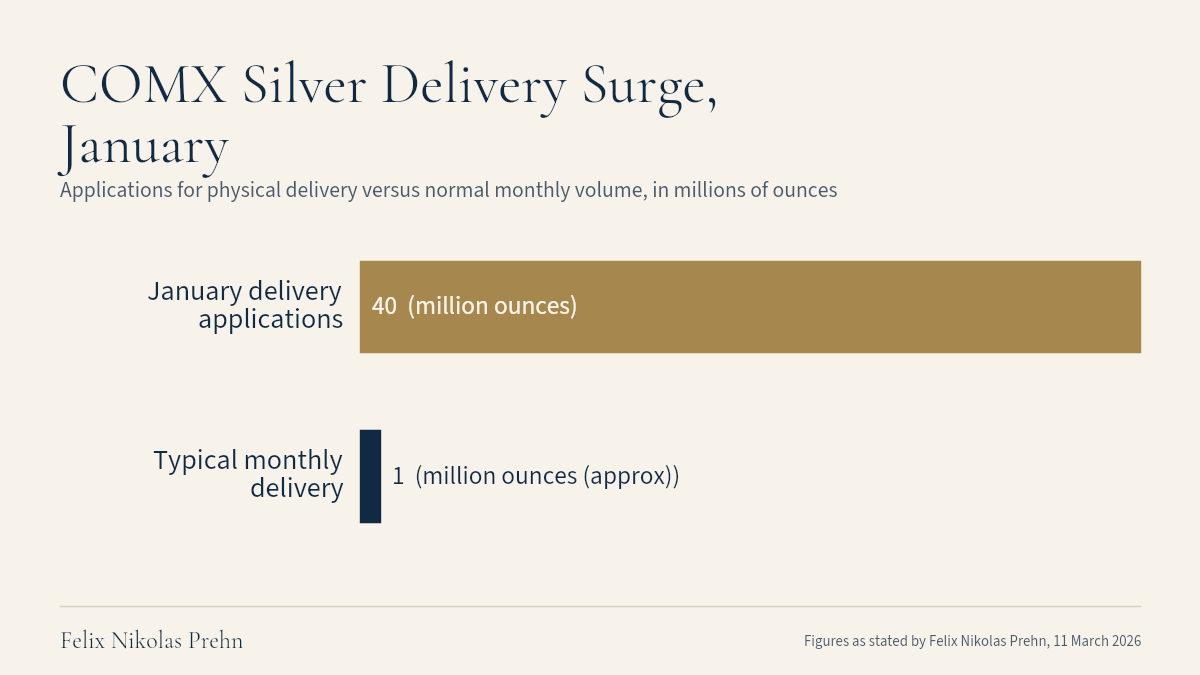
But something has changed. In January this year, which is typically a month where there is no delivery, something very unusual happened. The COMEX received applications for 40 million ounces of silver delivery. Now, that's about 40 times more than normally gets delivered. And the numbers don't really add up. Let me walk you through the maths here. It's very simple, but powerful.
Registered inventory is about 70 to 80 million ounces. Recent deliveries have taken out 26% of that inventory in one week. At the current pace, silver could be exhausted in 60 to 70 trading days. So there is not enough physical metal to satisfy the claims. So what happens on the next delivery day? What happens if they can't deliver?
Well, there are a few possibilities. They could just pay you the market price in cash, but it certainly would undermine trust in the system. They could declare an emergency and just change the rules. We've seen that happen before. Or as people realise physical silver is really running out, the price could dramatically rise and then bring some sellers into the market who want to take profits.
Now the market is showing some real stress here and we've literally built in our intel dashboard here, which you guys can access. It's like $6 a week or something. You can cancel anytime. And one of the cool things apart from silver, you see all the oil and gas infrastructure in the Gulf. You see what is being affected, what isn't, who owns what, and so on. Literally around the whole Gulf region, pretty much the whole world. You'll see the pipelines. So you can really see what's happening.
You see the earthquakes near the major mines. You see wars. You see tropical storms. You see shipping lanes and everything else that's happening. In fact, you can see live what's happening in the Strait of Hormuz to see who's actually going through there. And what nations' oil tankers are braving the Strait of Hormuz and who's stuck in place and so on.
But it also has a gold, silver, and copper squeeze indicator. And if I look at the silver one, it's just flashing at me literally. And it's saying something, a word that nobody ever uses if they have friends. It's called backwardation. And it means that current prices are higher than future prices. And it signals real urgent demand and a supply shortage.
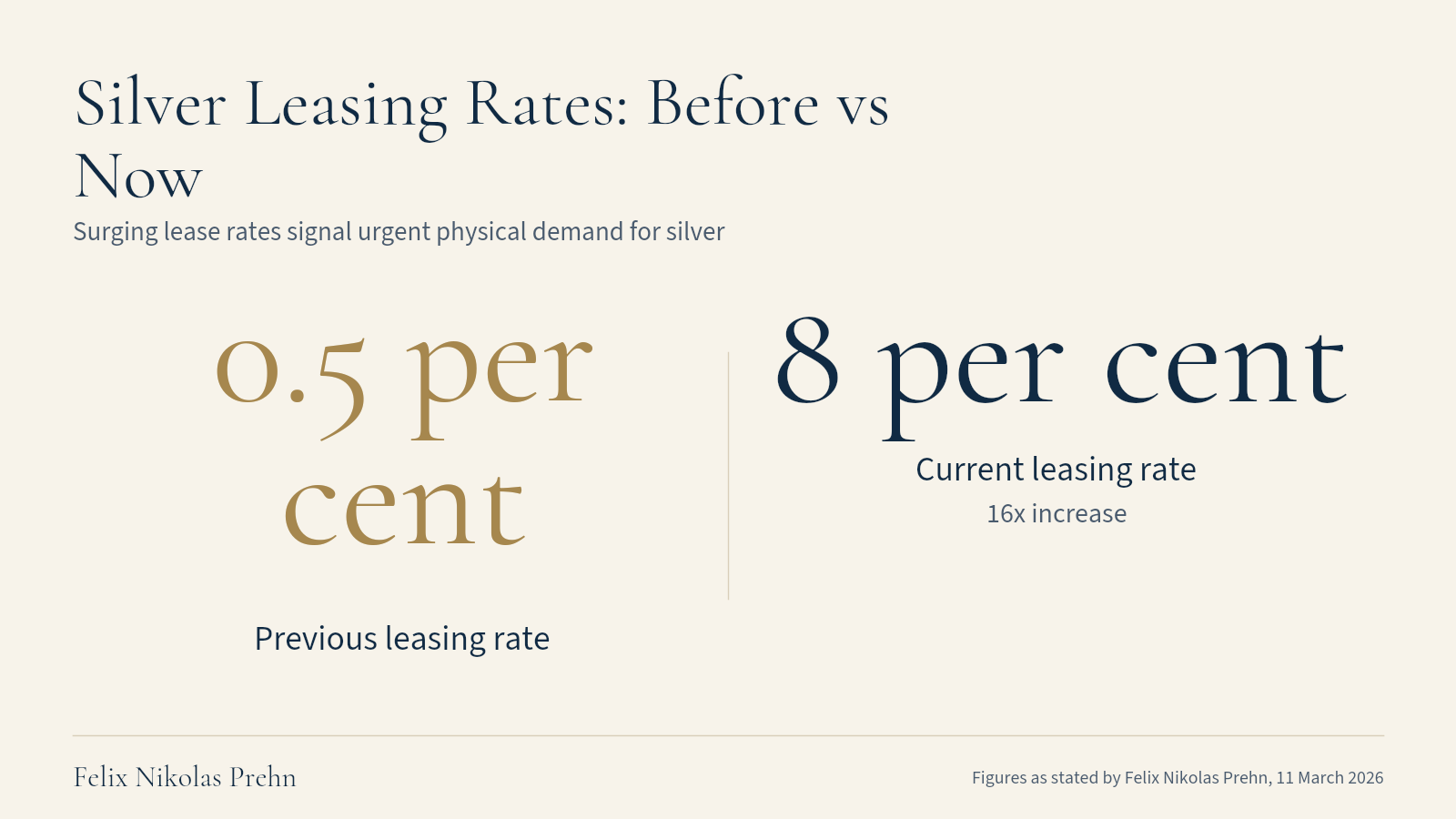
If you want to lease out your silver, which you can, you're getting about 8% now. That used to be 0.5%. It means people are paying a premium to borrow silver. And it's all screaming at us. There is a massive opportunity to potentially have a short squeeze.
Now, do I know a short squeeze is coming? No, I don't. I can just look at the data points. Am I telling you to buy silver? No, I'm not. I'm not a registered anything. I'm not a registered financial adviser, that's for sure. Just sharing with you my research and my data and you can then come to your own conclusions. My goal is to educate you, not to tell you what to do.
But let me ask you this. If you own a silver ETF like SLV, do you actually own silver or do you own some paper claim on silver? And think about that distinction. We're going to come back to that in a second when we talk about how we actually could position ourselves here.
Now, this situation, which you now understand, is very important. But we also have a war in Iran. So let's connect some dots that Wall Street's already watching. You've all seen oil prices are going through the roof no matter what the government's trying to do about it with panic selling and so on. And again we keep track of that here. Literally we have a live intel feed that updates every minute. There is the energy data that tells you precisely what's going on every minute of the year. Military action, mining action, shipping action, everything is there. It's all live from over 150 data sources that I actually trust.
And what's that telling us? Well, crude oil being at like $100 per barrel or thereabouts. Why does it matter for silver? Well, oil, inflation and the Fed ties together. There's a connection. Higher oil prices mean higher inflation. The rough estimate is that a $10 increase in oil adds about 0.1% to inflation. Sounds small, but when inflation is already above the Fed's target, every fraction really matters.
And Bank of America has just come out with this. Their analysis says that if oil stays elevated, the Fed will delay rate cuts. They could even consider rate hikes.
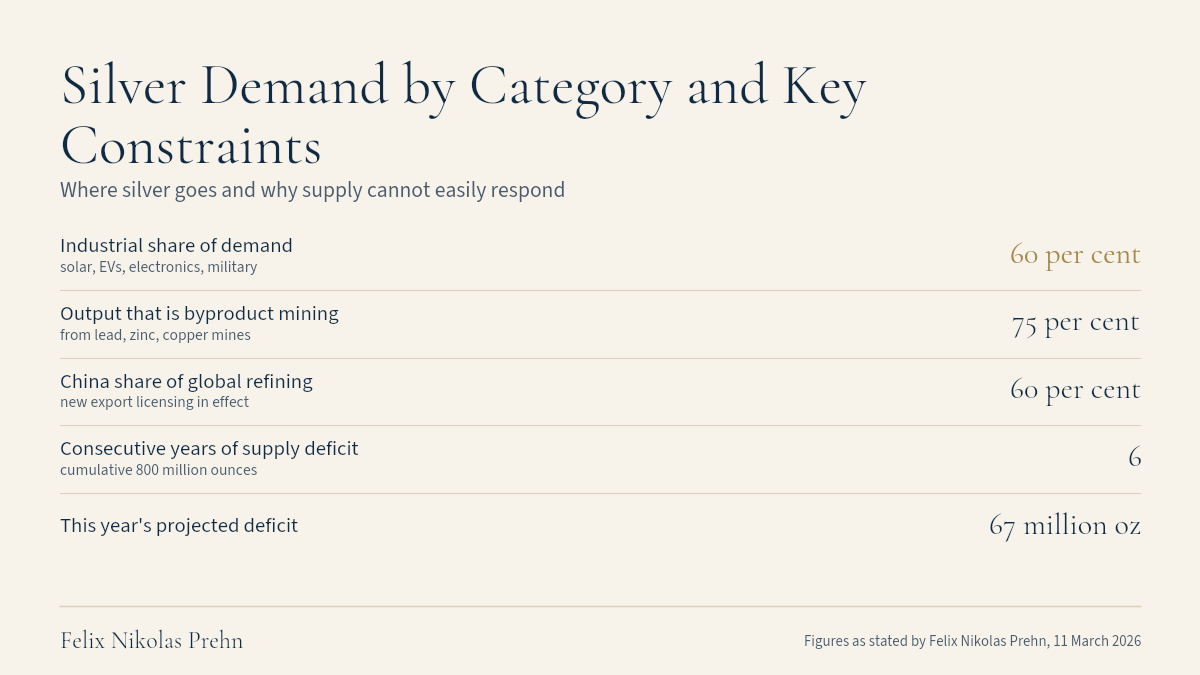
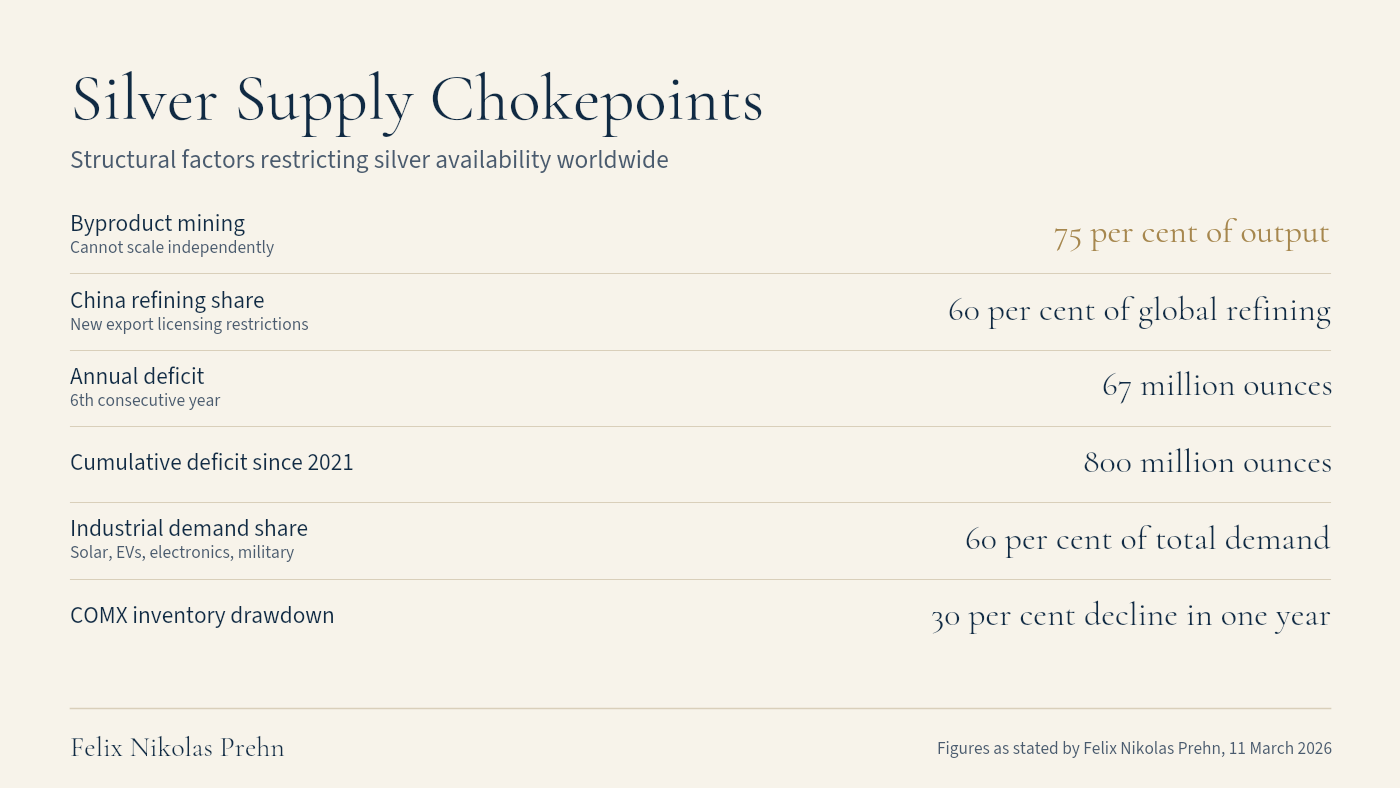
Traditionally precious metals, the shiny stuff, do really well when interest rates are falling, inflation is rising. So there's economic uncertainty. But the key insight is this. Silver actually benefits because it's both a precious metal and an industrial metal. So in my humble opinion, silver outperforms in this scenario because unlike gold, which is basically a monetary metal, silver has massive industrial applications. 60% of silver demand comes from industrial uses. Think of solar panels, electric vehicles, electronics, missiles, that kind of stuff.
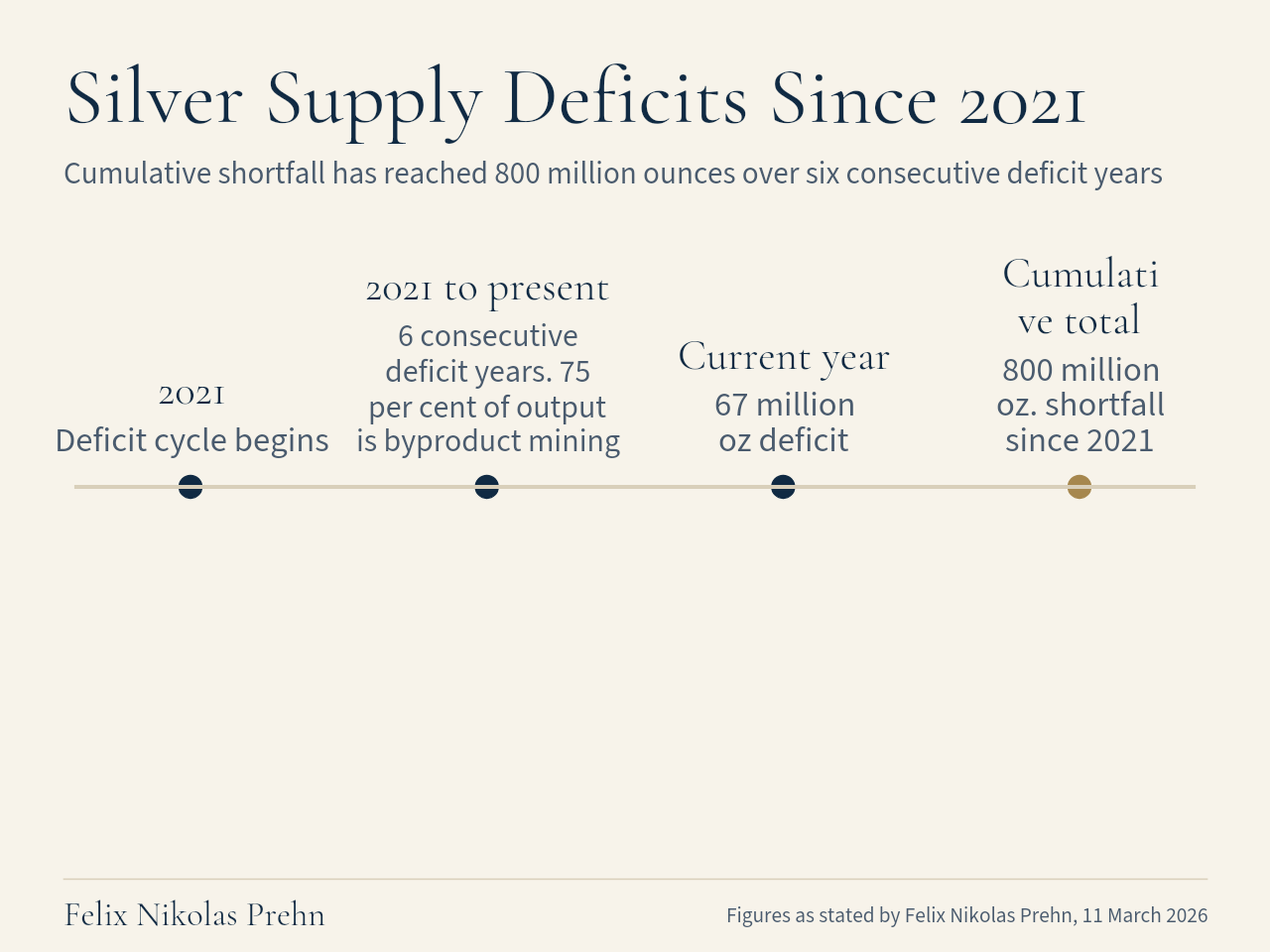
So while gold benefits from chaos, silver benefits from chaos plus industrial demand. So you have two engines instead of one. And then you have the deficit for 6 years running. Supply has been less than demand. The deficit for this year is about 67 million ounces. The deficit since 2021 is now 800 million ounces.
And unlike oil, the producers can just ramp up production, just turn the tap back on. 75% of silver is a byproduct of other mining. Think lead, zinc, copper. You can't just go, "Oh, let's dig up some silver." Doesn't work. And on top of that, we also have new this year China's export licensing requirements, which, by the way, China controls about 60% of global silver refining. This essentially restricts who can export silver.
So there is a heck of a lot less silver about because China is keeping it within China borders. They're treating it like a rare earth. So if you look at your phone, your laptop, your car, every single one of those has silver in it. Now imagine all the solar panels being installed worldwide, all the electric vehicles being manufactured, all the rockets being built. What do you think happens when there isn't enough?
Now before we go any further into the actionables here, I want to share something with you. And if you're watching this and thinking, this is a lot of information, how do I actually apply this to my situation? Well, that's exactly why my Wall Street mentors and I created a really comprehensive mentorship programme and academy. We break everything down to a level where everybody can understand this.
So if you want to go deeper into this completely for free, no strings attached, join me this weekend for a live training and I will teach you how to spot these opportunities just as Wall Street is discovering, because there are rules for this. There's 3 simple rules that Wall Street's been using for 50 years that don't get taught to you and me, the unwashed masses usually, but will help you identify a trend as it's starting to happen. Think about the wave building. We want to be earlyish in on that. And that's a rule-based system. It's data-based and you can learn that very rapidly if you join me on Saturday.
I think it is felixfriends.org/training. Grab yourself a free seat and make sure you show up on time because this is live, it's on Zoom. You can ask me questions in that Zoom room. It does get full. It has a limit to it and I don't want to disappoint you.
Now, I'm a big believer that history rhymes. There are 2 silver squeezes in recent history that every investor should understand whether you're into silver or not, into gold or not, or anything else. And let's look at what happened there and why it happened and most importantly what we can actually learn from this.
In April 2011, silver reached an all-time high, $49 and a bit, and that was 74% higher over the previous year. Why? The Fed was in the middle of printing money like crazy people and investors were worried about the dollar. Industrial demand especially from solar was growing and there was a lot of fear about inflation because the government was printing so much money. But silver didn't stay at 50. It crashed. Within a week it dropped 25%.
What happened? The Fed stopped the money printer. The major metal exchanges increased margin requirements and some large traders unwound their positions. We shan't mention who they might be. Morgan. The lesson here is silver can move very violently and you need to understand the catalysts both up and down.
And then in 2021, second lesson here, we saw another attempt at a silver squeeze and that came right after the GameStop short squeeze. Silver futures rose 13% in a day. Retail dealers, unprecedented demand. They couldn't fill the orders, which is precisely what we're seeing right now. But it fizzled out. Why did it fail? Because the community was divided. Many argued the silver thing was a distraction from the really important stuff like AMC and GameStop, and most of the buying was in paper silver ETFs. So when you buy paper, you're not actually putting pressure on physical supply. Therefore the squeeze didn't have any teeth.
So why do I think the present setup is actually different? Well, a couple of factors. Physical delivery demands are surging. There's literally a shortage of stuff. You go and try and buy a fair amount of silver and they'll tell you fine, we will deliver in 3 to 6 months and they're going to charge you a premium. COMEX inventories at critically low levels, 30% down. China has restricted exports. Industrial demand is just there. The military alone, Iran alone, that war will use up a lot of silver. And the deficit in supply is real. So this isn't some lunatic retail traders trying to coordinate a squeeze. This is a fundamental supply and demand pressure problem.
So let's get physical. If you get that musical reference, put it in the comments down below. You understand the thesis. You see the opportunity, but you're still a bit fuzzy on how you could position yourself. So I'm going to break this down for different types of investors. And let me know at this stage, what's your current exposure to silver? Is it zero? Is it a little? Is it a lot? Put a comment down below and I will read them. I don't read all of them.
Now, the most direct way to own silver is physically. You own coins like American Silver Eagles or Canadian Silver, Mexicans and bars from reputable refiners. Now there's no risk there other than that some lunatic might try and rob you. Nobody can really touch your ownership, but you have some storage and some security problems and maybe some insurance issues and a lot of ammunition you need to keep next to the bed. It's also a little harder to sell it, the transaction costs when you buy and sell it. So for most people it makes sense to have some physical metals but maybe not 100%.
So if you want silver exposure in a brokerage account, you have options. But, and this is important, please write this down, please help spread this message, because not all silver ETFs are equal. SLV, which is the largest and the most liquid silver ETF, $22 billion and up, but it's paper. You cannot redeem it for physical. The silver may be leased or hypothecated, whatever that means. And in a true crisis, paper claims will diverge from the physical.
And then you have another one which is called PSLV, stands for Sprott Physical Silver Trust, and they hold fully allocated physical silver bars. They're stored at the Royal Canadian Mint. That may or may not be a good thing depending on whether you trust the moose up north. And if you're a larger holder, you can redeem for physical silver. If you own a dollar of it, obviously you can't. It trades at a bit of a premium or at a discount to the actual net asset value, and you might want to look into that. It may also have some tax advantages, but the expense ratio is definitely higher.
So my personal view is this. If you're going to use an ETF, PSLV offers more direct exposure to something physical. The third option is if you have a retirement account, you have options too. If you're in a self-directed IRA, you can roll over funds from a 401k or a traditional IRA. And then you could purchase IRS approved silver. It must meet certain purity standards. It must be stored with an approved custodian, not at your home under the bed with all the ammunition. American Silver Eagles, Canadian Maple Leafs typically qualify.
Now most 401ks and IRAs can also hold silver ETFs. So check with your administrator overlord there, but it's the simplest way to get some silver exposure in your retirement account if that's what you're looking for. And I did warn you, this is a very, very volatile instrument.
Right now, if you want more risk in your life, I guess you're that way inclined, you could buy some mining stocks because when silver goes up say 20%, a miner could go up 50 or 100%, and the other way around. I give you a few tickers here. PAAS, AG, and HL. They're the more reputable players out there. There is also a silver mining ETF which is called SIL. You might want to write that down too if you want more diversity.
But mining stocks carry operational risks that physical silver doesn't have. Think permits, labour issues, risk management. If you look on our little screen here and if I just take off some of this good stuff and just show you the mining operations around the world, there are some risks blinking here around them because repeated community blockades. China owns the mine. What about this one? Peru, political instability, community protests. You get the idea.
So there are definitely some issues here, but I put all the major mines on the map so you can check those out and you can see where the world's silver is coming from and what might impact that. Earthquakes, for example. Earthquakes are not a good thing. And look here, we had just some fairly big quakes here in just in recent, 2 days ago, for example. 22 km south of somewhere. So gives you all that data there.
Including a link to more details. And that's all available as part of that $6 week subscription that we have. So how much silver should one own? Again, I'm not a financial adviser. This is not personalised advice, but I can share what many sophisticated investors consider. Common framework is 5 to 15% of portfolio in precious metals.
Some people say a smaller proportion of that should be silver, more of that should be gold. It really depends on your risk tolerance, your time horizon, your portfolio, what is it made up of, your income streams, and what risk and movements you are comfortable with.
Now, I know a lot of videos and people on YouTube only talk about the bullish scenario because they're trying to pump something up. We don't do that. I'd be doing a disservice if I only talked about opportunity and not risk. So let me share with you the problems that could happen.
Demand could get destroyed. If silver prices go too high, industrial users will find alternatives. We're already seeing that in solar panels. They're using less silver per cell. And this could accelerate if prices go extreme.
COMEX could declare force majeure or some sort of act of God. I thought that might be JP Morgan, but somebody corrected me on that one. They could just change the whole system and it's all just paper and cash based. So the squeeze may not happen and there could be a government intervention. In the 80s regulators changed rules halfway through the day. They could do that again. They can change margin requirements. They have a lot of rules to stabilise the market that they can implement.
And then of course there are a few other things like timing and so on. So position sizing matters. You never want to be somebody who puts all his life savings on one idea because you can be wrong. So diversification is important. I think silver is a good part of a portfolio, but it is definitely not the portfolio. And you might disagree with me on that violently and the comments go nuts.
So let's wrap this up. What are your next steps? Educate yourself further. This video is a starting point. If you want to learn how to understand when to pick a trend like this or a trend on any stock or any industry, join me on Saturday and I'll teach you how to pick better stocks, better metal things, better miners, better anything because the system is actually very much the same for all investments.
And then decide your approach. Is it physical? Is it ETFs? Is it mining stocks? Is it some combination? And definitely if you do want to start, start small. Don't ever go all in immediately. It is hard to do and the prices will swing violently and you might feel unlucky or something. And it's good if you can sleep well at night and sleep soundly.
And if you want to go deeper and you want to learn from me live and ask me questions live about gold and silver and tech stocks and inflation and the oil and the war and around and everything else, I'll show you how we can make sense of all of that with three simple Wall Street rules where we can follow the money, the big money. And I'll be teaching that to you live on Saturday at felixfens.org/training and grab yourself a free ticket there.
And keep learning, my friends. And if you got some value out of this video, join me Saturday and forward it to somebody who might benefit from it. I wish you great success. There is a huge investment opportunity that most retail investors are completely missing out. They're chasing the latest AI stocks while the real tech revolution is actually happening on the battlefields.