The 356-to-1 Paper Problem
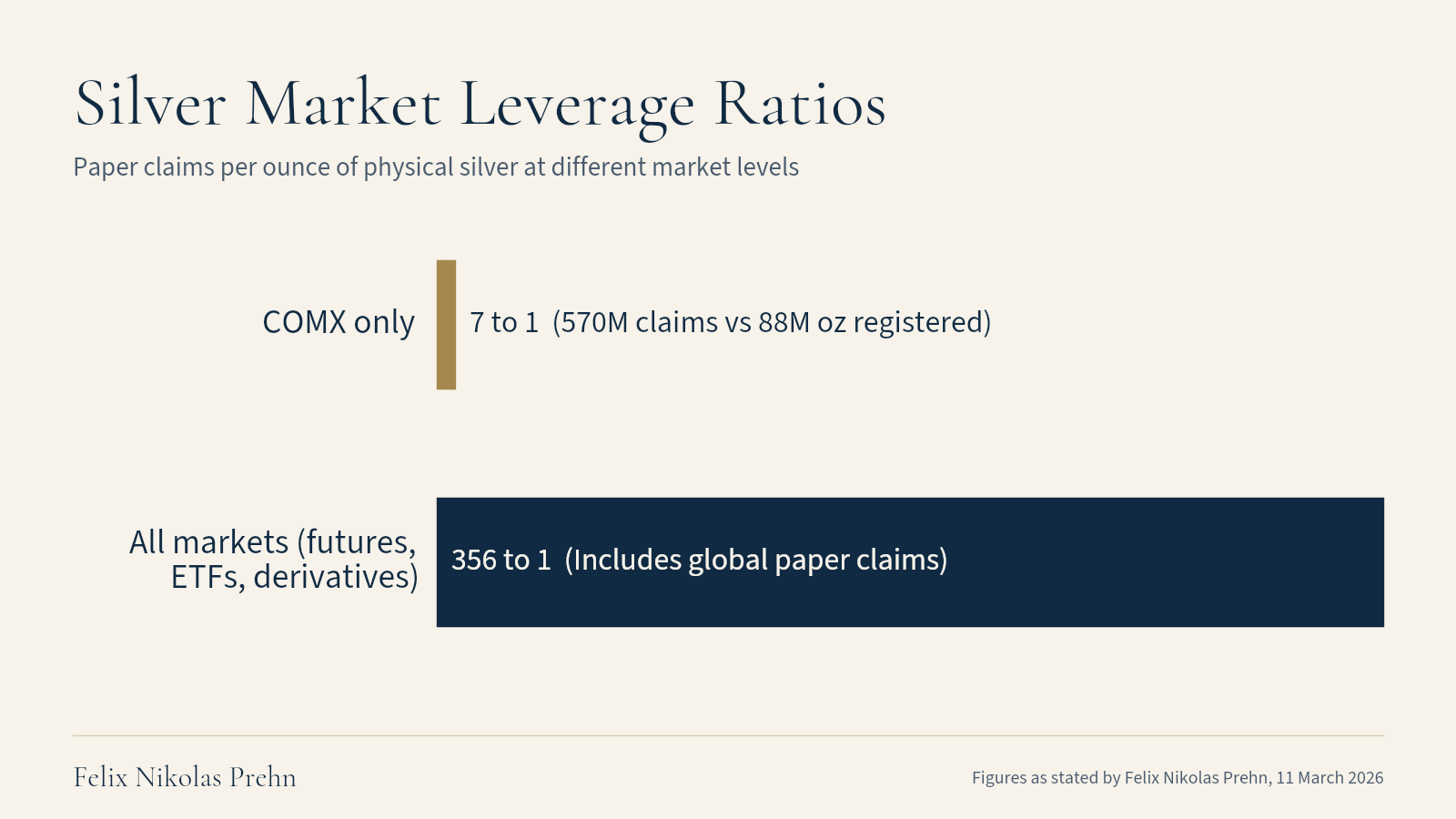
For every ounce of physical silver, 356 ounces of paper claims exist. The figure includes all futures, ETFs, and derivative markets. Felix Nikolas Prehn argues that when redemptions arrive in volume, some claimants will receive nothing.
The system resembles a coat check that has issued 356 tickets for 100 coats. It functions only so long as few guests collect at once. The fractional structure depends on most participants never requesting delivery.
Registered silver on COMEX, the metal available for delivery, has fallen to about 88 million ounces. The stock was 120 million a year ago. The decline amounts to roughly 30 per cent.
Against that shrinking stock, about 570 million paper claims remain outstanding. The ratio on COMEX alone exceeds 7 to 1.
Stress on Delivery Mechanisms
January of this year brought an anomaly. COMEX received applications for 40 million ounces of silver, roughly 40 times the normal volume, in a month that ordinarily sees no physical handover at all.
Recent deliveries removed 26 per cent of registered COMEX inventory in a single week. At the current pace, COMEX silver could be exhausted in 60 to 70 trading days.
Physical metal cannot satisfy paper claims if requests continue near recent rates.
Several outcomes are possible if COMEX cannot deliver. The exchange could settle in cash at market price, which would damage confidence in the pricing mechanism.
It could declare an emergency and alter the rules. Or rising prices could draw sellers into the market before inventories reach zero.
Indicators of Supply Constraint
Felix Nikolas Prehn argues that the silver market is in backwardation. Spot silver trades above forward contracts, signalling a supply shortage and urgent demand for immediate metal. The condition means buyers will pay more today than they expect to pay tomorrow, a pattern inconsistent with comfortable supply.
Silver leasing rates have risen to about 8 per cent from a previous level of about 0.5 per cent. The rate is the cost of borrowing physical metal for a set period.
The 16-fold increase means holders of silver can charge far more to lend it out. Tensions over COMEX inventories and broader supply constraints have coincided with this move.
Oil, Inflation, and the Fed Connection
A 10 dollar increase in oil adds about 0.1 per cent to inflation. On its own, 0.1 per cent is a small number. But when inflation already exceeds the Federal Reserve's target, each fraction constrains policy.
Bank of America analysis says that if oil stays elevated, the Fed will delay cuts to borrowing costs and could even consider raising them. The conflict involving Iran has pushed crude higher, feeding directly into consumer costs and complicating the Fed's path. In September 2026 the Federal Reserve raised its key interest rate for the first time in years, and polls suggest another increase before year end.
Felix Nikolas Prehn argues that precious metals perform well when interest rates fall, inflation rises, and economic uncertainty grows.
In his view, the white metal outperforms because gold is purely monetary while silver carries industrial demand too. He describes the combination as two engines rather than one.
Industrial Demand Meets Structural Deficit
60 per cent of silver demand comes from industrial uses: solar panels, electric vehicles, electronics, and military applications.
The silver market has been in a supply deficit for 6 consecutive years. The shortfall for this year is about 67 million ounces.
Since 2021 the cumulative gap has reached 800 million ounces.
Producers cannot simply ramp up output because the metal is rarely mined on its own. Felix Nikolas Prehn argues that 75 per cent of silver is a byproduct of mining other metals such as lead, zinc, and copper.
The metal arrives as a secondary product of decisions made for other commodities.
China controls about 60 per cent of global silver refining. Beijing has introduced new export licensing requirements this year restricting silver exports.
China's commerce ministry has confirmed that export quota management for silver remains suspended, but the permit regime limits who can ship metal out of the country. Felix Nikolas Prehn argues that the result is considerably less silver available on world markets because China is keeping refined metal within its borders.
If silver prices rise too far, industrial users will seek alternatives. Solar panel manufacturers are already reducing silver content per cell. Felix Nikolas Prehn acknowledges that demand destruction could accelerate if prices go to extremes, a constraint on any price forecast.
Lessons from 2011 and 2021
In April 2011 silver reached an all-time high of 49 dollars, 74 per cent above its level a year earlier. The Fed was printing money at scale and investors worried about the dollar. Industrial demand from solar was growing at the same time and fear of inflation ran high, before silver crashed 25 per cent within a week.
The Fed stopped the money printer. Major metal exchanges increased margin requirements. Some large traders unwound their positions.
Silver moved violently in each direction, and institutional rule changes reversed the rally overnight.
In 2021 a retail-driven squeeze attempt followed the GameStop episode. Silver futures rose about 13 per cent in a single day.
But the effort fizzled because the buying was concentrated in paper instruments. The community was divided; many argued silver was a distraction from GameStop and AMC.
Most of the buying flowed into paper silver ETFs. Paper purchases do not drain vaults of metal. The squeeze, as Felix Nikolas Prehn puts it, lacked the capacity to affect physical supply.
He argues that present conditions differ from each prior episode. Physical delivery demands are surging rather than paper bets accumulating.
COMEX inventories have fallen 30 per cent. China has restricted exports. Industrial demand persists and is growing.
The supply deficit is measured in hundreds of millions of ounces. The pressure, in his view, comes from structural supply and demand rather than coordinated retail speculation.
Physical Metal, ETFs, and Portfolio Sizing
SLV is the largest and most liquid silver ETF at 22 billion dollars and above. It is paper-based. Holders cannot redeem shares for physical silver.
PSLV, the Sprott Physical Trust, holds fully allocated silver bars stored at the Royal Canadian Mint. Larger holders can redeem shares for the metal itself.
Shares in silver miners move in a magnified way relative to the metal itself. When silver rises 20 per cent, a mining company's shares could rise 50 or 100 per cent.
Felix Nikolas Prehn argues that present conditions differ from 2011 and 2021 in their structural character. COMEX registered inventory has fallen 30 per cent in a year while China's export licensing regime has tightened supply from the world's largest refiner. Paper claims still outnumber physical metal 356 to 1.
The cumulative supply deficit since 2021 has reached 800 million ounces. Silver lease rates have risen from 0.5 per cent to 8 per cent. At current withdrawal rates, COMEX registered silver may last 60 to 70 trading days. At that pace, the gap between paper claims and deliverable metal would widen further.