
The price of money is at a generational high
The 10-year US bond pays about 5.2 per cent.
The 30-year yield is 5.6 per cent.
The 10-year hit its highest level since April 2002. A Bloomberg chart showed it rising from under 1 per cent in 2022 to about 6 per cent now.
A yield is the interest a government bond pays. It is set by the market, not by the government and not by the Federal Reserve. If buyers want more interest before they will lend to the government, the yield goes up.
The yield on a government bond is the floor under every other interest rate in the economy. Mortgages, car finance, factory lending and pension calculations are all priced off it. A rising floor lifts borrowing costs through the entire economy.
The effect is not confined to America. When Washington pays 5 per cent, capital drains away from Britain or Germany at 4 per cent. The money flows to America until London and Berlin match the rate.
The government is propping up its own bond market
The government spent about 6 billion dollars buying back bonds in a single day to fight rising yields.
The Treasury doubled its buyback programme, retiring old bonds with money raised by issuing new ones. The official story is about liquidity. On Wall Street the programme reads as the government trying to hold its borrowing costs down.
Citibank expects the Treasury to cut or stop sales of 20 and 30-year bonds. Short-term bills, IOUs that mature in months, would fill the gap.
No one wants to lend to America for 20 or 30 years at a tolerable rate. So the Treasury plans to borrow for 3 months at a time.
The Treasury publishes its refunding statement on 4th of November. If long bond sales get cut, the world's largest borrower will have conceded a point. It cannot sell long-dated debt at a tolerable price.
The bills replacing long bonds still require buyers. Money market funds would absorb most of them.
The risk moves rather than vanishing. It shifts from long-term bonds in pension funds to short-term instruments in money market accounts.
TLT, a fund tracking long-dated government bonds, has lost about half its value since 2020. A global bond selloff has raised interest rates worldwide.
Japan and the Fed have stepped away
Japanese pension funds and insurers bought American debt because domestic bonds paid nothing.
The Bank of Japan is raising rates. Domestic bonds pay a return for the first time in years, and Japanese capital is flowing home.
The Federal Reserve bought trillions of dollars of bonds after 2008 and again in 2020. The Fed is no longer buying and has not resumed purchases. The buyer of last resort for US government debt has become the Treasury itself.
With Japan repatriating capital and the Federal Reserve no longer purchasing, the Treasury's buyback programme is the remaining source of demand. The Treasury Secretary told Congress the market has it wrong. The statement fits a government fighting to keep its borrowing costs down.
AI is the inflation factor Goldman missed
Goldman Sachs forecast core inflation would be 2.3 per cent by August. The reading came in at 3 per cent.
Goldman published a postmortem on the miss. The biggest single cause on its own chart was AI: chips, laptops, memory and software.
Data centres are buying every memory chip on Earth. The memory chip in a phone or laptop costs more as a result.
The higher cost feeds through to consumer prices. Computer software prices are rising for the first time ever. Companies can attach an AI label and charge more.
The next iPhone is 300 dollars more expensive than the last one because of memory prices.
The Federal Reserve raised rates. The market expects another hike. AI investment continues to put inflation up.
Microsoft, Amazon and Meta do not care what the interest rate is. They keep spending regardless.
The Federal Reserve's interest rate lever has little purchase on this kind of spending.
The most concentrated stock market since the railroads
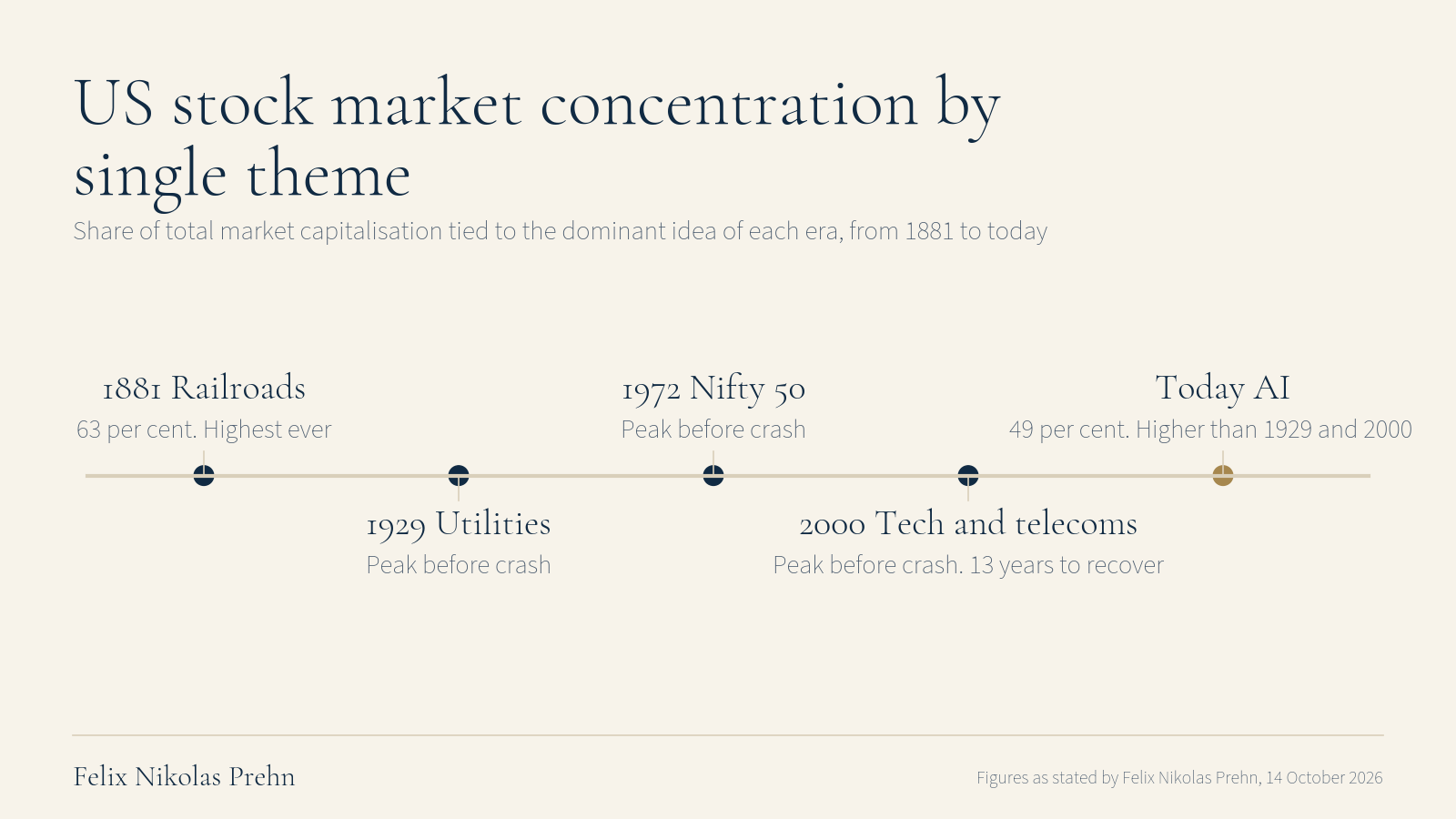
AI-related companies now represent 49 per cent of the S&P 500. In 1881, railroads were 63 per cent of the entire US stock market, the only time concentration exceeded today's level.
Four prior peaks stand out: railroads in 1881, utilities in 1929, the nifty 50 in 1972 and technology in 2000. In every case, investors lost heavily.
Although railroads were real infrastructure, investors who bought at the 1881 peak lost heavily. The price had stopped reflecting the underlying industry and had become a measure of how many others were piling in.
Smart money is heading for the exits
Temasek is a Singaporean wealth fund managing about 400 billion dollars. It said last week that the biggest risk is the unwinding of the AI trade.
In Felix's view, the fund is moving AI holdings into public markets. It is selling them to smaller buyers in listed shares.
R versus G and the Morgan Stanley warning
Morgan Stanley's economics team wrote a 60-page report for institutional clients.
The report centres on the relationship between R and G. R is the interest rate the government pays on its debt. G is the growth rate of the economy.
If the economy grows faster than the interest on government borrowing, the debt ratio shrinks on its own. A government running a deficit can still see its debt burden fall relative to output.
When the interest cost on government debt rises above the growth rate, the arithmetic reverses. The government borrows to pay its creditors. The larger debt stock raises the annual interest bill.
Morgan Stanley's projection is that R could exceed G by 2030. The 2030 estimate assumes no recession, and a downturn would bring the crossover forward.
Interest rates fell for 40 years straight, from 1981 to 2021. Buy-and-hold investing worked for that generation because interest rates fell for the entire period.
Rates stopped falling in 2022 and bond yields have climbed since, a reversal after four decades of decline.
AI spending drives inflation. Inflation keeps interest rates high. High rates threaten to push R above G.
Morgan Stanley projects that crossover could arrive by 2030, or sooner if a recession intervenes. The Treasury doubled its buyback programme and spent 6 billion dollars in a single day. The 10-year yield kept climbing regardless, reaching its highest level since April 2002.