The AI boom runs on a borrowed money layer, and the structure is showing cracks.
Coreweave, the company at the centre of AI infrastructure lending, carries around 50 billion dollars in debt.
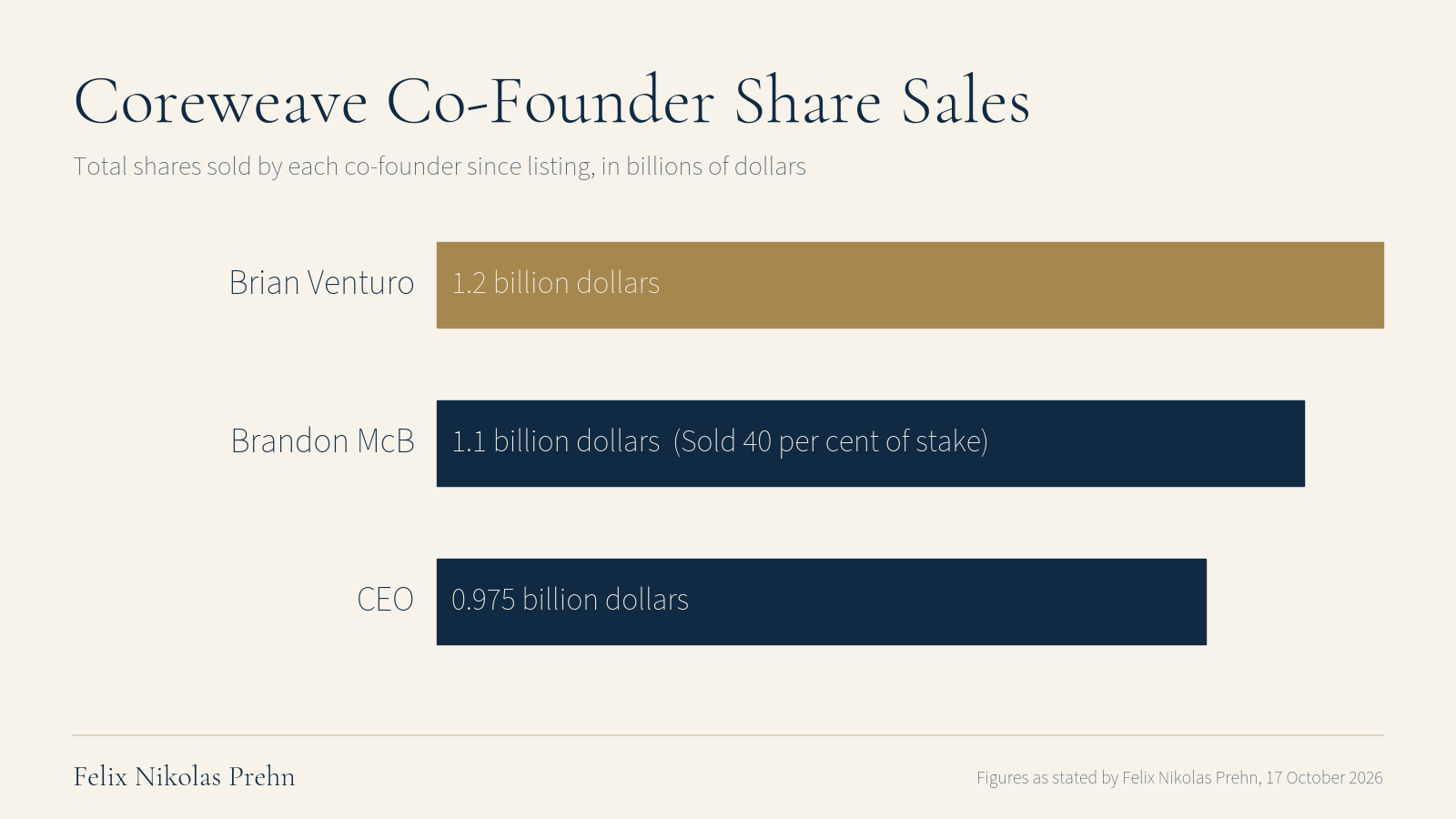
Its 3 co-founders have sold a combined 3.3 billion dollars of their own shares since listing.
The cost of insuring its debt against bankruptcy hit a record high.
If lenders stop lending, the resulting repricing could spread through index funds and pensions in a manner similar to the dot-com plumbing collapse. The technology would likely survive. Coreweave's bonds trading at 76 cents on the dollar suggest the financial structure is already under strain.
Coreweave: the company at the centre of the AI plumbing trade
Coreweave buys Nvidia chips in bulk, installs them in data centres and rents the resulting computing power to AI companies. The industry calls it a neocloud, a cloud provider built only for AI workloads. CNBC puts Coreweave's debt at around 50 billion dollars.
Borrowed money pays for the chips. Rental income from AI customers services the debt.
Coreweave's share price is down about 65 per cent from its peak. Bloomberg reports that co-founder McB sold 40 per cent of his stake. The 3 co-founders have sold a combined 3.3 billion dollars of shares since listing.
Insider selling: 3.3 billion dollars out the door
The CEO sold 975 million dollars of shares. Co-founder Brandon McB sold 1.1 billion dollars. Brian Venturo sold the remaining 1.2, the largest individual sum of the three.
Added together, the 3 co-founders have sold 3.3 billion dollars. Bloomberg reports that McB sold 40 per cent of his stake. The selling coincides with record-high costs to insure Coreweave's debt against bankruptcy.
The debt market flashes red
Coreweave has bonds paying just under 10 per cent interest, due in 2032. The bonds now trade at 76 cents on the dollar.
A buyer at 76 cents receives an effective yield (the interest rate implied by the discount) of about 15 per cent.
Lenders demand 15 per cent when they are not sure they will get their money back.
CNBC puts Coreweave's total debt at around 50 billion dollars.
The cost of insuring that debt for 5 years now exceeds 11 per cent of the amount covered every year, a record. Credit default swaps (insurance contracts that pay out if a borrower fails) are the market's way of pricing risk in real time.
Bloomberg says the insurance price implies roughly 60 per cent odds of failure.
The cash gap Deutsche Bank uncovered
Deutsche Bank calculated that Coreweave brings in about 10 billion dollars a year in cash from operations.
Planned spending on chips and buildings runs to 45 billion dollars. The shortfall is 35 thousand million dollars.
Coreweave fills that gap with more borrowing.
Coreweave has 104 billion dollars of signed work waiting to be delivered. About 2 thirds of that backlog is with customers whose credit ratings are high.
Deutsche Bank says Coreweave will need to raise more money over the next 12 to 18 months just to deliver work it has already signed contracts for.
Coreweave does not own every building it uses. It rents data centres from other companies.
Some of those landlords raised money by selling bonds. Coreweave's rent is what pays those bonds.
If Coreweave struggles, the companies renting space to it face a problem too. Felix argues that the money lent to the company comes from the same funds, banks and pension schemes that own the rest of the market. When one large borrower wobbles, lenders ask harder questions of everyone else who borrowed to build AI.
The dot-com parallel: Cisco, Amazon and the NASDAQ
In March 2000, Cisco became the most valuable company in the world at about half a trillion dollars. Its shares traded at around 200 times its profits. Cisco made routers and switches, the plumbing of the internet.
The NASDAQ closed at 5048 points on the 10th of March 2000. The NASDAQ never closed higher than 5048 during the dot-com era.
When lenders get nervous or borrowing costs rise, some borrowers cannot raise capital at all. Companies in the sector cut their spending. Their suppliers suddenly have fewer orders.
In the dot-com era, the turn came through many quiet decisions to stop lending.
Amazon was a genuine company with paying customers. Its shares fell 94 per cent from the dot-com peak. Amazon survived and went on to become one of the largest companies in the world.
The price paid at the peak was what destroyed returns.
Cisco shares did not make a new closing high until December 2025, 25 years after the dot-com peak. Felix argues that picking the best company of the era at the wrong price meant waiting 25 years to break even.
The NASDAQ fell for 31 months. It hit bottom on the 9th of October 2002, 78 per cent below the peak.
It did not reach a new record high until April 2015, 15 years later.
Companies that ran out of other people's money disappeared.
The dot-com reset moved money away from companies that needed endless borrowing. Capital flowed towards businesses that could fund themselves.
The current AI market and the dot-com template
AI is a technology changing the world, financed through a small group of infrastructure companies.
In 2000, the plumbing was routers and fibre optic cables. Today it is AI chips and data centres.
Coreweave borrows money to buy chips and rent capacity. The company does not manufacture chips or write software.
Two differences separate 2025 from 2000.
The NASDAQ 100 biggest tech companies traded at about 21 times expected next year profits, according to Bloomberg. The multiple is near its lowest level since the AI boom began in 2023.
At 21 times earnings, the market is expensive but far from the 200 multiple Cisco carried in 2000.
Computing power is still scarce. Companies already owning that capacity tend to do well.
The biggest tech companies pay for AI spending out of profits from existing businesses.
Coreweave has no such business underneath it. It has rental contracts and a lot of debt.
In Felix's view, the NASDAQ and the interest rate on American government debt have been falling together since September.
Lower rates would normally help tech shares. When the index and the yield fall together, it usually means the market is worried about growth.
People expecting slower growth pile into government bonds for safety, pushing the yield (the interest a bond pays) down.
What Gartner and Goldman see ahead
A Goldman Sachs systematic hedge fund strategy fell 1.4 per cent in a single day.
The loss is described as something that statistically almost never happens.
Funds were selling positions they owned and buying back stocks they had bet against, all at once, because they had to.
In Felix's view, Goldman Sachs told institutional clients that too much capital is chasing too little investable, power-ready compute capacity. The repricing could happen gradually or through a violent dislocation that spills into broader markets.
Research firm Gartner expects more than 80 per cent of neocloud companies to stop operating independently by 2030. Some will be acquired, while others will fail.
Gartner also reckons 3.5 trillion dollars of AI infrastructure is at risk of being written down in value.
An acquisition in a downturn usually happens at a low price, which benefits the acquirer. The buyer pays less than the asset cost to build. It is rarely good for the shareholder who paid full price.
The current AI expansion is built on a layer of debt centred on companies like Coreweave, echoing the financing of the dot-com era. If lenders pull back, the reset would hit the borrowed layer, not AI development itself.
After 2000, companies that funded themselves survived. Borrowers who depended on rolling over debt (replacing old IOUs with new ones at today's rate) went under.
Coreweave owes around 50 billion dollars. The annual shortfall between cash coming in and planned capital expenditure is 35 thousand million dollars. Deutsche Bank says the company must raise fresh capital within 12 to 18 months to honour contracts already signed. Bloomberg's implied default probability of roughly 60 per cent suggests that lender confidence is eroding. The bonds already trade at 76 cents on the dollar.