For forty years, a set of financial assumptions prevailed, resting on a single foundation: the steady decline of interest rates from 1981 to near-zero.
A good salary was supposed to build wealth. Buy-and-hold investing was expected to compound reliably. Cheap money, the logic went, would lift every asset class.
All three assumptions rested on falling rates. Each assumption has broken down since that decline ended.
The salary illusion
In the early 1970s a typical house in America cost 2.5 times annual income. Today the same house costs 4.5 times annual income. The price of a house measured in years of income has doubled.
Felix argues that nominal wage growth is the wrong measure. Real purchasing power, measured against houses, stocks and gold, has fallen. The nominal pay cheque grew 9-fold, yet a house today costs 4.5 years of income rather than 2.5.
Houses, stocks and gold all cost more relative to wages.
The American housing affordability problem remains unresolved. Some analysts suggest a return to earlier norms could take more than a decade.
Assets outran wages
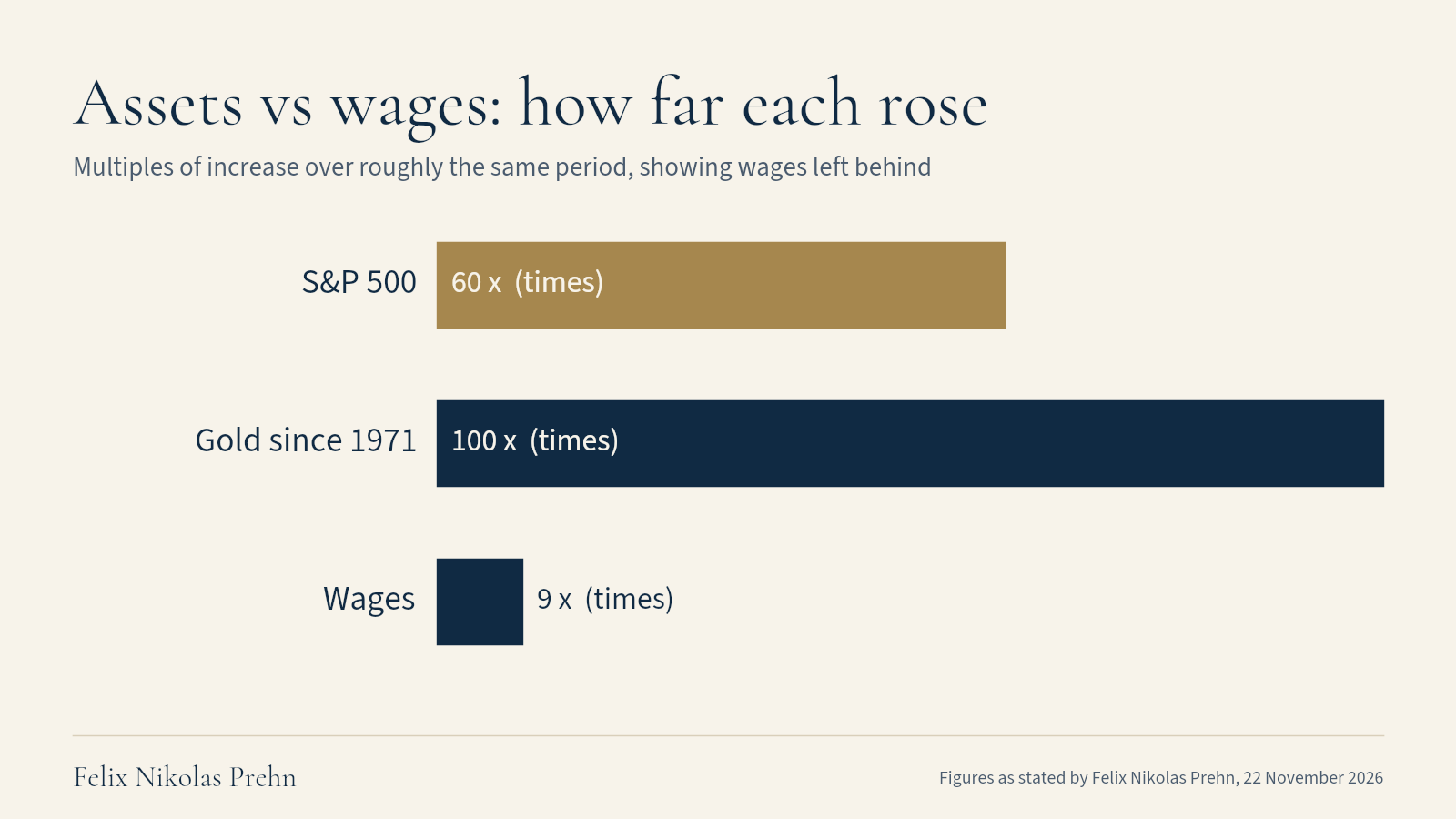
The S&P 500 is up more than 60 times over the period in which wages rose 9-fold.
The gold price shows a sharper version of the same pattern.
From 1971 to today gold has risen roughly 100 times. Wages grew 9 times.
Gold is more than 10 times more expensive relative to wages than it was in 1971.
In Felix's view, a salary that cannot keep pace with asset prices does not build wealth on its own.
The compounding myth
A standard projection assumes 10 per cent annual returns, run forward 20 or 30 years, producing an even upward curve. The curve conceals wide variation between decades.
The S&P 500 returned 11.8 per cent per year on average over the last 10 to 12 years. From 2000 to 2012 the S&P 500 lost money in a typical year.
From 1985 to 1999 the index delivered 15 per cent per year. The S&P 500 returned zero over the 15 years before 1985.
Someone who began in 2000 and liquidated in 2012 would have lost money in real terms. An investor who began in 1985 would have earned 15 per cent a year for 15 years.
The statistical case for compounding requires 20 years or more.
Felix argues that the extraordinary run of low rates and free money has ended. Mean reversion makes a decade of poor returns likely.
The probability of another 10 to 12 years at 11.8 per cent, coming straight after the period that produced it, is low on any historical reading.
Lost decades
The NASDAQ returned zero for 15 years after its peak in 2000.
Japan's Nikkei index topped out in 1989 and took 35 years to return to the same level. The Nikkei regained its 1989 high only recently.
The NASDAQ and Nikkei cases refute the claim that broad market indices always recover within a few years. A 15-year or 35-year recovery period exceeds most planning horizons.
The 40-year decline in rates
From 1981 interest rates in the United States fell for roughly 40 years to near zero.
Felix argues that buy and hold made people look like geniuses during this period. The falling cost of money lifted every asset class regardless of quality.
The 40-year decline has ended. Rates rose to fight inflation, and the 40-year pattern of successively lower peaks in the federal funds rate broke. Relief for borrowers is not yet visible in recent data.
The illusion of diversification and free money
In Felix's view, a tiny handful of giant tech names make up 30 to 40 per cent of the S&P 500. About 5 companies, all in technology, artificial intelligence and cloud computing, represent roughly 40 per cent of the index.
An S&P 500 index fund is therefore a concentrated bet on a small cluster of similar firms.
From 2008 to 2021 interest rates were near zero and money was free. Inflation was absent for most of that stretch.
The habits formed during those 13 years were rational responses to a zero-rate world. A company or household could borrow at rates close to zero for over a decade. Growth at any price looked sensible because borrowing carried no penalty.
US inflation then reached 9 per cent, as Felix puts it, the worst in 40 years.
To fight it, interest rates went up. The era of free money ended when rates rose.
Felix argues that money won't return to zero because governments need to run inflation to inflate away government debt. Inflation erodes the real value of currency. Debt is denominated in that same unit, so rising prices shrink the real burden of what governments owe.
The new cost of borrowing
The average 30-year mortgage rate was about 2.5 per cent in 2021. It is now at 7.5 per cent.
The cost of borrowing to buy a house has tripled in roughly 4 years. Recent data show the 30-year rate near the 7 to 7.5 per cent range.
When rates were falling for 40 years, passive exposure to any asset class captured the benefit. When rates are flat or rising, the lift from cheaper borrowing disappears.
Felix argues that the foundation beneath all 3 rules has been removed. Asset prices rose faster than wages because the cost of borrowing fell in every successive period. Every new cycle of lower rates produced cheaper credit.
The pattern of successively cheaper credit has broken.
Governments now need inflation to erode their debt, so rates are unlikely to fall back to zero. The period of zero rates looks, on that logic, like a 13-year exception rather than a norm to which policy will return.
Every institutional manager consulted in recent years has described the current environment as an active market, no longer passive buy and hold. The salary, the index fund and the cheap mortgage all drew their power from 40 years of falling rates. The decline in rates has ended, and the conditions behind those rules have not returned. The rules written for it no longer describe the world as it is.