
The Day 1.2 Trillion Vanished
The NASDAQ 100 fell 2.9 per cent in one day, its largest drop in several months.
In Felix's view, 1.2 trillion dollars vanished from the index that afternoon.
Some commentators described it as a crash. The sell-off was more specific than broad, indiscriminate selling.
The AI trade derated. Investors would no longer pay the same price for the same prospective earnings.
The underlying companies had not changed overnight. Investors decided the earnings outlook no longer justified prevailing prices and marked the stocks down.
What Goldman Sachs Told Its Clients
Goldman Sachs wrote to its institutional clients. The AI complex had endured a trying couple of weeks. The note listed 3 reasons.
First, Tesla announced it is cutting capital expenditure. The term means money a company spends on long-lasting assets like factories and chips.
The whole AI boom rests on companies building enormous extensions. When a name like Tesla says it will spend less, chip suppliers lose expected revenue.
Second, Meta's AI spending sent the cost of insuring its debt to a record. The insurance contract is a credit default swap.
A credit default swap, or CDS, is a contract that pays out if a borrower fails to meet its obligations.
Third, Lamb Research, which makes the machines that manufacture computer chips, gave guidance that underwhelmed. Such a forecast tells investors what the company expects to earn next.
Goldman Sachs said the disappointment reignited concerns about the durability of AI spending. If AI investment slows, the first companies to suffer are those living on borrowed money.
Hedge Funds Were Already Short
Goldman Sachs reported that hedge funds are shorting American stocks at a 5-year high. A short sale is selling a share one does not own. The trader buys it back later at a lower price, profiting from the decline.
In global stocks, for every 1 trade buying there were about 5 selling short. The 5 to 1 ratio is at the extreme of what has been observed in 5 years.
Goldman Sachs's prime brokerage is the division that lends money and shares to hedge funds. Its data showed the largest 2-week selling of global tech stock in more than 10 years.
Felix argues that hedge funds read the Goldman research notes weeks before the sell-off. They had already taken short positions and profited from the decline.
All that shorting creates a secondary risk.
When many traders have borrowed and sold shares, a sudden price rise forces them to buy back at once. The rush itself pushes prices higher.
A sudden spike can occur even in a difficult week.
Not a Market Crash, a Rotation
The NASDAQ dropped almost 3 per cent that day.
The S&P equal-weight index closed in the green. In that version, every company receives the same slice regardless of size. If most constituents rose, the measure rises.
The Dow, which comprises 30 of the biggest American companies, finished flat. Consumer staples, utilities, healthcare, and financials all rallied. Money rotated out of the hyperscalers, the giant AI spenders, into defensive sectors.
The sell-off targeted the AI trade specifically. Capital that left the hyperscalers moved into defensive sectors.
Japan's stock market entered a technical correction in the same period, dropping 10 per cent in 2 weeks.
Defensive sectors still rallied as AI stocks fell. The broad market was flat or positive while the AI trade repriced sharply.
The Junk Debt Mountain Under AI
When a company borrows by selling bonds, agencies assign a grade to the obligation. The safest companies receive the highest ratings, allowing them to borrow at lower interest rates.
Riskier borrowers receive low grades and pay much higher rates. Debt from such companies is rated as junk, or high-yield.
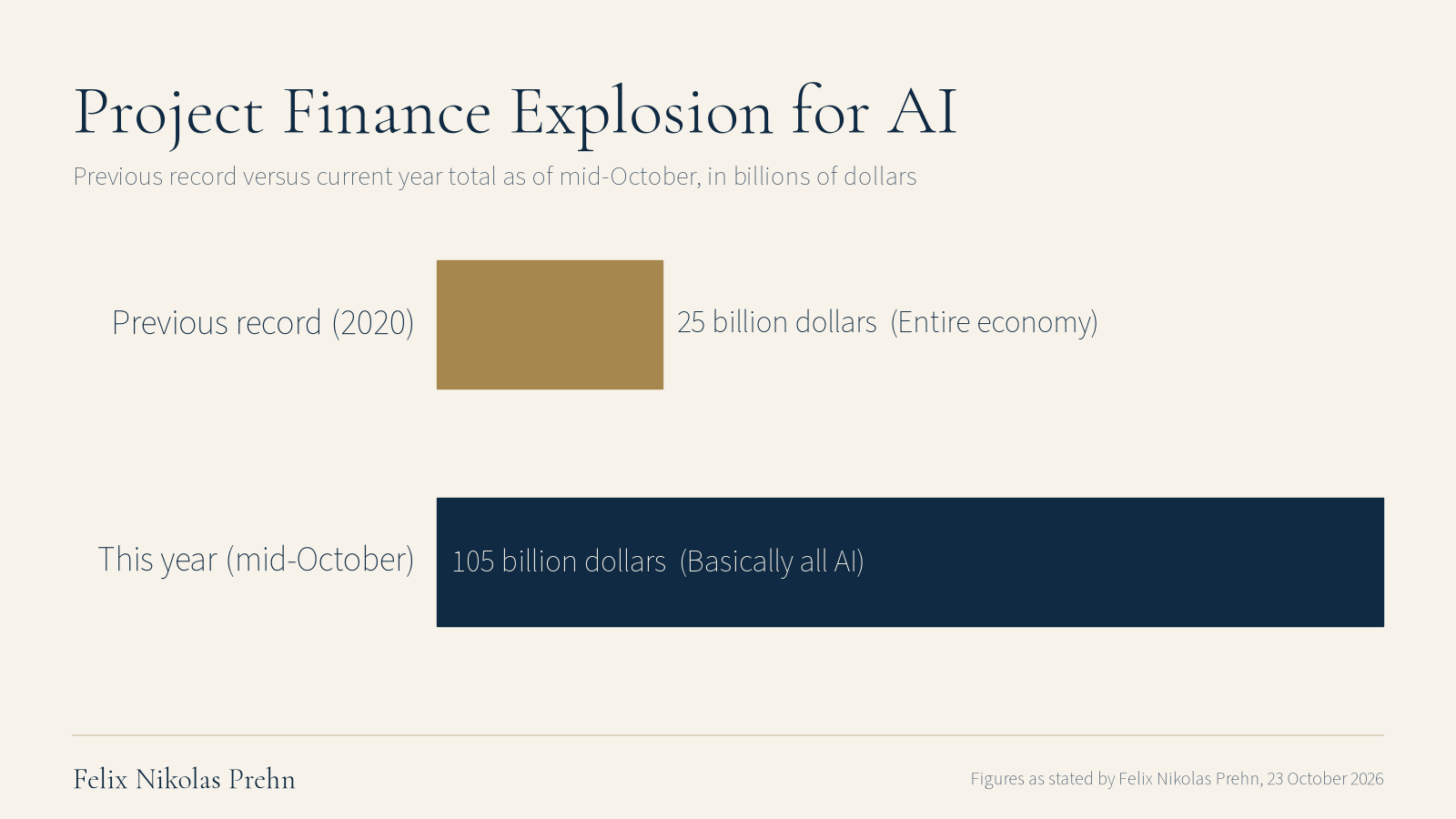
Project finance is lending tied to a single venture, repaid only from that venture's own income. For decades, such deals financed power stations, pipelines and toll roads, assets with predictable revenue. The largest annual total previously recorded was 25 billion dollars for the entire economy in 2020.
As of mid-October, in Felix's view, project finance has reached 105 billion dollars. Nearly all of it is for AI, and the total is 4 times the previous maximum.
Junk-rated data centre borrowers pay extra interest above government borrowing costs.
The premium has more than doubled since the summer. Felix argues that lenders demand double because they doubt they will get paid back.
They want compensation up front through higher interest.
Morgan Stanley counted 20 project finance style bonds in the junk market worth about 46 billion dollars. Some pay 15 and 16 per cent a year.
Goldman Sachs said the market is having a hard rethink about whether the AI building boom pays. Interest rates are higher, so borrowing is more expensive, and energy costs could rise.
The risk is concentrated around specific companies, such as the cloud infrastructure provider CoreWeave. Many data centres were built on the premise that the firm would lease them, and should it disappear, those buildings could sit empty.
How AI Risk Became Index Fund Risk
Goldman Sachs's basket of AI stocks dropped almost 5 per cent in a single day. The basket tracks the companies most exposed to the AI spending cycle.
The correlation between that basket and the S&P 500 has jumped to almost 1. A reading of 1 indicates the two move in near-perfect lockstep.
Zero indicates no connection. At almost 1, a fall in AI stocks drags the S&P 500 lower.
The S&P 500 is weighted by company size. Nvidia and Microsoft receive massive slices of the index.
Hundreds of smaller constituents carry negligible weight. When a handful of AI-exposed giants fall, they drag the index with them.
The fund sold as diversified and low-risk already moves almost in lockstep with a handful of AI stocks. The building boom behind those stocks leans on expensive junk-rated debt. Stress in the junk bond market feeds through the AI basket into the S&P 500.
What the Structure Implies
Investors marked down AI stocks specifically, not the broad market.
Tesla's decision to cut capital expenditure came first. Then the cost of insuring Meta's debt hit a record. Lamb Research's disappointing guidance followed.
All 3 raised doubts about whether debt-fuelled AI spending can last.
Project finance for AI reached 105 billion dollars, 4 times the previous record. Extra interest on junk-rated data centre debt has more than doubled since the summer.
Defensive sectors rallied on the same day the NASDAQ fell 2.9 per cent. The equal-weight S&P closed green. Hedge funds, reading Goldman Sachs's own data, had positioned short at a 5-year high before the drop.
What links the AI trade to the broader index is the correlation. The S&P 500, weighted by company size, now tracks Goldman Sachs's AI basket at nearly 1.
Losses in AI stocks pass directly into the index at that correlation. Junk debt behind the AI boom adds credit risk to the link.
Junk-debt-financed AI stocks already move the S&P 500. Junk bonds paying 15 and 16 per cent a year finance the AI building boom.
The AI trade, in turn, dominates the index by weight. Lenders demand higher rates on that debt. The cost feeds into the companies that carry the S&P 500.