The inflation the Fed cannot fix
A large chunk of current inflation is driven by energy costs. Oil powers the trucks and planes that move goods.
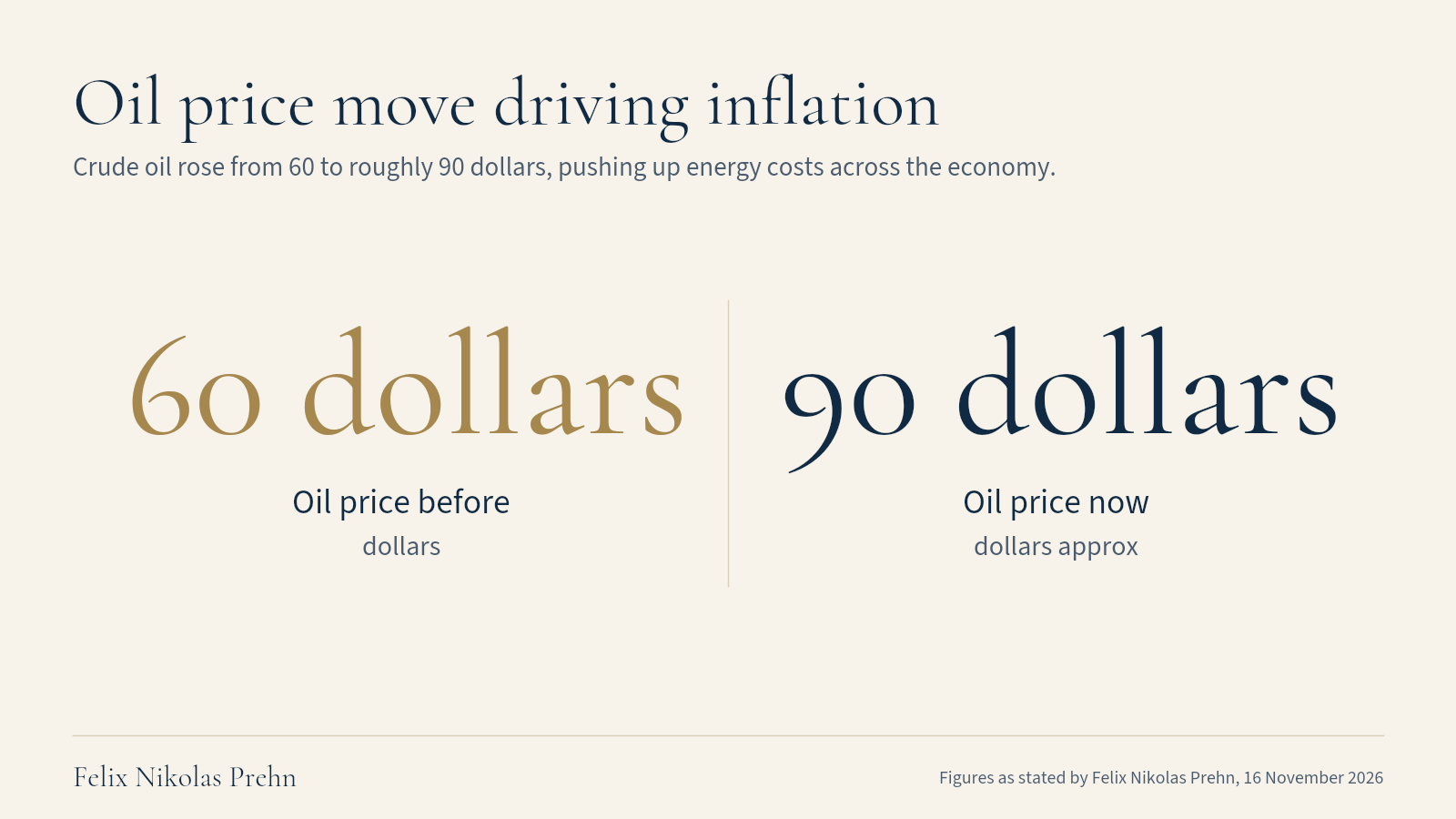
Crude oil prices went from 60 to roughly 90 dollars. Everything that travels by diesel or jet fuel became more expensive as a direct result.
Higher interest rates serve a single purpose: they make borrowing more expensive. Fewer houses and cars get bought as a result.
Businesses hire less and build fewer factories. Rate hikes reduce spending but do nothing to increase the supply of oil.
No rate hike drills more oil out of the ground. In fact, rate hikes make it more expensive to invest in oil infrastructure, refineries and machinery.
The Federal Reserve is reaching for its only instrument, knowing it was not built for a supply-side problem. In Felix's view, the Fed is itself a source of inflation through money printing, and oil prices remain beyond any central bank's control.
The inflation is a supply problem. No interest rate increase unblocks a port or ends a conflict in the Middle East.
The rate hike signal
Fed Governor Christopher Waller said at a conference that one more hot inflation print should prompt a full half percentage point rate hike. A gentle quarter of a percentage point would not be enough. Inflation numbers then came in hot for the third month in a row.
Goldman Sachs put out a report saying it expects rate hikes to run all the way into 2027. The bank has pencilled in the first rate cut not in early 2027 but further down the line. Rate hikes could therefore continue for 3 more years.
Adjustable mortgages and the 2008 echo
About 180,000 households in America have adjustable mortgages. Each loan will reset its interest charge next year, and payments will rise on average by 650 dollars per month per household.
The adjustable mortgage problem is what initiated the 2008 financial crisis, when higher rates crippled the housing market. Some industry analysis describes the broader market risk as limited. The resets will still raise payments and make new mortgages more expensive.
After 10 years of near-zero borrowing costs
The last 10 years featured close to 0 per cent interest rates. Money was cheap to borrow for businesses. Growth companies could raise capital at minimal cost and expand without producing profits.
A portfolio built for that decade of near-zero borrowing costs is expected to lose value with every subsequent Fed meeting if hikes climb into 2027. Rates are no longer close to 0 per cent, and Goldman Sachs sees no return to that level before 2027 at the earliest.
Why gold suffers in a rising rate world
Gold pays no interest and no dividend. It is a non-yielding physical asset.
When cash and bonds pay next to nothing, the cost of holding gold is low. When rates rise, that cost climbs.
Government bonds could pay 6 or 7 per cent. Corporate bonds could pay 8 to 10 per cent.
Every month spent holding gold means forgoing that income. Economists call this opportunity cost.
A stronger dollar compounds the pressure. Higher rates push the dollar up.
For anyone outside the United States who must convert local currency into dollars to buy gold, the metal becomes more expensive in their own money. Demand from foreign buyers falls.
In Felix's view, a further source of downward pressure on the price of gold is selling from oil-rich states. He argues that states unable to easily move oil and gas are likely offloading gold reserves to cover expenses.
Gold's long-term case, built on money printing and debt accumulation, remains valid in Felix's assessment. The short-term pressure from rising rates and a stronger dollar is a separate force.
The great stock split: growth versus value
A stock's value is the sum of the cash it will generate over its life, discounted back to today. Cash in hand today is worth more than the same sum arriving in 10 years, because it can be invested and grown.
The gap between cash in hand and earnings owed in the future widens as interest charges rise. At 0 per cent, the gap is small. At 5 or 6 per cent, the gap grows with each passing year.
Growth stocks represent future cash. Their profits lie in the future, not in the present.
The discounted value of those future earnings falls as interest rates rise. Growth stocks lose value as a result.
Profitable companies generating cash now benefit from the same arithmetic in reverse. Present cash becomes relatively more valuable when rates rise.
A company already producing free cash flow today rises in relative worth against a competitor whose profits are years away.
Sectors positioned for higher rates
Banks, financials, and insurance companies are direct beneficiaries of higher interest rates. Philip Morris, Republic Services and J&J are established, cash-generating businesses. Their value comes from the cash they produce today.
When rates rise and present earnings become more valuable, such companies gain in relative terms. If rates stay high into 2027, the gap between these firms and growth stocks widens further.
The wrong tool for the wrong problem
Rate hikes lower demand. The current inflation stems from oil supply constraints.
Insufficient demand did not cause this inflation. The Fed has no other instrument, so the mismatch will persist.
High oil prices and, in Felix's view, prior money printing cause the inflation.
Interest rate policy cannot bring more oil to market or reverse the money already printed.
The Federal Reserve is therefore applying a demand-side tool to a supply-side problem. Interest rate policy cannot increase the supply of oil, and higher borrowing costs may hinder investment in energy infrastructure. Oil prices remain beyond the Fed's reach, and costlier credit raises the price of building refineries and drilling wells.