
Goldman Sachs sent its 2027 gold research report to institutional clients with a price target well above current levels.
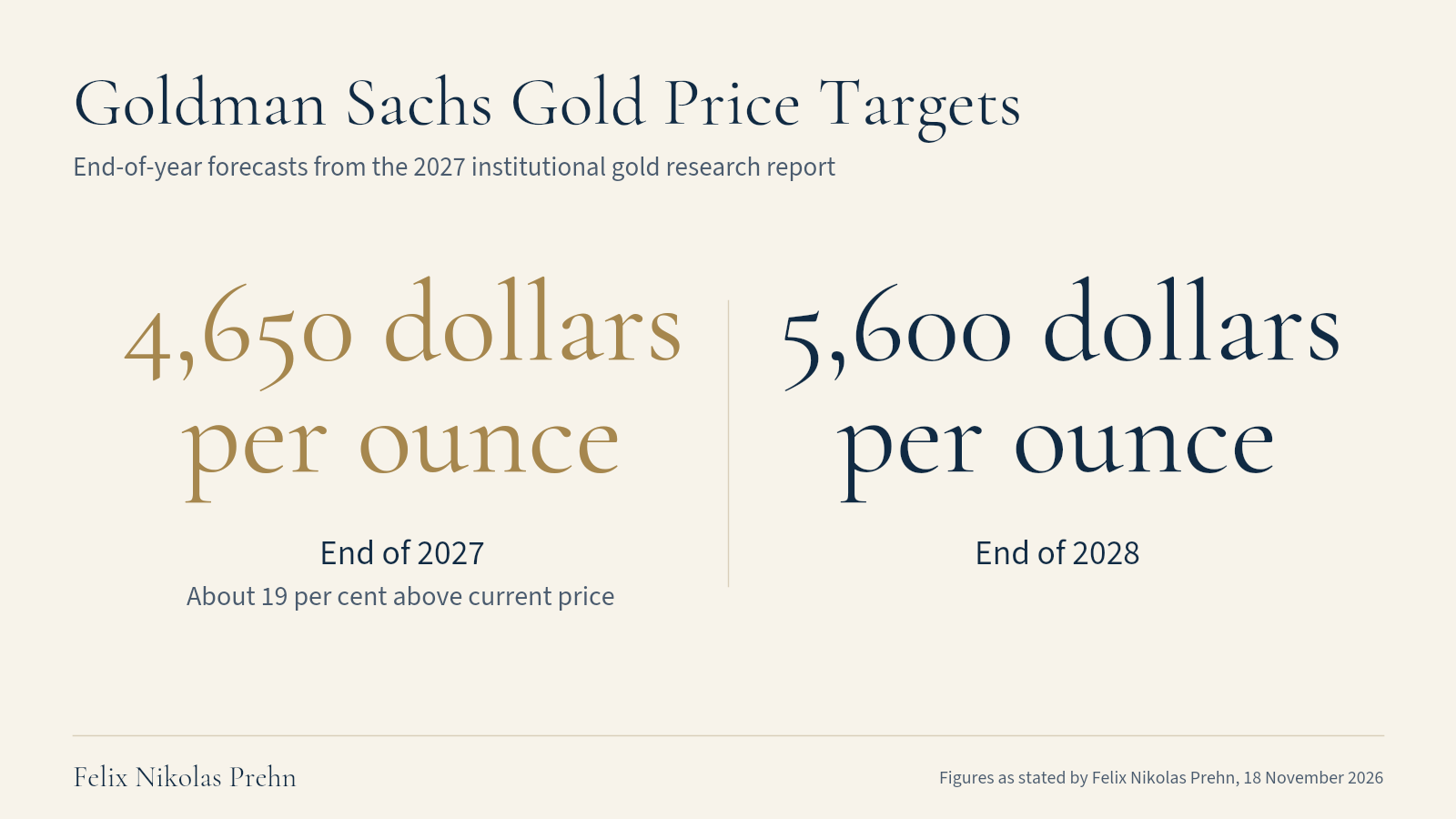
The report forecasts gold at 4650 by the end of 2027 and 5600 by the end of 2028.
It also expects the Federal Reserve to raise rates twice more before any cuts arrive.
The two positions appear to contradict each other.
Goldman's 2027 and 2028 Gold Targets
The 4650 target for end of 2027 is about 19 per cent above where gold traded when the report was issued. The 5600 target for end of 2028 implies a further leg higher once rate pressure fades.
The report's price targets rest on a structural argument about the nature of current gold demand and the persistence of its primary buyers.
The Rate Hike Drag
Goldman Sachs expects the Federal Reserve to deliver a second rate hike in December and a third in March 2027. Rate hikes push gold lower through two channels.
The first channel runs through the dollar.
Higher rates lead to a stronger dollar. Gold is priced in dollars. A rising dollar lifts the cost for buyers outside the United States, reducing demand and pulling the price lower.
The second channel is opportunity cost.
Gold pays zero income. Holders must pay to store it.
When rates rise, bonds and cash pay more. The gap between a government bond's yield (the interest a bond pays) and gold's zero income widens. As the gap widens, capital moves out of gold and into bonds.
Zero interest rates are not returning any time soon.
The era of near-zero rates lasted many years. The cost of capital has risen.
Forecasts on the Federal Reserve's path remain mixed.
Some analysts predict multiple hikes into 2027. At least one Fed official has suggested a hike may not be necessary.
Goldman's view is that hikes are coming, and that gold will fall in the near term because of them.
The 2022 Playbook
In 2022 the Federal Reserve started one of the most aggressive rate hiking cycles in modern history. Gold fell about 20 per cent from its peak.
Rates rose and the dollar strengthened. The opportunity cost of owning gold widened, and the price fell.
Many sold during the downturn, interpreting the price fall as a structural end to gold's rally. After the bottom, gold rose 130 per cent over the following 3 years.
Goldman Sachs sees the current setup as a near copy of 2022.
The Federal Reserve is hiking and gold is falling. The paper price is declining for the same mechanical reasons it declined then.
Felix argues that the structural buyer underneath, the central bank, never left. The central bank buyer continued to accumulate gold throughout the 2022 drawdown and has maintained this activity.
Central Banks as the Structural Buyer
In Felix's view, central banks are buying gold at about 60 tons per month and have maintained that rate since 2022. Before 2022 the average was about 17 tons per month. The increase is roughly fivefold.
The 2022 surge began when Russia's foreign reserves were frozen. A major country found that its money, parked in dollars and euros in western banks, was rendered inaccessible. Other central banks consequently reassessed the security of their own foreign-held reserves.
In assessing alternatives, central banks noted that assets such as stocks, crypto and stablecoins could also be frozen or disabled.
Gold stored in a sovereign vault does not depend on anybody else's permission. Central banks moved into gold on that logic.
Central banks do not trade gold for short-term profit but accumulate steadily, regardless of where the paper price trades.
A purchase rate of 60 tons per month creates a floor beneath gold that did not exist before 2022. The floor does not prevent further price declines, but it does mean that a persistent buyer absorbs supply at every level.
Repatriation and the Trust Fracture
France and the Netherlands have been repatriating their gold from foreign vaults into their own. Each country is moving the metal to sovereign vaults on home soil.
The debate among developed nations has shifted from whether to own gold to where it should be stored and which custodians are trusted.
France and the Netherlands are allied nations, yet each is withdrawing gold from the other's custody. Central banks in several regions are reportedly reshuffling and relocating reserves in response to geopolitical shifts.
Allied nations are pulling gold from each other's vaults. Such moves suggest the international financial architecture has cracked.
Trust within the international financial system has eroded.
Felix argues that gold is the asset institutions reach for when confidence in banks, governments and exchanges breaks down. The response is to move the metal home and store it under sovereign control.
Goldman's Hedge Demand Model and the Fed Pivot
Goldman Sachs tracks what it calls macro policy hedge demand for gold. The model measures demand for call options on gold (contracts that pay off if the price rises). Call option demand serves as a proxy for how much institutional money is buying gold as insurance against policy risk.
Goldman forecasts that hedge demand will decline toward historical averages as rates rise.
When rates climb, the desire to hold insurance on gold falls. Bonds and cash pay more.
The incentive to own a non-yielding hedge weakens. Lower hedge demand is the force pressing gold down in the near term.
Goldman expects the Federal Reserve to begin cutting rates in November 2027.
When the Fed turns and begins to lower rates, the drag from hikes will be removed. The structural central bank buying will still be running underneath.
At that point, Felix argues, the paper price may converge with the fundamentals of the physical market. The expected convergence is why Goldman sets its 5600 target for end of 2028.
Silver and Gold Under Rate Hikes
Silver spiked to about 110 dollars during a liquidity squeeze in 2025 and early 2026. A repeat might seem plausible. Goldman Sachs says a repeat is unlikely while interest rates are rising.
Gold and silver differ in reserve demand, and that difference matters when rates rise.
Central banks buy gold for their reserves but do not buy silver.
Silver is too bulky and too difficult to store at reserve scale. When rates rise and speculative buying cools, gold retains a structural floor from central bank purchases. Silver lacks an equivalent floor from institutional reserve buying.
Goldman Sachs expects gold to outperform silver throughout 2027.
The ratio of the two metals' prices climbs when silver falls behind gold. A rising ratio usually signals nervousness in the market.
Higher interest rates tend to cause economic contractions, which reduce industrial demand for silver.
Silver may still rise in absolute terms.
Any comparison that treats the two metals as interchangeable ignores the gap in reserve demand.
In Felix's view, gold has a buyer accumulating 60 tons per month. Silver has no comparable buyer at that scale.
The Structural Floor
The structural floor for gold, created by central bank accumulation at five times the pre-2022 rate, remains in place. Near-term drag from Federal Reserve rate hikes is mechanical and temporary, similar to the 2022 episode that preceded a 130 per cent rise. Goldman forecasts the Federal Reserve to begin cutting rates in November 2027. Once cuts arrive, the rate drag lifts while central bank buying continues. Goldman's 5600 target for end of 2028 rests on that sequence.