The invisible system behind global trade
The world burns through about 93 million barrels of oil every day. Oil is refined into petrol, plastic, fertiliser, shipping bunker and aviation kerosene. Every country that imports oil must pay for it.
For over 50 years, the answer to the question of which currency to use has been the same: the US dollar. The petrodollar system creates permanent structural demand for dollars that has nothing to do with the American economy.
Japan, Germany, South Korea and every other oil importer must accumulate dollars before they can purchase energy. Saudi Arabia and the Gulf states receive those dollars and recycle them into American assets.
Oil-importing nations send dollars abroad to pay for energy. They return as investments in US debt, real estate and weapons.
From Bretton Woods to Nixon
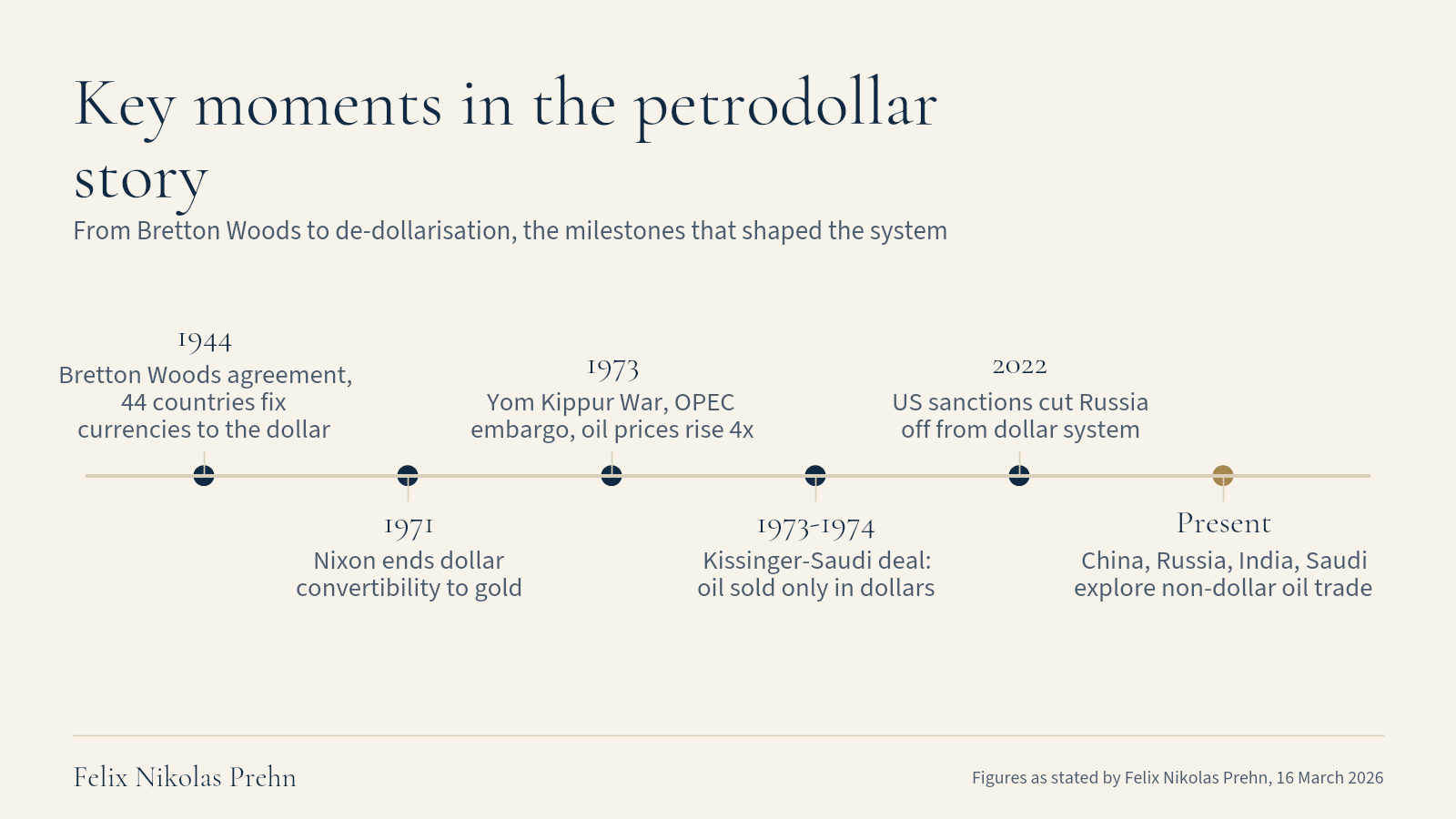
In 1944, 44 countries gathered at a resort in Bretton Woods, New Hampshire, to create a new global financial system. America had emerged from the Second World War with intact factories, as the world's manufacturer, creditor and gold vault. Most of Europe's industrial capacity had been destroyed.
The resulting agreement made the dollar the world's reserve currency. Other currencies were pegged to it at fixed exchange rates. The dollar itself was convertible to gold at a fixed price of 35 dollars per ounce.
The system worked for about 25 years. The Vietnam War and Great Society programmes drove federal outlays sharply higher.
The United States printed far more dollars than it had gold to back them. France, under de Gaulle, noticed the gap and began demanding gold in exchange for its dollar holdings.
President Nixon responded by ending dollar convertibility to gold.
The dollar has not been backed by gold since 1971. It became fiat currency, money backed by nothing except a government's assertion that it is worth something.
The dollar fell sharply in the years that followed, and exchange rates became volatile.
The 1973 crisis and the Kissinger deal
In 1973 the Yom Kippur War broke out, pitting Israel against Egypt and Syria.
The United States backed Israel with weapons. OPEC announced an oil embargo against the United States and its allies.
Oil prices quadrupled almost overnight, which forced a response from the White House.
Nixon sent Henry Kissinger, the Secretary of State, to Saudi Arabia with a proposal. Saudi Arabia would agree to sell oil only in US dollars.
The United States would provide military protection and weapons. Every nation that needed oil, which was nearly all of them, would henceforth need dollars first.
The petrodollar system has been in place for over 50 years since that agreement.
Felix Nikolas Prehn argues that the deal converted the dollar from a weakening fiat currency into something far more durable. It became the only way to buy energy on the global market.
Before 1971, gold convertibility anchored the dollar. After 1973, the obligation to buy oil in dollars created a new anchor. It was tied to daily consumption rather than a metal price.
How petrodollar recycling works
The mechanics form a closed loop. An oil importer such as Japan cannot pay Saudi Arabia in yen; it must first earn or buy dollars.
Japan then sends those dollars to Saudi Arabia in exchange for oil.
Because oil is a constant daily need, Japan and every other importer must keep a large reserve of dollars on hand at all times. The safest store for those dollars is US government bonds, debt instruments that pay interest to the holder.
Saudi Arabia and the Gulf states, meanwhile, receive more dollars than they can spend domestically. They invest the surplus back into the United States: into government debt, stocks, real estate and weapons.
Petrodollar recycling describes this loop. Dollars leave the United States to buy oil. They return as investments in US debt, stocks, real estate and weapons.
Constant bond purchases by oil importers allow Washington to borrow at lower interest rates than other countries can obtain.
Lower bond rates, in turn, push capital into stocks, real estate and riskier assets.
In Felix Nikolas Prehn's view, the environment of rising stock prices over recent decades rests on this invisible force. American purchasing power for imports is artificially inflated as well.
Consumer goods priced in weaker currencies become cheaper when the dollar is stronger than the underlying economy alone would justify.
The dollar as a weapon
The petrodollar system gives the United States a capacity no other country possesses. Washington controls the currency everyone must use and can cut any nation off from the global economy through the banking system.
When the United States sanctioned Russia in 2022, it did not invade or bomb. Washington cut Russia off from using dollars.
Russian banks lost the ability to trade. Companies inside the country could not pay suppliers, and oligarchs found their foreign holdings frozen.
The sanctions were devastating precisely because the dollar is at the centre of global commerce. America's armed forces back the dollar system with 11 aircraft carriers and 750 military bases around the world. Countries are therefore reluctant to challenge an arrangement enforced by that hardware.
Cracks in the system
Other countries have noticed how the dollar can be weaponised, and some are acting on that observation. In Felix Nikolas Prehn's view, China and Russia are already trading oil in renminbi. India is paying for Russian oil in rupees.
Saudi Arabia, America's original partner in the petrodollar deal, is openly discussing selling oil in other currencies. Felix Nikolas Prehn argues that the dollar's share of global reserves has declined from about 70 per cent to 58 per cent.
Felix Nikolas Prehn argues that a real alternative to dollar dominance is emerging. It would be the first since the petrodollar deal was struck.
Recent reporting suggests the picture is mixed. Russia's attempt to shift trade into renminbi has run into difficulties. US sanctions have complicated yuan-based transactions.
Saudi Arabia's position remains ambiguous, with some reports suggesting it has pulled back from a Chinese payment system.
The dollar's enduring strengths
Three factors explain why the dollar has not collapsed despite these pressures.
Momentum is the most obvious reason. Trillions of dollars in contracts, pricing systems and banking infrastructure are built around the dollar. Any transition away from that architecture is slow and costly.
The second factor is the absence of a credible alternative. China has capital controls preventing free movement of money in and out, which limits the renminbi as a replacement. Europe cannot agree on a common fiscal policy.
Military force is the third factor. The arrangement is backed by 11 aircraft carriers and 750 bases worldwide.
What a shifting petrodollar means for portfolios
Foreign buyers may purchase less US debt. If they do, Washington will have to pay higher interest rates to attract new lenders.
Higher government borrowing costs feed through to mortgages and corporate debt. Stock valuations tend to fall when the cost of capital rises.
A gradual decline in dollar demand would make imports more expensive and erode American purchasing power over time. A weakening dollar would benefit holdings that are not denominated in dollars: gold, commodities and real property.
Renewables, battery storage, nuclear plants and LNG facilities let countries generate their own energy. Domestic generation cuts their need to buy dollars.
Each megawatt produced at home displaces imported fuel and the dollar reserves required to pay for it. Felix Nikolas Prehn argues that the energy transition is a geopolitical project. Countries that generate their own power no longer need to accumulate dollars to keep their economies running.
The petrodollar system made the dollar the sole medium of exchange for oil. The arrangement created permanent structural demand for the currency.
It has sustained American financial dominance for over 50 years. Constant demand for dollars kept the currency stronger than the economy alone would justify. Washington borrowed cheaply and wielded sanctions as a weapon. Felix Nikolas Prehn argues that the dollar's share of global reserves has fallen from about 70 per cent to 58 per cent. If foreign demand for dollars continues to weaken, borrowing costs will rise, imports will grow more expensive and the currency premium the United States has enjoyed will narrow.