
Corporate insiders sometimes spend their own money buying their own company's shares. It is one of the most honest signals the stock market gives. The only plausible reason to buy is that they believe the stock is undervalued.
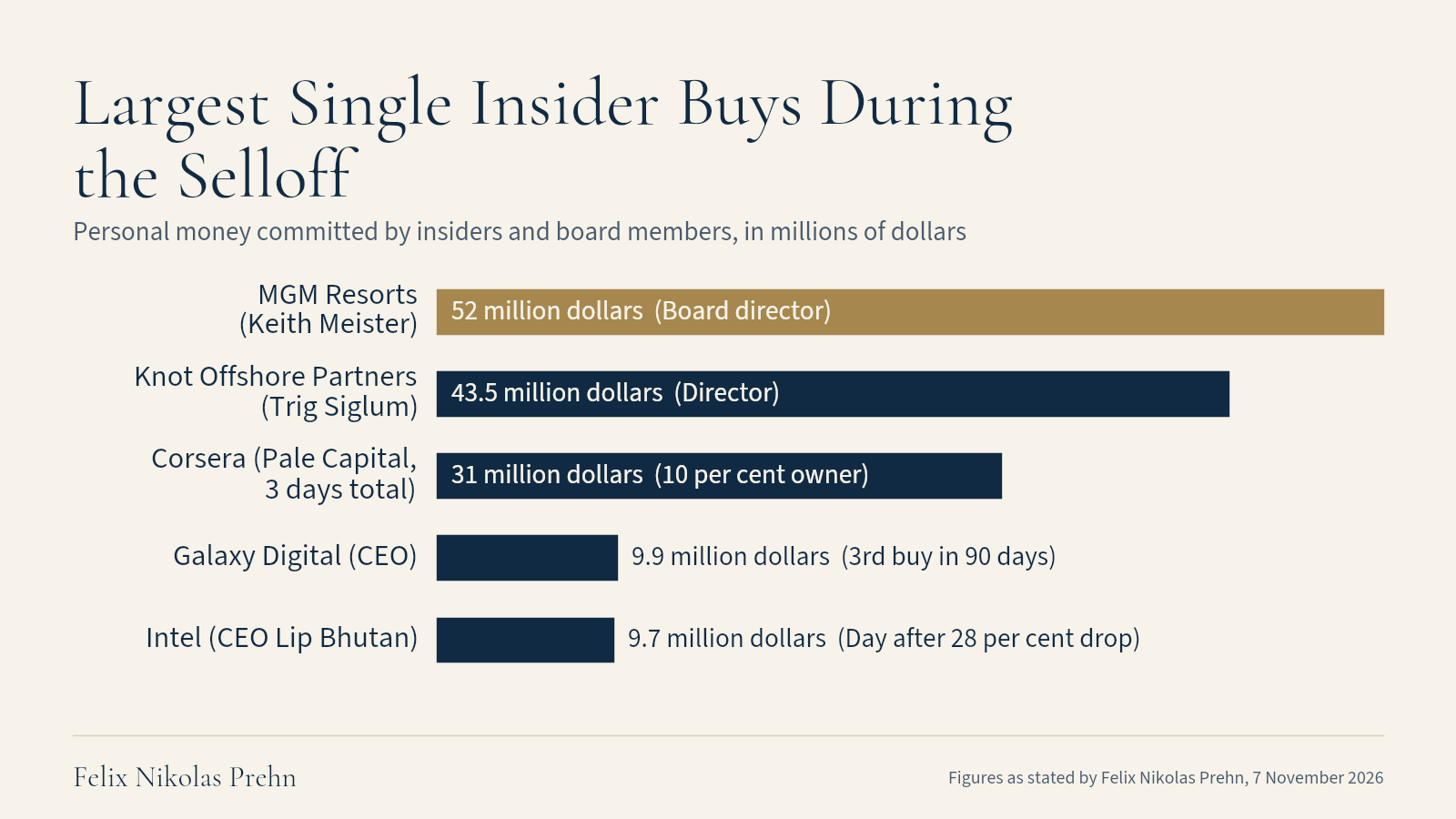
Insider purchase filings appeared from Intel, MGM Resorts, SiriusXM, Upbound Group, Matador Resources and Galaxy Digital. Congressional disclosures added another layer. What follows is a record of the insider trades filed during the period.
The 28 per cent drop that triggered a buying spree
Intel shares fell 28 per cent on Friday the 30th of October, dropping from 92 dollars to 65 dollars. The following Monday was the first trading day after the drop.
Filings indicate Intel's chief executive spent 9.7 million dollars of his own money on shares. The purchase was voluntary and filed with the SEC. While headlines have not confirmed the buyer's identity, the filing is consistent with a chief executive reporting under SEC rules.
The same chief executive had also bought 10 million dollars of Intel shares in August.
Insider sales tell very little about what executives think of their own company. Officers receive stock as compensation and sell for many personal reasons: tax bills, divorce settlements, diversification advice, lifestyle expenses.
A purchase carries a different informational content. An insider can take money from a personal bank account to buy stock. The same shares could have come free as compensation.
Board members betting big on MGM and SiriusXM
Keith Meister sits on the board of MGM Resorts and runs Corex, an activist fund. On the same Friday Intel fell 28 per cent, the board director bought 1.5 million shares of MGM. The stake cost 52m dollars.
Headlines from early November confirmed the purchase at a figure close to 52 million dollars.
Berkshire Hathaway, which owns more than 10 per cent of SiriusXM Holdings, bought the stock 3 times in the space of 4 days. Because the firm owns more than 10 per cent, it must file every time it adds to its position.
Berkshire Hathaway, not Warren Buffett personally, made the trades. Reports from early November confirmed the purchases and noted the stock reached a 52-week high around the same period.
Institutional insiders doubling down on education and shipping
Pale Capital, an investment group that already owns 10 per cent of Corsera, bought on 3 consecutive days. The 3 purchases came to 9.4, 10.4 and 11.7 million dollars respectively. Together, the 3 trades came to 31m dollars.
Trig Siglum, a director at Knot Offshore Partners, bought 43.5 million dollars' worth of the shuttle tanker business. The trade was filed on the 3rd of November.
In June he had spent 25 million dollars on the same stock. The November purchase nearly doubled that commitment.
Headlines from early November confirmed the trade.
The cluster buy at Upbound Group
Filings show 7 insiders at Upbound Group bought shares within about 48 hours. The trades fell on Monday the 2nd and Tuesday the 3rd of November.
Headlines from the same period confirmed at least one of the filings. The full cluster of seven buyers has not been independently verified.
Academic work on insider trading goes back decades. Research finds that 3 or more insiders buying within weeks of each other carries more weight than a single purchase.
Form 4 filings show 7 officers buying within 2 days. Each buyer reviewed the same internal numbers independently and came to the same conclusion.
Upbound Group CEO Fari Karan put 100,000 dollars of his own money into the stock. The chief growth officer put 99,000 dollars in, just below the CEO's amount.
Director Molly Langenstein put 50,000 dollars in. Jeffrey Brown put 400,000 dollars in.
Chief technology officer Balaji Kumar put 50,000 dollars in. Glenn Marino put 393,000 dollars in.
Chief financial officer Haleem Kuri put 251,000 dollars into the stock. All 7 committed their own money within about 48 hours.
Brown bought at 17 dollars; as of mid-November, the stock was trading between 24 and 25 dollars.
Reports from early November noted the company's shares had fallen and a price target had been lowered.
More clusters at Matador and Galaxy Digital
At Matador Resources, 4 executives bought on the same day, November 5th, putting in about 230,000 dollars on a particularly heavy dip. Headlines confirmed the purchases by 4 officers, including the company's president and its head of accounting. Four executives buying on the same day fits the cluster pattern that academic research treats as more informative than a lone purchase.
Galaxy Digital's CEO put in 9.9 million dollars, marking the 3rd insider buy in the last 90 days.
Why insider buying matters more than selling
An insider must report any trade in company shares to the SEC within 2 business days. The filing is called the Form 4.
Executives receive stock as compensation and sell it regularly. A tax bill, a divorce, a house purchase, a desire to diversify: all are common reasons to sell.
Buffett told Bill Gates many decades ago to spread his wealth. Had Gates not done so, he would be the richest man on the planet. A sale, then, reveals little about an insider's view of the company's prospects.
When an insider uses personal money to buy shares available for free as compensation, the filing carries a different weight. The only plausible reason is a belief that the stock is undervalued.
Academic research reinforces the point. When 3 or more insiders buy within a few weeks of each other, the pattern carries more weight.
Each insider has independently reviewed the same internal numbers and arrived at the same conclusion.
Congressional trading disclosures
Members of Congress are required to report their trades under a law called the Stock Act. Congresswoman Maria Ela Salazar, a Republican from Florida, filed paperwork showing she bought Nvidia and Procter and Gamble. Headlines from early November confirmed the Nvidia purchase.
David Purdue made 2,000 trades and a fellow legislator named Greg filed 1,300, per congressional disclosures.
Congressional trades carry a different informational weight. A CEO sits in board meetings and reviews internal accounts before buying. The Stock Act requires disclosure but does not require explanation.
The late October and early November period produced an unusual concentration of insider buying at 8 companies. Intel's chief executive spent 9.7 million dollars after a 28 per cent single-session fall.
Keith Meister filed a 52m dollar MGM purchase on that same Friday. Berkshire Hathaway added to SiriusXM 3 times in 4 days.
Pale Capital put 31 million dollars into Corsera over 3 consecutive sessions. A director at Knot Offshore Partners filed a 43.5m dollar purchase in early November, eclipsing a 25m dollar buy in June.
Seven insiders at Upbound Group filed purchases within 48 hours, and 4 executives at Matador committed money on the same day.
Executives sell stock for many reasons, including tax bills, divorce settlements, and diversification. An insider purchase using personal funds signals a belief that the stock is undervalued. Academic research finds that 3 or more insiders buying within weeks of each other carries more weight than one officer acting alone. In Felix's view, each of those buyers had access to the same internal accounts and independently decided the price was too low.